
PNC Stock Analysis: Record Earnings, Strategic Expansion, and Positive Operating Leverage
The PNC Financial Services Group, Inc. (NYSE: PNC) delivered another solid quarter, reporting third-quarter 2025 net income of $1.8 billion, or $4.35 per diluted share, supported by record revenue, strong fee growth, and resilient credit performance.
Fundamental Strength: Record Revenue and Controlled Expenses
Total revenue rose to $5.9 billion, up 4% from the previous quarter and 9% year over year, with net interest income of $3.6 billion and fee income of $2.1 billion.
While Net Interest Margin (NIM) saw a slight 1 basis point decline to 2.79% due to a 5% average commercial deposit growth, Net Interest Income (NII) still increased 3% quarter over quarter, benefiting from fixed-rate asset repricing and loan expansion. Noninterest income grew 8% quarter over quarter, driven by a massive 35% jump in Capital Markets and Advisory revenue, while noninterest expense increased modestly by 2% quarter over quarter.
Business Segment Performance
Retail Banking: Retail Banking saw a 3% decline in earnings compared with Q2 2025, as higher noninterest expense and credit provisions offset modest revenue growth.
-
Noninterest income increased 1%, supported by stronger mortgage activity.
-
Noninterest expense rose 3% due to technology and branch investments.
-
Provision for credit losses was $126 million.
-
Average loans fell 1% as growth in auto and credit card loans was more than offset by lower residential real estate and commercial loans, while deposits remained stable.
Corporate & Institutional Banking: This segment posted a strong 19% earnings increase quarter over quarter, supported by rising noninterest and net interest income and lower credit provisions.
-
Noninterest income climbed 11%, led by capital markets and advisory fee growth.
-
Noninterest expense rose 3%, reflecting higher variable compensation associated with increased business activity.
-
Provision for credit losses was $44 million.
-
Average loans grew 2% and deposits surged 6%, driven by interest-bearing deposit growth.
Asset Management Group: Earnings declined 9% quarter over quarter, as higher credit provisions and expense outweighed income gains.
-
Noninterest income grew 4% amid favorable equity markets.
-
Noninterest expense rose 2% due to technology investments and marketing.
-
Discretionary client assets under management increased 5% on higher spot equity markets and positive net flows.
-
Average loans and deposits remained stable.
Strategic Growth and Exceptional Credit Quality
PNC continues to prioritize strategic expansion, most notably with the announced acquisition of FirstBank Holding Company for an implied consideration of $4.1 billion. This acquisition, expected to close in early 2026, is a key move to accelerate PNC’s expansion in the high-growth markets of Colorado and Arizona, more than tripling the branch network in Colorado.
Fundamentally, the balance sheet remains solid:
Capital: The CET1 capital ratio improved to 10.6%, maintaining a "well capitalized" status. PNC returned $1.0 billion of capital to shareholders through dividends and buybacks.
Credit Quality: Credit metrics were excellent. Net loan charge-offs decreased by $19 million QoQ to only $179 million (0.22% annualized to average loans), reflecting lower commercial real estate net loan charge-offs. The allowance for credit losses remains stable at $5.3 billion.
Tangible Book Value (TBV): TBV per share increased 4% to $107.84, a crucial metric for evaluating a bank's intrinsic value.
Technical Analysis
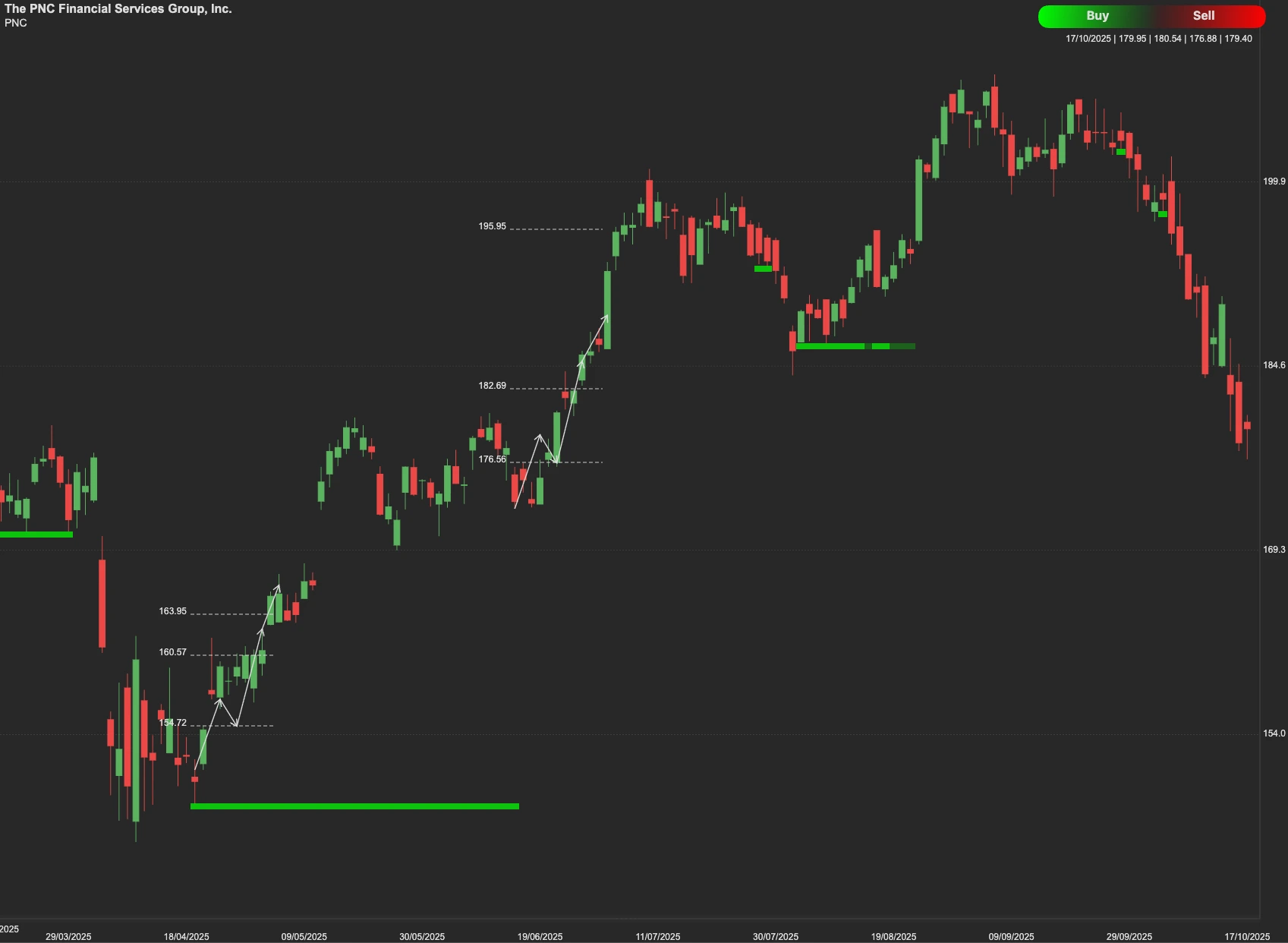
PNC stock is currently testing a key resistance level at $199. If the price breaks and sustains above this threshold, the next upside target could be $220. However, failure to hold above $199 may trigger a pullback toward the support zone at $163, or even the lower support near $147 if selling pressure intensifies.