
Alibaba Stock Analysis: AI Investments Drive Revenue, But Profitability Under Pressure
Alibaba Group (NYSE: BABA) reported its September quarter 2025 results, showcasing strong momentum in AI and cloud while profitability declined significantly as the company entered an aggressive investment phase. The quarter highlighted Alibaba’s long-term strategic positioning in AI-driven cloud infrastructure and quick commerce, but also revealed short-term cost pressures and cash outflows that investors must closely watch.
Financial Results: The Investment Impact
Revenue Growth: Total revenue reached RMB247.8 billion (US$34.8 billion), an increase of 5% year-over-year. Crucially, excluding disposed businesses (Sun Art and Intime), revenue on a like-forlike basis would have grown by 15% year-over-year.
Profitability Decline: Income from operations plummeted by 85% year-over-year to RMB5.4 billion (US$754 million). Adjusted EBITA, a key non-GAAP metric, fell by 78% to RMB9.1 billion (US$1.3 billion). Non-GAAP net income was similarly impacted, decreasing 72% year-over-year.
Cash Flow: The intensive capital deployment resulted in a free cash flow outflow of RMB21.8 billion (US$3.1 billion), compared to an inflow in the prior year period. Management directly attributed this shift to the high investment in quick commerce and cloud infrastructure.
CFO Toby Xu explicitly confirmed this strategy, noting, "We are re-investing our profits and free cash flow for the future," highlighting the deployment of approximately RMB120 billion in capital expenditure toward AI and cloud infrastructure over the past four quarters.
Business and Strategic Updates
Cloud Intelligence Group (AI + Cloud): Alibaba’s Cloud Intelligence Group delivered standout performance, with revenue climbing 34% year-over-year to RMB39.8 billion (US$5.6 billion), driven by public cloud adoption. Even more impressive, AI-related product revenue achieved triple-digit year-over-year growth for the ninth consecutive quarter. The Cloud Intelligence Group’s Adjusted EBITA grew by 35%.
Alibaba also reinforced its leadership in China’s AI cloud market, holding a 35.8% share, according to Omdia. With more than 180,000 derivative models built on Alibaba’s Qwen family as of October 2025, the company continues expanding its ecosystem advantage.
These results underline Alibaba’s strategy of deep investment into full-stack AI capacities—from cutting-edge AI foundation models to high-performance AI infrastructure, including servers, high-performance networking, distributed storage, intelligent computing clusters, Platform for AI (PAI), and services for model training and inference.
China E-commerce Group: Total China E-commerce Group revenue grew 16% to RMB132.6 billion (US$18.6 billion). Quick commerce was the standout segment, surging 60% year-over-year due to order growth as a result of the rollout of “Taobao Instant Commerce” at the end of April 2025.
However, these gains came with steep spending. Alibaba significantly increased technology, user-experience investments, and incentives to scale quick commerce. As a result, Alibaba China E-commerce Group adjusted EBITA decreased by 76% to RMB10.5 billion (US$1.5 billion) in the quarter.
Despite the near-term margin drag, Alibaba highlighted major improvements in quick commerce unit economics from September onward.
International Digital Commerce Group (AIDC): This group achieved a positive Adjusted EBITA of RMB162 million (US$23 million), a significant turnaround from a loss in the previous year, highlighting improved operating efficiency in global retail businesses like AliExpress.
BABA Technical Outlook
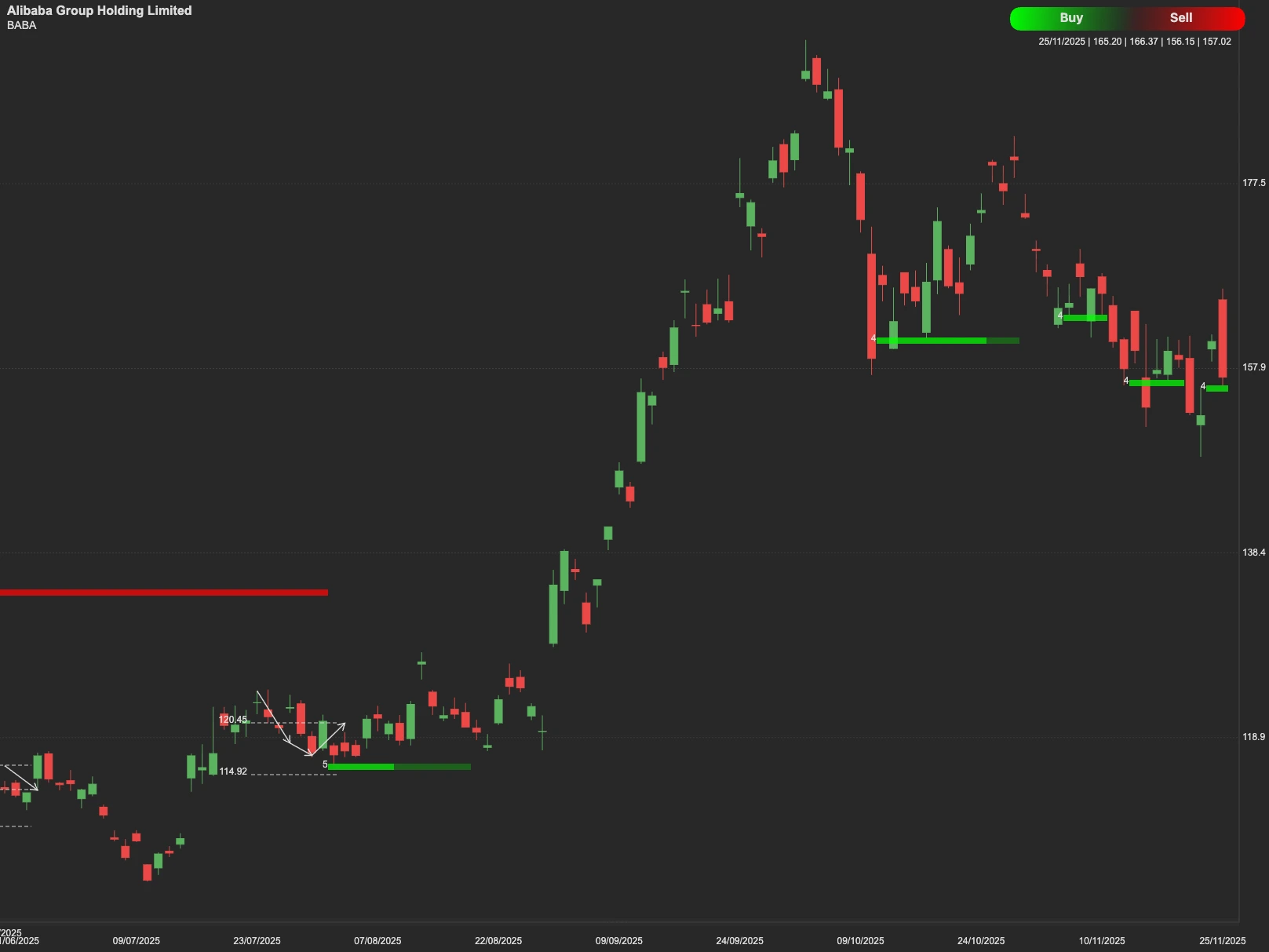
For BABA stock, the price point of $177 currently stands as a significant technical resistance level. If market sentiment swings to prioritize the accelerating growth in Cloud (34% YoY) and Quick Commerce (60% YoY), combined with the successful monetization of AIDC, the stock could break this resistance. A confirmed move and sustained trading above $177 would set the next technical price objective at $193.
Conversely, failure to break the $177 barrier could lead the stock to seek downside support. The immediate major support level is identified at $137. A breach of this level would confirm a deeper correction, potentially exposing the stock to the further support level at $111.