
Alibaba Stock Surges After Earnings as AI Momentum Reshapes Growth Narrative
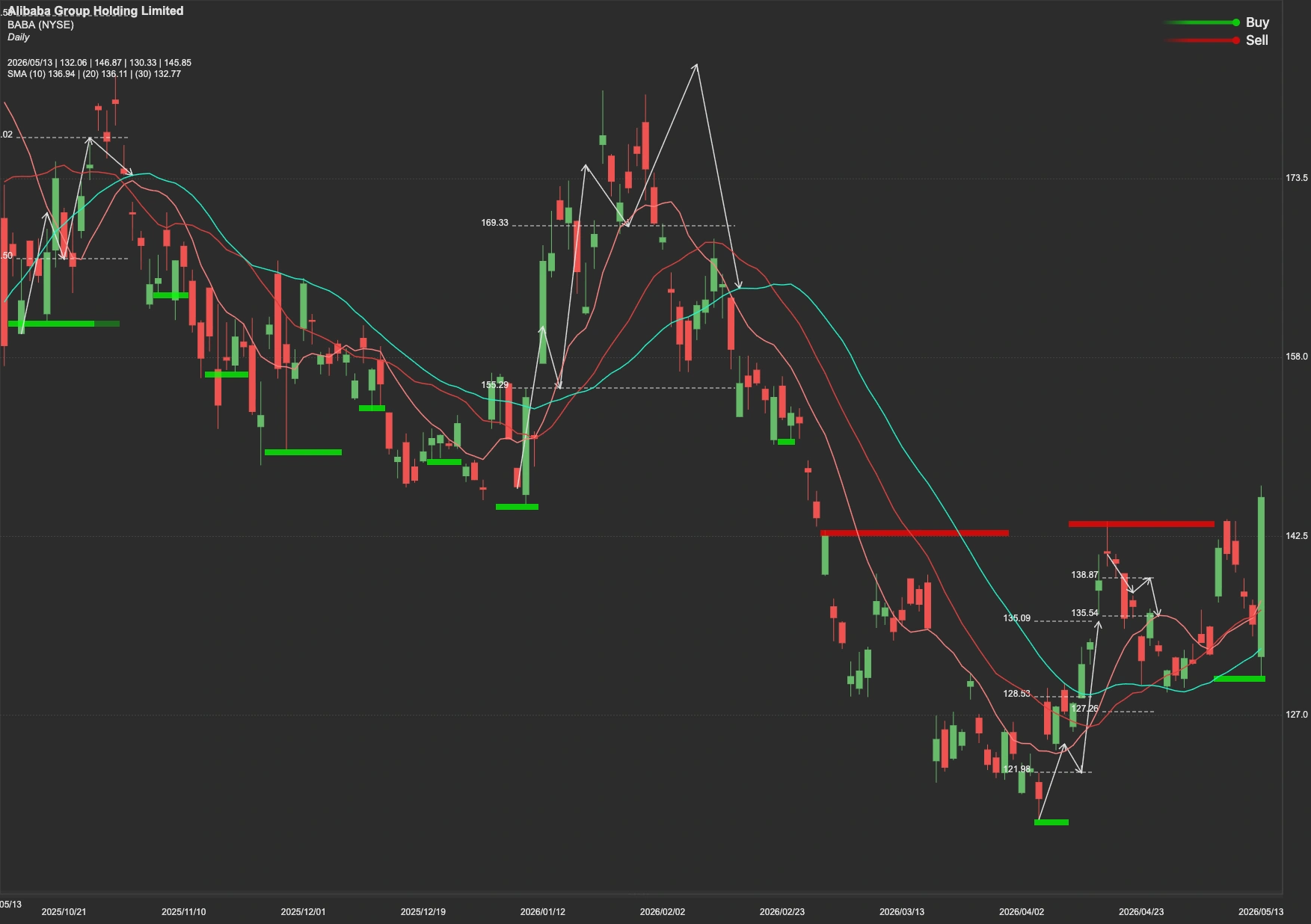
Shares of Alibaba Group (NYSE: BABA) climbed roughly 8% following the company’s March quarter and fiscal year 2026 earnings report, as investors responded positively to accelerating AI and cloud growth despite significant pressure on near-term profitability.
Growth Amidst Heavy AI Spending
Revenue for the March quarter reached RMB243.38 billion (US$35.28 billion), up 3% year-over-year. Excluding the disposed Sun Art and Intime businesses, like-for-like revenue growth would have been 11%.
Quarterly adjusted EBITA declined 84% year-over-year to RMB5.10 billion (US$740 million), primarily attributable to the investment in technology businesses, quick commerce and user experiences, while operating income swung to a loss of RMB848 million (US$123 million) compared to operating income of RMB28.47 billion a year earlier.
Cost of revenue in the quarter was RMB159.39 billion (US$23.11 billion) compared to RMB145.63 billion in the same quarter of 2025. Sales and marketing expenses surged 48% year-over-year as Alibaba heavily invested in its quick commerce operations and the expansion of the Qwen app ecosystem. Product development expenses also increased significantly as the company accelerated AI infrastructure and research spending.
Net income was RMB23.50 billion (US$3.41 billion), an increase of 96% year-over-year, primarily attributable to the year-over-year increase in net gain from mark-to-market changes of the equity investments, and disposal losses of Sun Art and Intime in the same quarter last year. Non-GAAP net income nearly collapsed to RMB86 million (US$12 million) versus RMB29.85 billion in the prior-year period.
Diluted earnings per share was RMB1.30 (US$0.19). Non-GAAP diluted earnings per share was RMB0.08 (US$0.01), a decrease of 95% year-over-year.
Free cash flow saw a significant shift to an outflow of RMB17.30 billion (US$2.51 billion) for the quarter, primarily due to the investment in quick commerce, user acquisition of Qwen app and increase in the cloud infrastructure expenditure.
Alibaba’s balance sheet remains relatively strong. The company ended the quarter with RMB520.82 billion (US$75.50 billion) in cash and other liquid investments, giving management substantial financial flexibility to continue funding AI expansion. Total debt increased to approximately RMB260.0 billion (US$37.69 billion) as of March 31, 2026, compared with RMB230.7 billion a year earlier.
The company also maintained shareholder returns by approving an annual dividend of US$0.13125 per ordinary share or US$1.05 per ADS.
The Cloud and AI Growth Engine
Cloud Intelligence Group delivered one of the strongest performances of the quarter, with revenue rising 38% year-over-year to RMB41.63 billion (US$6.04 billion). Revenue from external customers accelerated 40%, driven primarily by AI-related demand and public cloud adoption. Management disclosed that AI-related product revenue achieved triple-digit year-over-year growth for the eleventh consecutive quarter and now contributes approximately 30% of external customers revenue.
CEO Eddie Wu noted that Alibaba’s full-stack AI investments have moved from "incubation to commercialization at scale." highlighting rapid progress across models, cloud infrastructure, and applications.
The company’s Qwen large language model ecosystem continues to expand aggressively. During the quarter, Alibaba launched Qwen3.6-Plus, upgraded enterprise AI agents, and integrated AI-powered shopping experiences directly into Taobao and Tmall. The company also accelerated rollout of AI applications such as Wukong and Accio Work to improve merchant productivity and cross-border commerce efficiency.
Resilience in Core Commerce
Despite a high-spending environment, the core Alibaba China E-commerce Group remains robust. Total Alibaba China E-commerce Group grew 6% year over year to RMB122.22 billion (US$17.72 billion). Customer Management Revenue (CMR) also saw a healthy 8% growth on a like-for-like basis (excluding disposed businesses).
The company continues to lean into its highest-value users, with 88VIP members surpassing 62 million. Meanwhile, the International Digital Commerce Group (AIDC) narrowed its losses significantly, approaching break-even through improved logistics and operating efficiencies in the AliExpress "Choice" business.
Fiscal Year 2026 Financial Results
For the fiscal year ended March 31, 2026, Alibaba generated revenue of RMB1.024 trillion (US$148.4 billion), representing 3% year-over-year growth. Excluding the disposed Sun Art and Intime businesses, revenue would have increased 11% on a like-for-like basis.
Income from operations declined 64% year-over-year to RMB50.15 billion (US$7.27 billion), while adjusted EBITA fell 56% to RMB76.42 billion (US$11.08 billion). Non-GAAP net income dropped 62% year-over-year to RMB60.66 billion (US$8.79 billion), while non-GAAP diluted earnings per share declined 59% to RMB3.35 (US$0.49). Net income on a GAAP basis fell 19% to RMB102.13 billion (US$14.81 billion).
Technical Analysis
Currently, the first major resistance level sits around $158. A sustained move above $158 could open the door toward the next resistance area near $176. If bullish momentum remains intact and shares successfully clear $176, the next major upside target could emerge near $193.
Conversely, if the stock fails to hold its current gains, it may retreat to seek support at $119. If bearish pressure intensifies further, the next key support zone sits around $104.