
Amazon Stock Analysis After Q4 and Full-Year 2025 Results
Amazon’s fourth-quarter and full-year 2025 results highlighted strong top-line momentum and accelerating profitability, but the market reaction was swift and negative. Shares of Amazon fell 11.2% following the earnings release, reflecting investor caution around near-term margins, elevated capital expenditures, and forward guidance despite clear operational strength.
Strong Revenue Growth, But Heavy Investment
Amazon delivered strong fourth quarter results with net sales rising 14% year over year to $213.4 billion. Excluding foreign exchange impact, net sales still grew 12%. Operating income increased to $25.0 billion, or $27.4 billion excluding special charges, compared with $21.2 billion a year earlier. Operating margin was 11.7%, compared with 11.3% in the prior year. Net income reached $21.2 billion or $1.95 per diluted share, compared with $20.0 billion, or $1.86 per diluted share, in fourth quarter 2024.
For full year 2025, Amazon generated $716.9 billion in net sales, representing 12% growth compared with 2024. Operating income rose to $80.0 billion from $68.6 billion the prior year. Operating margin was 11.2%, compared with 10.8% in the prior year. Net income climbed to $77.7 billion or $7.17 per diluted share, a substantial improvement from $59.2 billion in 2024.
Operating cash flow increased 20% to $139.5 billion for the trailing twelve months. Despite this strong cash generation, free cash flow declined to $11.2 billion due to a $50.7 billion year over year increase in property and equipment purchases. This increase primarily reflects investments in artificial intelligence. This compares to free cash flow of $38.2 billion for the trailing twelve months ended December 31, 2024. Management also signaled that capital spending could reach approximately $200 billion in 2026.
Revenue Strength Led by AWS Acceleration
AWS remained the company’s most profitable division, delivering $35.6 billion in fourth quarter sales, up 24% year over year, marking its fastest pace in thirteen quarters. Operating income reached $12.5 billion in Q4, compared with $10.6 billion a year earlier, with a margin of 35%, down from 36.9%. Although margins compressed slightly due to AI infrastructure expansion, AWS continues to account for almost half of Amazon’s total Q4 operating income.
The North America segment generated $127.1 billion in fourth quarter sales, up 10% year over year, with operating income increasing to $11.5 billion and operating margin expanding to 9%.
The International segment produced $50.7 billion in Q4 sales, growing 17% year over year, though operating income declined to $1.0 billion and margin narrowed to 2.1%.
The "Frontier" Strategy
Amazon’s diversified ecosystem showed remarkable resilience:
Advertising: Grew 22% year over year to $21.3 billion, emerging as a powerhouse high-margin revenue stream.
Silicon Dominance: AWS custom chips (Trainium and Graviton) now boast a combined annual revenue run rate exceeding $10 billion, growing at triple-digit percentages. The 500,000+ Trainium2 chips "Project Rainier" cluster is already being used to train Anthropic's Claude models.
The Rise of Agentic AI: Amazon introduced "frontier agents" like Kiro and the AWS Security Agent, which can autonomously handle a range of tasks and perform penetration testing. Meanwhile, the Rufus shopping assistant helped drive nearly $12 billion in incremental annualized sales.
Logistics Superiority: Amazon delivered at its fastest speeds ever for Prime members globally in 2025, doubling same-day delivery monthly customers in rural U.S. areas. The "Amazon Now" ultra-fast delivery service is expanding globally, offering thousands of items in 30 minutes or less.
First Quarter 2026 Guidance
Management expects net sales to be $173.5 billion and $178.5 billion, or to grow between 11% and 15% year over year, and operating income to be between $16.5 billion and $21.5 billion, compared with $18.4 billion in first quarter 2025. Operating income guidance embeds higher costs related to Amazon Leo, quick commerce expansion, and pricing investments in international retail.
Technical Analysis
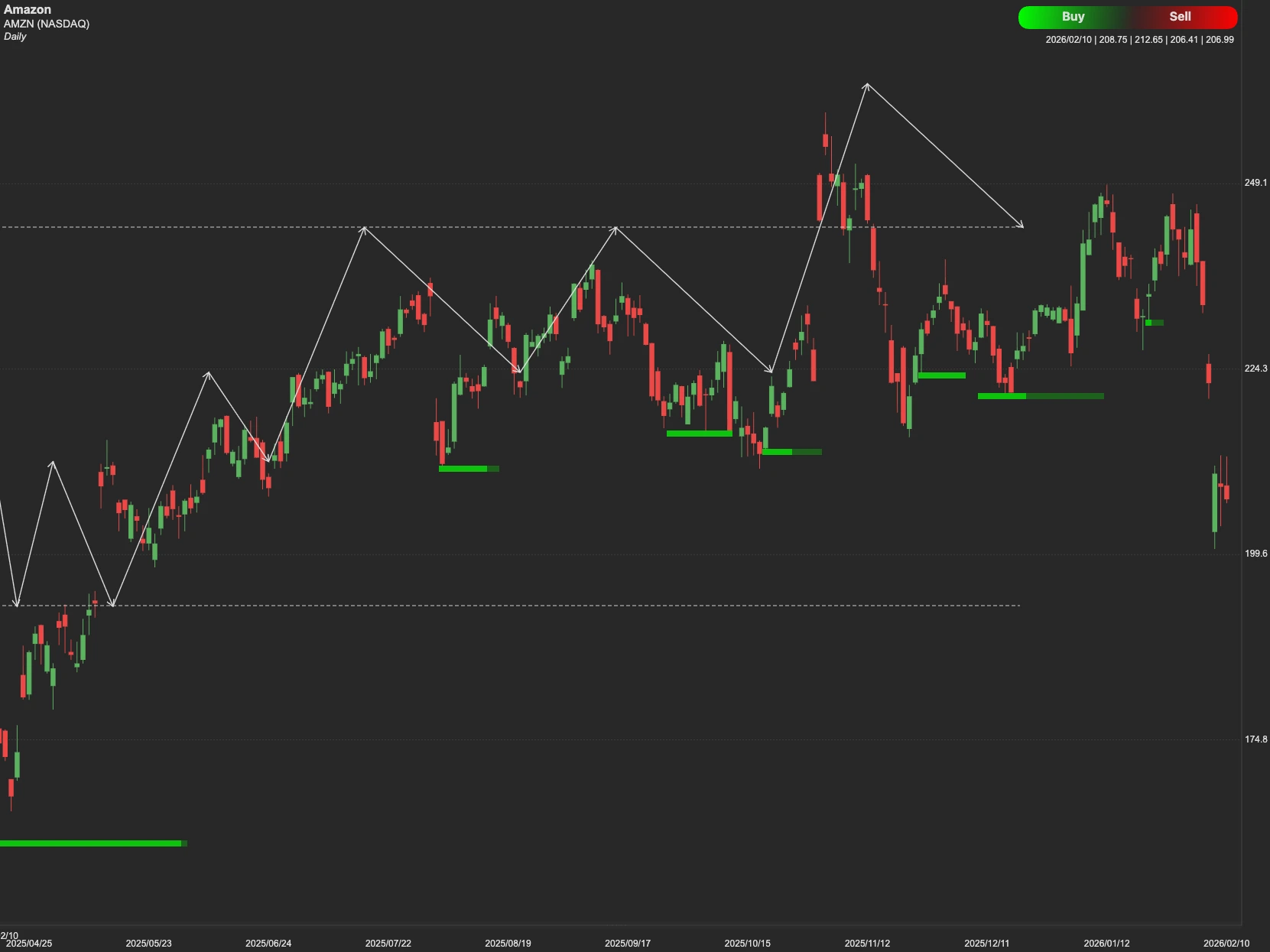
From a technical perspective, the immediate hurdle for a recovery is the $230 level. If the stock can regain its footing and close decisively above this resistance, the next logical target for a bullish reversal is the $252 mark.
Should the stock fail to reclaim $230, it is likely to seek historical support. The first safety net sits at $187. If macro sentiment weakens or AI spending fears intensify, a deeper correction toward $165 becomes possible.