
Apple Stock Analysis: Record Q3 Earnings Overshadowed by Supply Headwinds
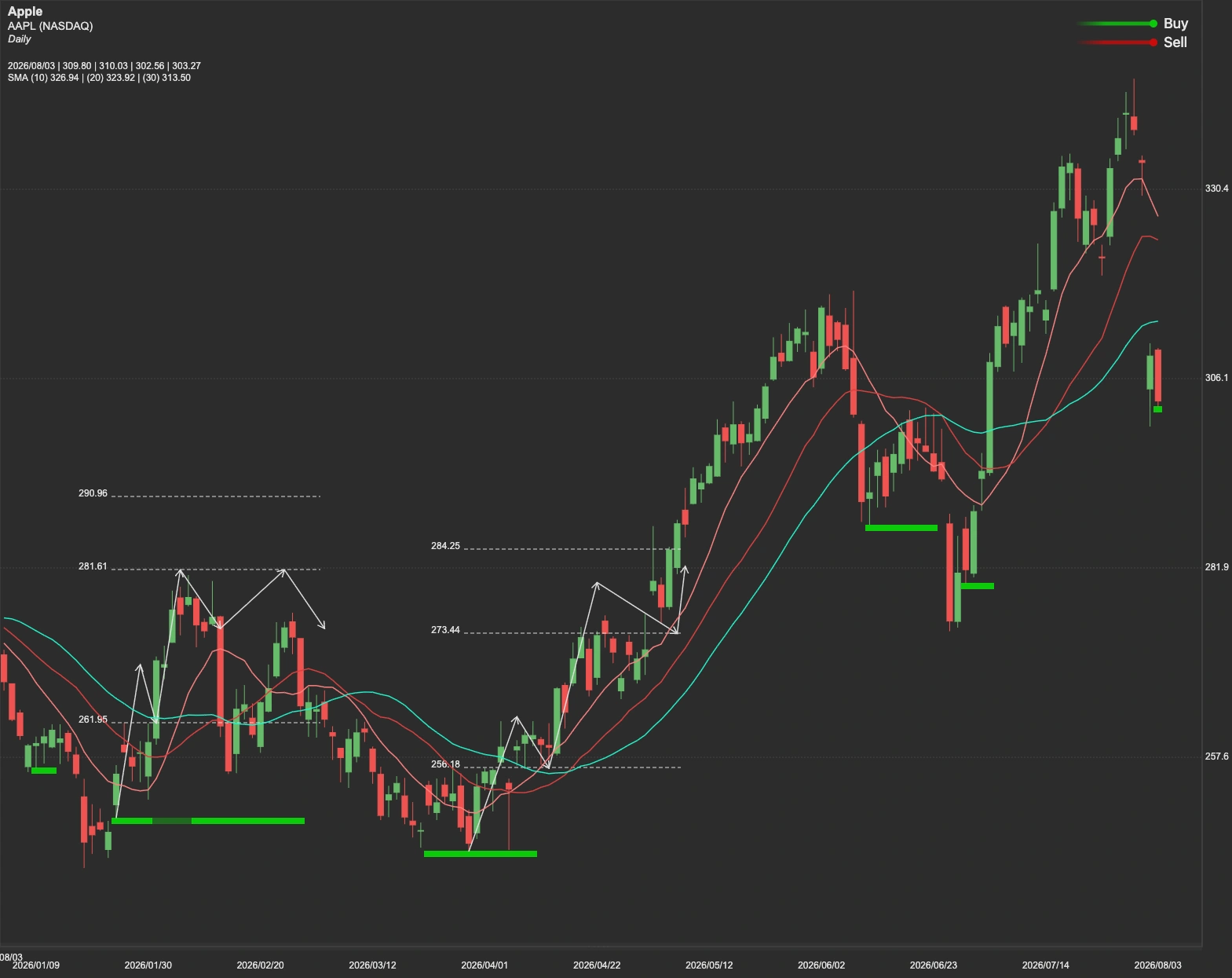
Apple Inc. (NASDAQ: AAPL) delivered a strong fundamental performance for its fiscal 2026 third quarter, setting June quarter revenue and earnings per share (EPS) records. Despite these landmark results, AAPL shares retreated sharply by 9% following the release. Market sentiment was weighed down by management’s forward guidance, which highlighted intensifying supply constraints, foreign exchange headwinds, and persistent upward pressure on component costs—specifically memory modules.
Q3 2026 Financial Performance
For the fiscal third quarter ended June 27, 2026, Apple reported revenue of $109.4 billion, representing a 16% year-over-year increase and marking the company’s strongest June quarter ever.
Apple achieved an overall gross margin of 50.1% in Q3 2026, up from 46.5% in the prior-year quarter, including a favorable impact of approximately 2 percentage points from tariff refunds.
-
Products Gross Margin: Expanded to 40.1% (compared to 34.5% in Q3 2025), driven by a favorable product mix and tariff refunds, partially offset by higher costs, including memory.
-
Services Gross Margin: Remained flat year-over-year at 75.6%.
Total operating expenses rose 23% year-over-year to $19.1 billion. The expansion was primarily driven by Research and Development (R&D) spending, which jumped 32% year-over-year to $11.7 billion. The acceleration reflects substantial investments in AI infrastructure following the announcement of the all-new Siri AI at WWDC26 alongside upgraded child safety features and software innovations.
Operating income was $35.7 billion, up 26.6% compared to $28.2 billion last year. Diluted earnings per share reached $2.02, up 29% year-over-year, supported by stronger operating performance and a favorable impact ($0.11 per diluted share) from tariff refunds.
Operating cash flow remained exceptionally strong at $34.4 billion. The company ended the quarter with cash and cash equivalents of $39.5 billion and total debt of $84.3 billion.
The board declared a $0.27 per share dividend, payable August 13, 2026.
iPhone and Services Remain Growth Engines
The iPhone business showed strong momentum during the quarter, generating $54.3 billion in revenue, up 22% year over year, driven primarily by demand for the iPhone 17 family.
Mac revenue reached a new June quarter record of $10.4 billion, increasing 29% year over year, supported by strong demand for MacBook Neo and MacBook Pro products.
Services continued to be one of Apple’s most important growth drivers, generating a record $30.7 billion in revenue, up 12% year over year. Apple achieved June quarter records across multiple Services categories, including advertising, App Store, AppleCare, Music and video services, while cloud services and payment services reached all-time highs.
However, iPad revenue remained under pressure, declining 6% year over year to $6.2 billion, mainly due to difficult comparisons against the previous year’s A16-powered iPad launch.
Geographic Strength, Led by Europe and Greater China
Regionally, Apple grew everywhere. Europe rose 22% to $29.4 billion and Greater China rose 22% to $18.8 billion, both helped by favorable currency, with China's gain driven almost entirely by iPhone. Rest of Asia Pacific gained 16%, Japan 13% despite yen weakness, and the Americas 11% to $45.8 billion.
Management noted the installed base of active devices reached a new all-time high across all major product categories and all geographic segments.
September Quarter Guidance
Revenue Guidance: Overall company revenue is projected to grow between 9% and 11% year-over-year in Q4. iPhone revenue growth is expected to remain in the mid-teens.
Supply Constraints: Chief Financial Officer Kevan Parekh cautioned that supply constraints will increase significantly on a sequential basis, directly impacting production volumes for iPhone, Mac, and iPad.
Foreign Exchange (FX) Drag: Unfavorable currency fluctuations are expected to create a sequential headwind of approximately 2.5 percentage points to the year-over-year growth rate.
Gross Margin Compression: Gross margin is forecast to moderate to between 47% and 48% (inclusive of a ~1 percentage point tariff refund benefit).
Rising Memory Costs: CEO Tim Cook highlighted that memory pricing has risen for three consecutive quarters and is expected to increase further into late 2026, which could drive an increasing impact on the company's business.
AAPL Stock Technical Analysis
The post-earnings decline has pushed AAPL stock into an important technical zone. The first key resistance now sits near $326. A decisive breakout and sustained move above this level would improve bullish momentum and could open the path toward the $345 upside target.
Conversely, failure to reclaim resistance may lead to a pullback toward initial support near $287, with a deeper downside support zone around $273–$258.