
Applied Digital Stock Analysis: Explosive Growth Meets Heavy Investment Phase
Applied Digital Corporation (Nasdaq: APLD) delivered fiscal third quarter 2026 results that underscore both the immense demand for AI infrastructure and the scale of capital deployment required to capture it.
Financial Performance: A Massive Revenue Leap
In the quarter ended February 28, 2026, Applied Digital reported revenues of $126.6 million, a staggering 139% increase year-over-year. This surge was primarily driven by the High-Performance Computing (HPC) Hosting segment, which contributed $71.0 million as the company's first 100 MW direct-to-chip liquid-cooled facility became fully operational. Adjusted revenue was $108.6 million (excluding Cloud Services Business revenue).
Cost of revenues in Q3 FY2026 were $72.8 million, up 48% year over year, primarily driven by an increase of $18.0 million in expenses associated with tenant fit-out services for the HPC Hosting business. Selling, general and administrative expenses were $79.7 million, up 251% year over year, compared to $22.7 million in Q3 FY2025. Operating loss for the quarter was $85.7 million, compared to an operating loss of $18.9 million a year ago.
Applied Digital reported a net loss of $100.9 million, largely influenced by stock-based compensation, asset write-downs tied to its cloud business restructuring, and elevated operating expenses. The non-GAAP figures told a different story. Adjusted net income reached $33.2 million, or $0.09 per diluted share. This compares to an adjusted net loss of $2.6 million, or $0.01 per diluted share, for the fiscal third quarter of 2025. Adjusted EBITDA rose to $44.1 million, up from just $6.3 million a year prior.
Segment Performance
HPC Hosting (Core Growth Engine)
- Revenue: $71 million
- Driven by base rent, tenant fit-out services, and power pass-through
- First 100 MW facility now fully operational
Data Center Hosting (Bitcoin / Legacy Segment)
- Revenue: $37.5 million (+7% year over year)
- Strong profitability and high return on assets
- Stable cash generator supporting expansion
Cloud Services Business (Being Restructured)
- Planned merger into a new entity (ChronoScale Corporation)
- Applied Digital expects to initially own approximately 97% of the combined entity
Strategic Execution and Scaling
Management, led by CEO Wes Cummins, highlighted that the current 100 MW online represents approximately one-sixth of the company's contracted capacity and one-tenth of what is operating or under construction. The pipeline is expanding rapidly:
-
Polaris Forge 1 & 2: Construction across its North Dakota campuses remains on schedule. At Polaris Forge 1, two additional 150 MW facilities are progressing in parallel. At Polaris Forge 2, a 200 MW hyperscaler-focused campus, foundational work is largely complete, with construction advancing into structural and interior phases. The company signed an approximately 15-year lease with a U.S. based investment-grade hyperscaler for 200 MW at Polaris Forge 2.
-
Delta Forge 1: The company recently broke ground on Delta Forge 1, a 300 MW critical IT load AI Factory campus spanning more than 600 acres in a strategic southern U.S. market, with initial operations expected in mid-calendar 2027.
Capital Structure Reflects Heavy Investment
The recent $2.15 billion private offering provides the necessary capital to build out 200 MW of critical IT load at the Polaris Forge 2. As of February 28, 2026, the Company had $2.1 billion in cash, cash equivalents, and restricted cash, along with $2.7 billion in debt.
Technical Analysis
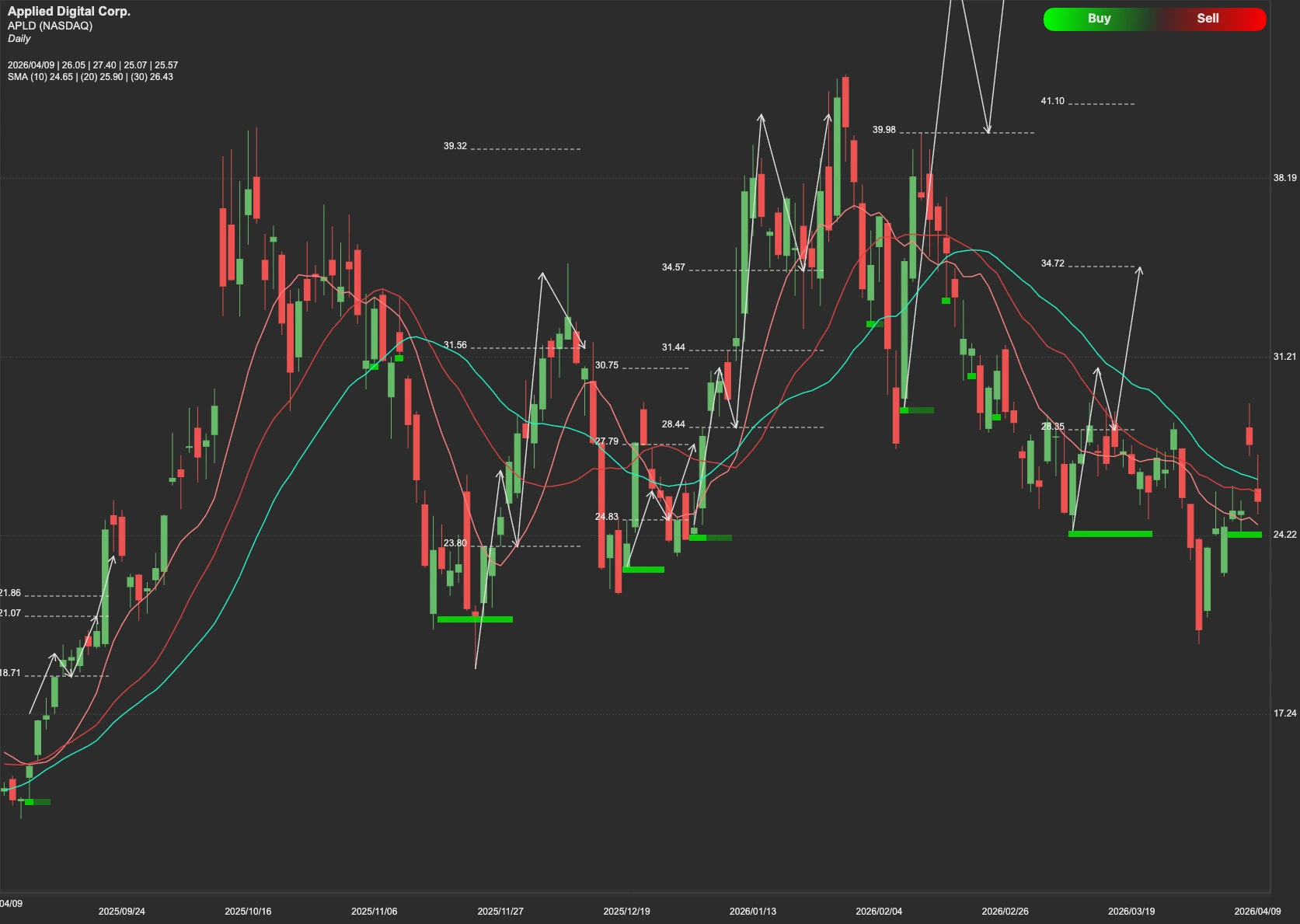
From a market perspective, the $32 level now acts as a key resistance threshold for APLD stock. A sustained breakout above this level would likely open the path toward $40, reflecting increased investor confidence in execution and future cash flow visibility. Conversely, failure to hold momentum could see the stock retrace toward the $20 support level, with a deeper downside risk extending to $13 if broader sentiment weakens or execution risks intensify.