
Cadence Design Systems: AI Momentum and Record Backlog Fueling Growth
Following its February 17, 2026, earnings announcement, Cadence Design Systems (Nasdaq: CDNS) has solidified its position as a primary beneficiary of the generative AI infrastructure build-out. The company reported a standout fiscal year 2025, marked by 14% revenue growth and a record-breaking backlog of $7.8 billion, signaling sustained demand for its electronic design automation (EDA) and IP portfolios.
Financial Performance: The AI Tailwinds
In the fourth quarter, Cadence delivered revenue of $1.440 billion, up from $1.356 billion a year earlier. Despite slightly lower operating margins, GAAP operating margin was 32.2%, compared to 33.7% in Q4 2024, and non-GAAP operating margin was 45.8%, compared to 46.0%. GAAP diluted EPS rose to $1.42, compared to $1.24 in Q4 2024, while non-GAAP diluted EPS reached $1.99, compared to $1.88.
For the full fiscal year 2025:
-
Revenue climbed to $5.297 billion from $4.641 billion in 2024.
-
GAAP operating margin of 28.2%, compared to 29.1% in 2024
-
Non-GAAP operating margin expanded to 44.6%, up from 42.5%.
-
GAAP diluted EPS was $4.06, compared to $3.85 in 2024; non-GAAP diluted EPS surged to $7.14 from $5.97.
-
Year-end backlog hit a record $7.8 billion, with $3.8 billion expected to be recognized within the next 12 months.
The combination of recurring software revenue, AI-driven product expansion, and strong IP growth underpins visibility into 2026. Management’s guidance calls for revenue between $5.9 billion and $6.0 billion, with non-GAAP diluted EPS projected at $8.05 to $8.15—another year of meaningful earnings growth. Cadence's outlook does not include the impact of its pending acquisition of Hexagon's design and engineering business.
Innovation as a Growth Engine
During 2025, Cadence introduced ChipStack, an agentic AI Super Agent for chip design and verification built on its foundational EDA platform. By deploying intelligent agents that autonomously call underlying Cadence tools, ChipStack enables faster design convergence and materially improves engineering productivity.
The Core EDA business grew 13 percent in 2025, supported by broad hyperscaler adoption, expanding digital full-flow deployments, and increasing penetration of AI-driven products.
Hardware also delivered a record year, adding more than 30 new customers. Seven of the top ten customers purchased both Palladium Z3 and Protium X3 systems, highlighting strong demand from AI and hyperscale customers.
Cadence’s IP business expanded nearly 25 percent year over year in 2025, driven by strong adoption of high-performance IP solutions such as HBM, UCIe, PCIe, DDR, and SerDes.
The System Design and Analysis segment grew 13 percent in 2025, supported by demand for the 3D-IC platform and advanced simulation technologies that are critical for AI infrastructure, high-performance computing, and advanced mobile applications.
Cash Flow and Capital Allocation
Operating cash flow reached $1.73 billion in 2025, up meaningfully from $1.26 billion in 2024. The company repurchased $925 million of stock during the year, reflecting disciplined capital return alongside M&A deployment.
The company ended the year with $3.0 billion in cash and equivalents, giving it flexibility for acquisitions, R&D investment, and share repurchases.
Technical Analysis
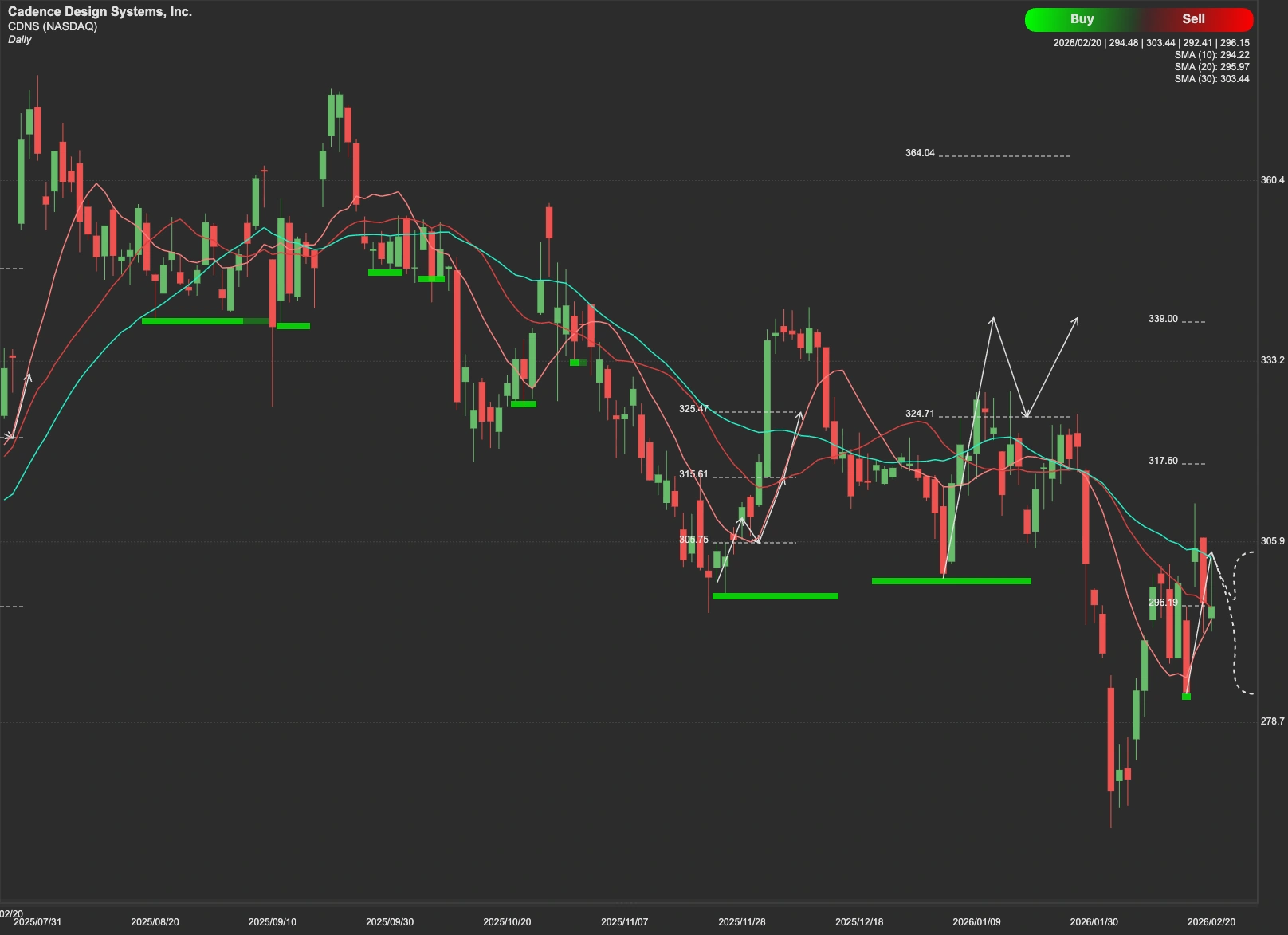
From a technical perspective, CDNS is currently facing a significant ceiling at $328. If CDNS can break above $328 and hold that level with strong volume, the next upside target would be $359. A sustained breakout would likely require continued AI-driven demand narrative and consistent earnings execution.
Conversely, if the stock fails to reclaim and maintain momentum above $328, it may pull back to test primary support near $262. In a broader market correction scenario, the secondary support at $241 could come into play.