
Campbell’s Faces Margin Pressure as Fiscal Q3 Results Reflect Challenging Operating Environment
The Campbell's Company (NASDAQ: CPB) reported third-quarter fiscal 2026 results that generally aligned with internal expectations, though persistent demand softness and inflation-driven cost pressures continued to weigh on profitability. While the company reaffirmed its full-year guidance and highlighted progress in cost savings initiatives, the near-term outlook remains clouded by weak sales momentum and ongoing margin challenges.
Volume Drops and Margin Contraction
For the quarter ended May 3, 2026, Campbell’s generated net sales of $2.4 billion, representing a 4% year-over-year decline. Organic net sales also fell 4%, primarily due to weaker volume and mix, although positive net price realization partially offset the decline. The company noted that the divestiture of the noosa business created a modest headwind.
While revenue trends remained soft, profitability faced even greater pressure. Gross profit declined 11% to $650 million, while gross margin compressed by 190 basis points to 27.5%. Adjusted gross margin fell even further, down 240 basis points to 27.7%, reflecting persistent inflationary pressures, tariff-related costs, and elevated supply chain expenses, partially offset by supply chain productivity improvements and cost savings, as well as favorable net price realization.
Profitability pressures were evident throughout the business. Adjusted EBIT declined 24% to $274 million, mainly due to lower adjusted gross profit. Adjusted earnings per share dropped 32% to $0.50. On a reported basis, however, net earnings rose sharply to $124 million from $66 million a year ago, benefiting from the absence of a prior-year impairment charge that significantly impacted fiscal 2025 results.
From a balance sheet perspective, Campbell’s ended the quarter with $402 million in cash and cash equivalents and total debt of $7.01 billion, resulting in net debt of approximately $6.61 billion.
Cash flow generation remained relatively stable. Operating cash flow for the first nine months of fiscal 2026 reached $839 million, while capital expenditures totaled $297 million. The company returned approximately $380 million to shareholders year-to-date, primarily through dividend payments.
Segment Performance
Segment performance revealed continued challenges in both of Campbell’s major operating divisions. The Meals & Beverages segment reported a 4% decline in net sales, with U.S. soup sales dropping 8%, driven by weakness in condensed and ready-to-serve products. Nevertheless, management highlighted that flagship brands such as Campbell’s, Rao’s, and Swanson continue to benefit from durable at-home cooking trends, offering some resilience within the portfolio.
Meanwhile, the Snacks segment also struggled, posting a 4% decline in net sales, both reported and organic. Weakness in salty snacks, crackers, and fresh bakery products weighed on results, while unfavorable volume trends remained a notable challenge. However, management indicated that early signs of improvement are emerging as the company focuses on strengthening Goldfish, improving execution within Pepperidge Farm's fresh bakery operations, and taking actions to improve overall snack category performance.
Cost Savings and Reaffirmed Guidance
Chief Executive Officer Mick Beekhuizen acknowledged that third-quarter performance remained under pressure but emphasized operational initiatives aimed at improving long-term execution. The company continues to focus on simplifying operations, accelerating productivity, and extracting cost savings to create flexibility for reinvestment. Campbell's generated approximately $20 million in savings during the third quarter, bringing cumulative savings to $200 million toward its fiscal 2028 target of $375 million.
Looking ahead, Campbell’s reaffirmed its full-year fiscal 2026 guidance, expecting organic net sales to decline between 1% and 2%, adjusted EBIT to fall between 17% and 20%, and adjusted EPS to range from $2.15 to $2.25 (a 26% to 23% decline compared to the $2.91 achieved in fiscal 2025).
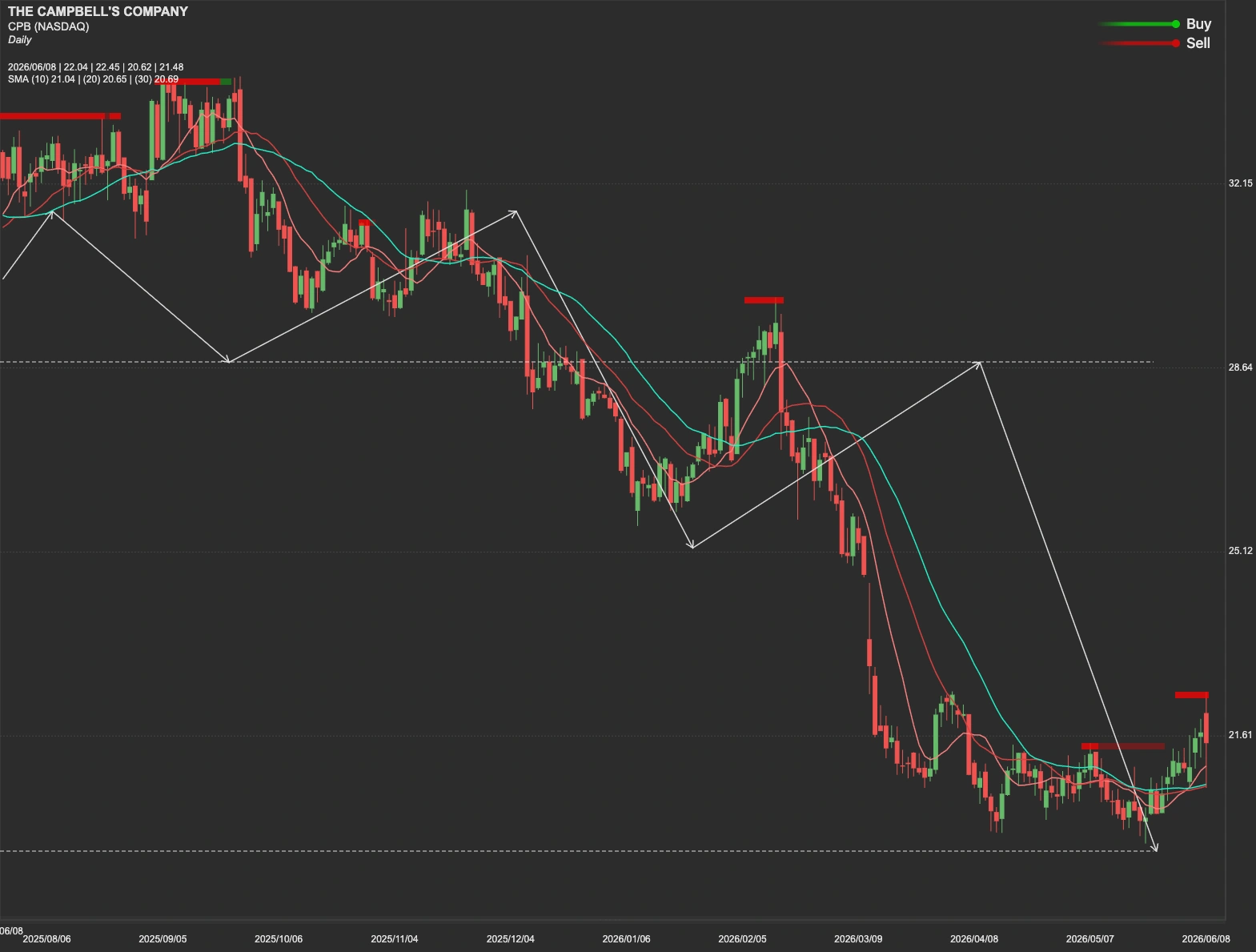
CPB Stock Technical Analysis
From a technical perspective, currently the immediate resistance sits at $27. For any short-term bullish momentum to develop, the stock must break and firmly consolidate above this $27 level. If CPB successfully establishes a foothold above $27, the next major key resistance level sits at $35.
Over the longer term, a more significant resistance level remains near $43. At this stage, the combination of declining sales, margin pressure, inflationary headwinds, and limited earnings visibility makes the investment outlook remain unclear.