
CarMax Stock Analysis: Growth Strategy Shows Early Progress, But Key Technical Resistance Remains
CarMax, Inc. (NYSE: KMX) delivered a mixed first-quarter fiscal 2027 report, demonstrating encouraging operational improvements while facing continued pressure on profitability. The used-car retailer also unveiled a new four-pillar growth strategy designed to accelerate unit sales growth, improve margins, and enhance shareholder returns over the long term.
Revenue Growth Continues
For the quarter ended May 31, 2026, CarMax reported net revenue of $8.0 billion, representing a 6.2% year-over-year increase. Combined retail and wholesale vehicle sales rose 3.3% year over year to 392,357 units.
Wholesale operations were a bright spot, with unit sales increasing 8.4% and wholesale revenue climbing 14.0%. Retail used vehicle sales were essentially flat at 230,293 units, while comparable store used unit sales declined 0.8% from the prior year’s first quarter.
The company benefited from higher average selling prices, with retail vehicle prices increasing approximately 4.5% and wholesale prices rising 5.1% compared to the prior-year period.
Despite higher revenue, profitability faced pressure. Total gross profit declined 4.4% year over year to $854.4 million, while gross margin narrowed to 10.7% from 11.8% a year earlier. Retail gross profit per used unit was $2,177, down $230 from the prior year's record level, reflecting management's pricing actions aimed at improving sales momentum.
SG&A expenses declined 3.7% year over year, while SG&A per total unit improved 6.8% to $1,619. This represents a tangible step toward CarMax's goal of saving $200 million in exit-rate SG&A by the end of fiscal 2027.
Net earnings declined 11.8% year over year to $185.6 million, and diluted earnings per share came in at $1.31 compared with $1.38 in the prior-year period.
CAF Continues to Support Earnings
CarMax Auto Finance continued to deliver solid results despite a slight decline in income. The finance segment generated $140.2 million of income during the quarter, down just 1.0% year over year.
CAF penetration increased 150 basis points year over year to 43.3%, reflecting continued execution of the company's full spectrum growth strategy. The weighted average contract rate remained stable at 11.3%, while total interest margin percentage improved to 6.7% of average auto loans outstanding.
New Four-Pillar Growth Strategy
Chief Executive Officer Keith Barr introduced a strategic framework designed to accelerate growth and improve shareholder returns over time.
The strategy focuses on four key pillars:
Great Offering: CarMax aims to maintain competitive pricing, expand saleable inventory, and improve vehicle accessibility for customers.
Easy Experience: Management plans to further integrate digital and physical sales channels, creating a more seamless customer journey and improving conversion rates.
Add Value on Each Transaction: Management intends to grow profitability through increased contributions from CarMax Auto Finance (CAF) and Extended Protection Plans (EPP).
Run Lean: The company continues to pursue cost-reduction initiatives, improve logistics efficiency, and lower reconditioning expenses through technology and operational enhancements.
Balance Sheet and Cash Flow
CarMax ended the quarter with $132.2 million in cash and cash equivalents.
CarMax reported adjusted net debt of $2.87 billion after excluding non-recourse notes payable. The company continues to generate positive operating cash flow of $17.6 million. Meanwhile, adjusted operating cash flow reached $272.4 million during the quarter, supported by net issuances of non-recourse notes payable.
Although management did not repurchase shares during the quarter, CarMax still has approximately $1.31 billion remaining under its authorized share repurchase program, providing potential future support for shareholder returns.
KMX Stock Technical Analysis
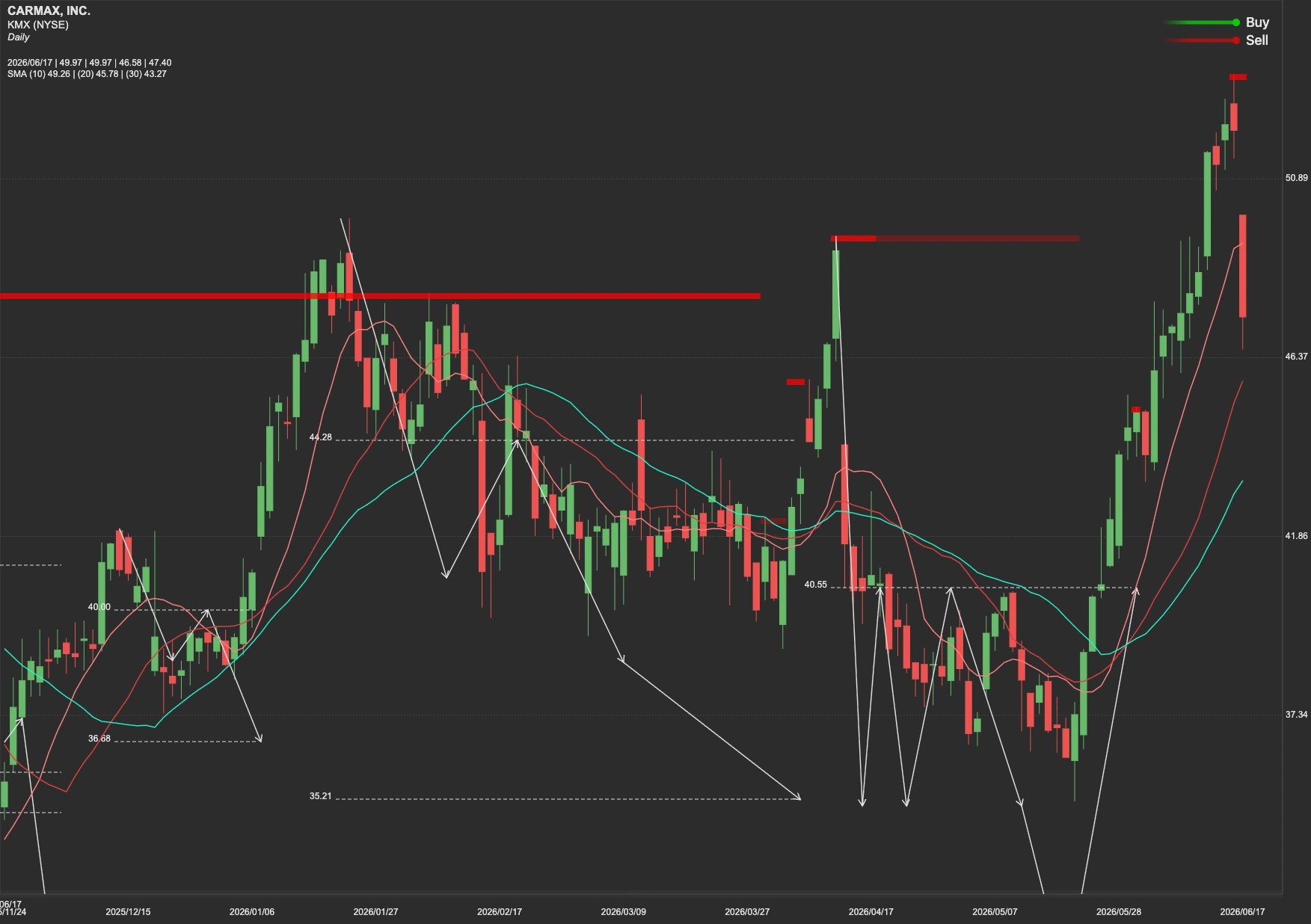
From a technical perspective, KMX stock is currently confronting a major resistance zone near $64. Once $64 is established as new support, the path clears for KMX to challenge its next major structural resistance level at $82. The stock must successfully overcome these resistance levels before a longer-term uptrend can be confirmed. Until then, upside momentum remains tentative.
On the downside, failure to break above resistance could trigger renewed selling pressure. In that scenario, the first major support level sits near $36. Should broader market weakness or company-specific challenges emerge, shares could potentially retreat toward the deeper support range between $30 and $26.