
CarMax Stock Analysis: Restructuring and Market Pressures Cloud FY2026 Results
CarMax, Inc. (NYSE: KMX) recently unveiled its fourth-quarter and full-year fiscal 2026 results, painting a picture of a company in the midst of a leadership transition and structural overhaul. While the company welcomed Keith Barr as the new President and CEO, the financial figures underscore a challenging environment characterized by non-cash impairments, restructuring charges, and a strategic pivot in pricing.
Q4 Financial Performance Overview
For the fourth quarter ended February 28, 2026, the company reported total net sales and operating revenues of $5.95 billion, down 1.0% year over year. Overall unit volumes showed modest improvement, with combined retail and wholesale sales rising 0.7% to 303,969 vehicles. Wholesale units increased 3.0%. Underlying demand softness was evident in the retail segment. Retail used unit sales slipped 0.8%, and comparable store used unit sales declined 1.9%.
Operationally, the company continues to lean into its omnichannel model, with 83% of retail unit sales involving digital engagement. While this remains a competitive strength, it has yet to fully offset macroeconomic pressures.
Pricing actions taken to stimulate demand weighed on profitability. Gross profit per retail used unit declined by $207 to $2,115, while wholesale gross profit per unit fell by $105 to $940. As a result, total gross profit dropped 9.4% to $605.3 million, and gross margin compressed to 10.2% from 11.1% a year earlier.
Cost discipline provided a partial offset. SG&A expenses remained flat at $611.3 million despite restructuring charges and increased advertising spend. On an adjusted basis, SG&A declined 5.4%, or $33.1 million, in the fourth quarter of 2026.
However, earnings were heavily impacted by non-operational items. The company reported a net loss per diluted share of $0.85, compared to earnings of $0.58 in the prior year. This was largely driven by a $141.3 million non-cash goodwill impairment and $33.9 million in restructuring charges. Excluding these items, adjusted diluted EPS came in at $0.34—still a significant decline from prior-year levels.
CarMax Auto Finance (CAF) also reflected near-term headwinds. Income declined 9.8% to $143.7 million due to a lower loan balance following securitization activity and higher provision for loan losses tied to expansion in the credit spectrum.
Full Year Performance
For the full fiscal year, the picture was similarly subdued. Total net sales and operating revenues declined 1.8% year over year to $25.88 billion, while net income dropped sharply to $247.3 million from $500.6 million in the prior year. Adjusted EPS fell to $2.91 from $3.27. Retail used unit sales decreased 1.1% year over year to 780,684, and wholesale unit sales decreased 1.1% year over year to 538,203.
Efficiency and Future Outlook
In a move to streamline operations, CarMax has increased its SG&A reduction target to $200 million in exit rate savings by the end of fiscal year 2027. The quarter saw a reduction in the corporate workforce as part of this aggressive cost-cutting measure.
CEO Keith Barr emphasized a "move with urgency," focusing on competitive pricing and an omni-channel customer experience to regain momentum.
For fiscal 2027, the company plans to open four new stores, two stand-alone reconditioning/auction centers, and two stand-alone auction facilities. Management expects capital expenditures of approximately $400 million in fiscal 2027, largely reflecting spending to support future long-term growth in offsite reconditioning and auction facilities, as well as new stores.
Technical Outlook and Investment Perspective
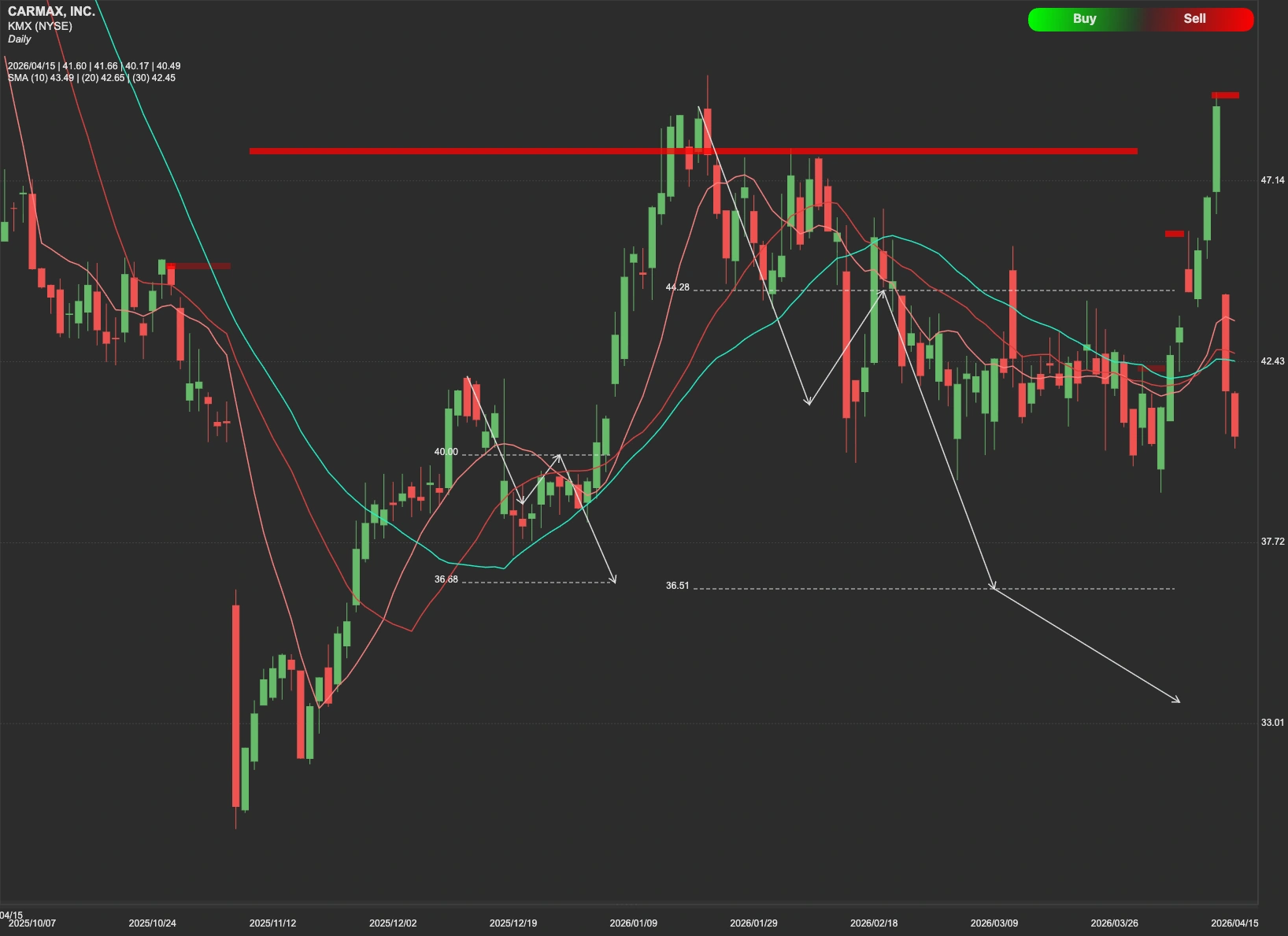
From a technical perspective, KMX stock remains in a consolidation phase with no confirmed uptrend. In the short term, $51 represents a key resistance level. A sustained move above this threshold could open the path toward the next resistance at $64. However, failure to break resistance would likely see the stock retrace toward support in the $30–$27 range. Over the longer term, a more significant resistance level sits at $83, which would require a meaningful improvement in both fundamentals and market sentiment to challenge. Margin pressure, declining earnings, and the technical pressure on the share price all suggest that the company is still working through a difficult adjustment period. At this stage, an investment in KMX is not recommended.