
CarMax Under Pressure as Earnings Slide and Leadership Changes Add Uncertainty
CarMax, Inc. (NYSE: KMX) reported third-quarter fiscal 2026 results on Dec 18, 2025 that highlighted continued pressure across its core used-vehicle business, a sharp year-over-year decline in earnings, and ongoing uncertainty tied to leadership changes and market conditions.
Earnings Decline Reflects Weak Demand
For the quarter ended November 30, 2025, CarMax posted net earnings of $62.2 million, or $0.43 per diluted share, down sharply from $125.4 million, or $0.81 per share, in the prior-year period. Earnings were further impacted by $0.08 per share in restructuring charges related to executive changes and workforce reductions.
Total net sales and operating revenues declined 6.9% year over year to $5.79 billion. The weakness was broad-based, driven by lower unit volumes in both retail and wholesale channels.
Total retail used vehicle unit sales fell 8.0%, while comparable store used unit sales declined 9.0%. Total wholesale vehicle unit sales decreased 6.2%, with management citing steep market depreciation as a key headwind. While average retail used vehicle prices edged up 0.9% year over year, this was insufficient to offset lower transaction volumes.
Margin Compression and Elevated Cost Structure
Total gross profit declined 12.9% to $590.0 million, reflecting pressure across all major segments. Retail used vehicle gross profit per unit came in at $2,235, down $71 from last year’s record level but still within historical averages. Wholesale gross profit per unit dropped more sharply, falling $116 year over year to $899; like volume, gross profit per unit was impacted by steep market depreciation.
Selling, general, and administrative expenses increased 1.0% to $581.4 million, despite lower sales. As a result, SG&A rose to 98.5% of gross profit, up significantly from 85.0% a year earlier. Management reiterated its goal of achieving at least $150 million in SG&A exit-rate savings by the end of fiscal 2027, with initial workforce reductions already underway.
Auto Finance Provides Partial Offset
CarMax Auto Finance (CAF) remained a relative bright spot. CAF income increased 9.3% to $174.7 million, supported by gains related to a $900 million non-prime securitization completed during the quarter.
However, this strength was partially offset by lower interest margin dollars due to lower auto loans outstanding resulting from the securitization transaction.
Credit quality metrics showed modest improvement, with the allowance for loan losses declining to 2.87% of auto loans held for investment as of November 30, 2025, compared with 3.02% as of August 31, 2025.
Leadership Transition Adds Uncertainty
During the quarter, CarMax announced leadership changes, naming board member David McCreight as Interim President and CEO and Chair Tom Folliard as Interim Executive Chair. The company acknowledged that recent performance indicates a need for change, while a search for a permanent CEO is ongoing. This change comes at a difficult time as the company struggles with falling sales and shrinking profits.
Outlook
Looking ahead to the fourth quarter, CarMax plans to improve price competitiveness by lowering retail used vehicle margins and increasing marketing spend to stimulate demand.
Technical Stock Outlook
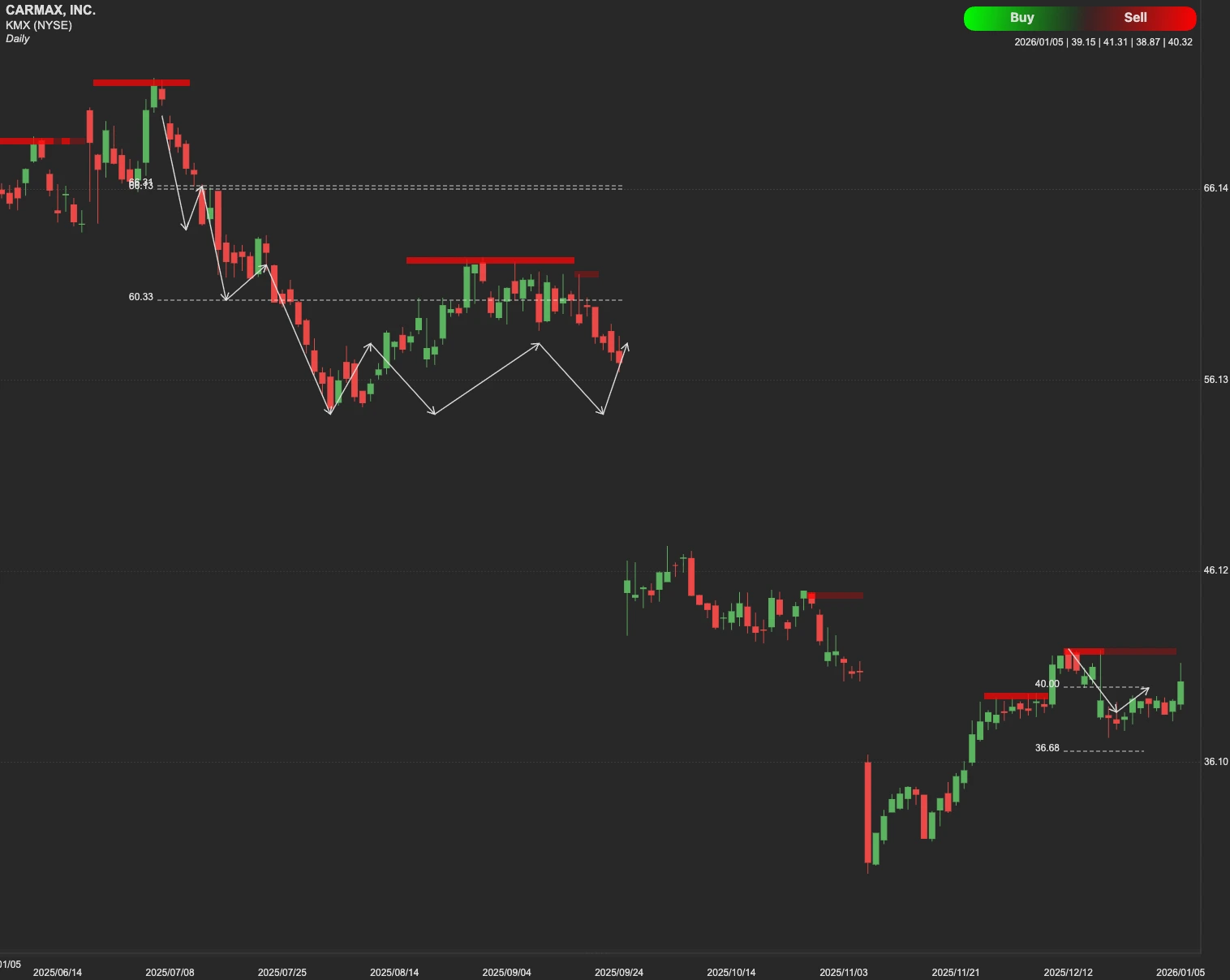
From a market perspective, the stock is currently in a downward trend. At this time, the price faces immediate resistance at $49. If the stock cannot stay above this mark, it will likely drop to find support at $31. If that level fails, the next floor is much lower at $23. On the other hand, if the price manages to break above $49, the next key resistance level would be $59. While a move toward $69 is mathematically possible, the current weak financial data makes such a rally seem very unlikely.