
Cisco Q3 FY2026 Earnings Analysis: AI Demand Fuels Record Revenue
Cisco Systems (NASDAQ: CSCO) delivered one of its strongest quarters in recent years, highlighting how artificial intelligence infrastructure is becoming a major growth driver for the company. Record revenue, accelerating networking demand, expanding AI orders from hyperscale customers, and raised full-year guidance all reinforce Cisco's position as the critical infrastructure for the AI era.
Record Quarter Driven by AI Infrastructure
Cisco reported third-quarter fiscal 2026 revenue of $15.8 billion, increasing 12% year over year and exceeding the high end of management's guidance. Product revenue climbed 17%, while services revenue declined slightly by 1%. Product revenue performance reflected growth in Networking, up 25% and Observability up 3%. Collaboration was down 1%. Security was flat.
Gross margins declined modestly from last year. GAAP gross margin was 63.6%, while adjusted gross margin reached 66.0%, compared with 65.6% and 68.6% in the third quarter of fiscal 2025.
Operating leverage remained impressive, with GAAP operating income increasing 24% to $4.0 billion and adjusted operating income climbing 11% to $5.4 billion. Non-GAAP operating margin reached 34.2%.
Chief Financial Officer Mark Patterson noted that disciplined execution enabled Cisco to deliver record non-GAAP operating income while continuing to invest for future growth.
GAAP net income was $3.4 billion, an increase of 35%. GAAP earnings per share rose 37% to $0.85, while non-GAAP EPS increased 10% to $1.06.
AI Infrastructure Continues to Drive Growth
Perhaps the most encouraging takeaway from the quarter was the continued acceleration in AI-related business.
Management disclosed that AI infrastructure orders from hyperscale customers have already reached $5.3 billion year-to-date, prompting the company to substantially raise expectations for fiscal 2026. The company now expects $9 billion in AI infrastructure orders during FY2026, nearly doubling its previous outlook of $5 billion.
Demand wasn't limited to hyperscale customers.
Total product orders increased 35% year over year (19% excluding hyperscalers), reflecting broad-based enterprise demand. Networking product orders accelerated to more than 50% growth.
A massive multi-year campus networking refresh cycle is underway. Campus networking orders expanded by more than 25% year over year, fueled by next-generation portfolio ramping faster than prior product launches. Data center switching orders increased by more than 40% year over year.
Cash Generation Remains Healthy
Cisco generated $3.8 billion in operating cash flow during the quarter.
The company ended the quarter with $16.6 billion in cash, cash equivalents, and investments while carrying $31.3 billion in total debt.
Cisco also continued returning capital to shareholders through both dividends and share repurchases.
During the quarter, the company returned $2.9 billion to shareholders, including $1.7 billion in dividends and $1.3 billion of share buybacks. The remaining authorized amount for stock repurchases is $9.6 billion with no termination date. Cisco also declared another quarterly dividend of $0.42 per share, payable on July 22.
Raised Guidance
Management raised expectations for fiscal 2026, reflecting confidence in ongoing demand.
For the fourth quarter, Cisco expects revenue between $16.7 billion and $16.9 billion, with adjusted earnings per share projected between $1.16 and $1.18.
For the full fiscal year, Cisco now forecasts revenue of $62.8 billion to $63.0 billion and non-GAAP earnings per share of $4.27 to $4.29.
Management also increased its projected FY2026 AI infrastructure revenue from hyperscalers to $4 billion, compared with its prior estimate of $3 billion.
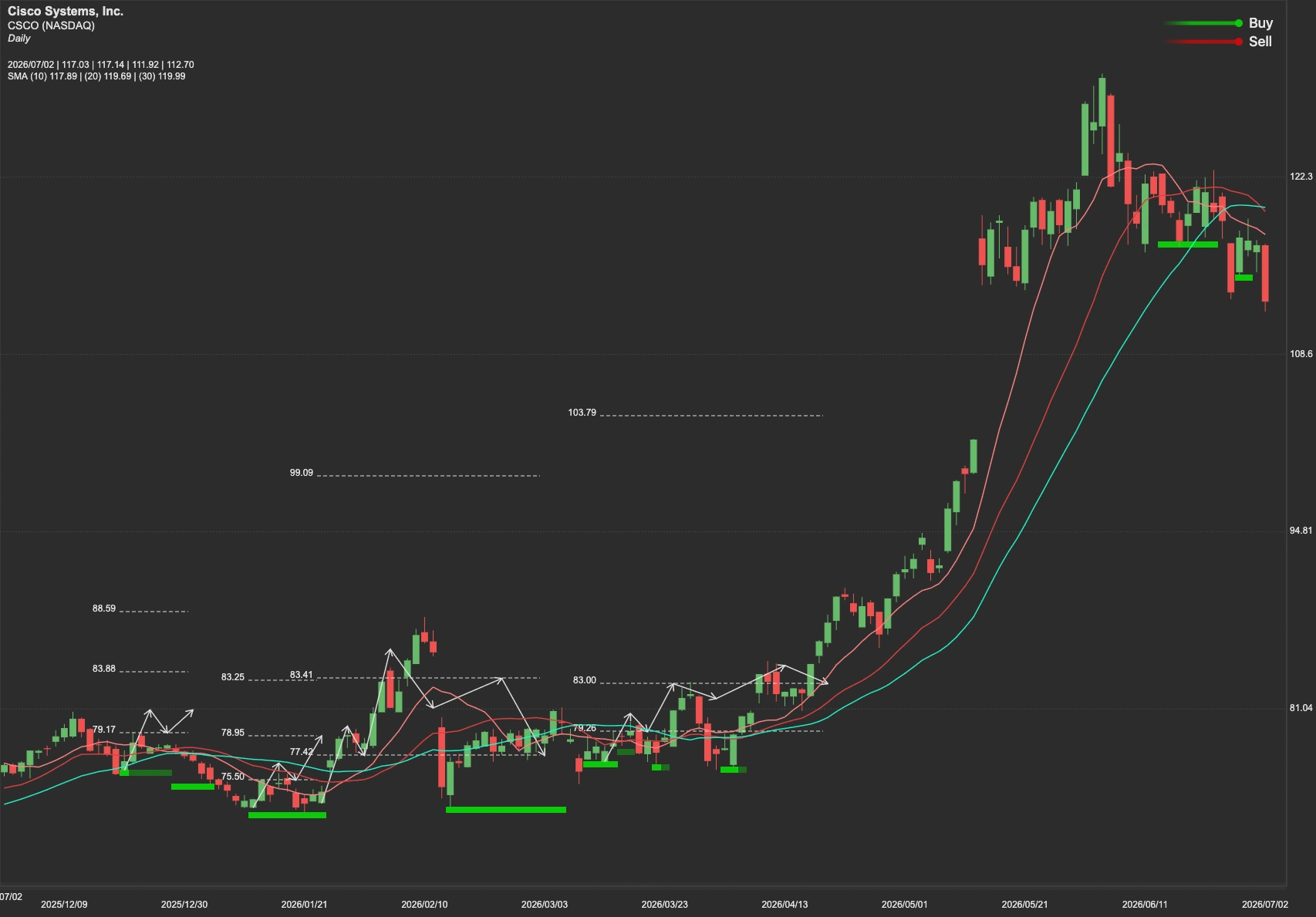
CSCO Stock Technical Analysis
From a technical perspective, $130 has emerged as the key resistance level for CSCO stock. A decisive breakout and sustained move above $130 would likely signal renewed bullish momentum, potentially opening the path towards the next major upside target around $150.
However, failure to overcome this resistance could trigger a period of consolidation or profit-taking. In that scenario, the first significant support lies near $93. Should broader market weakness intensify, the stock could retreat further towards the stronger support zone around $84.