
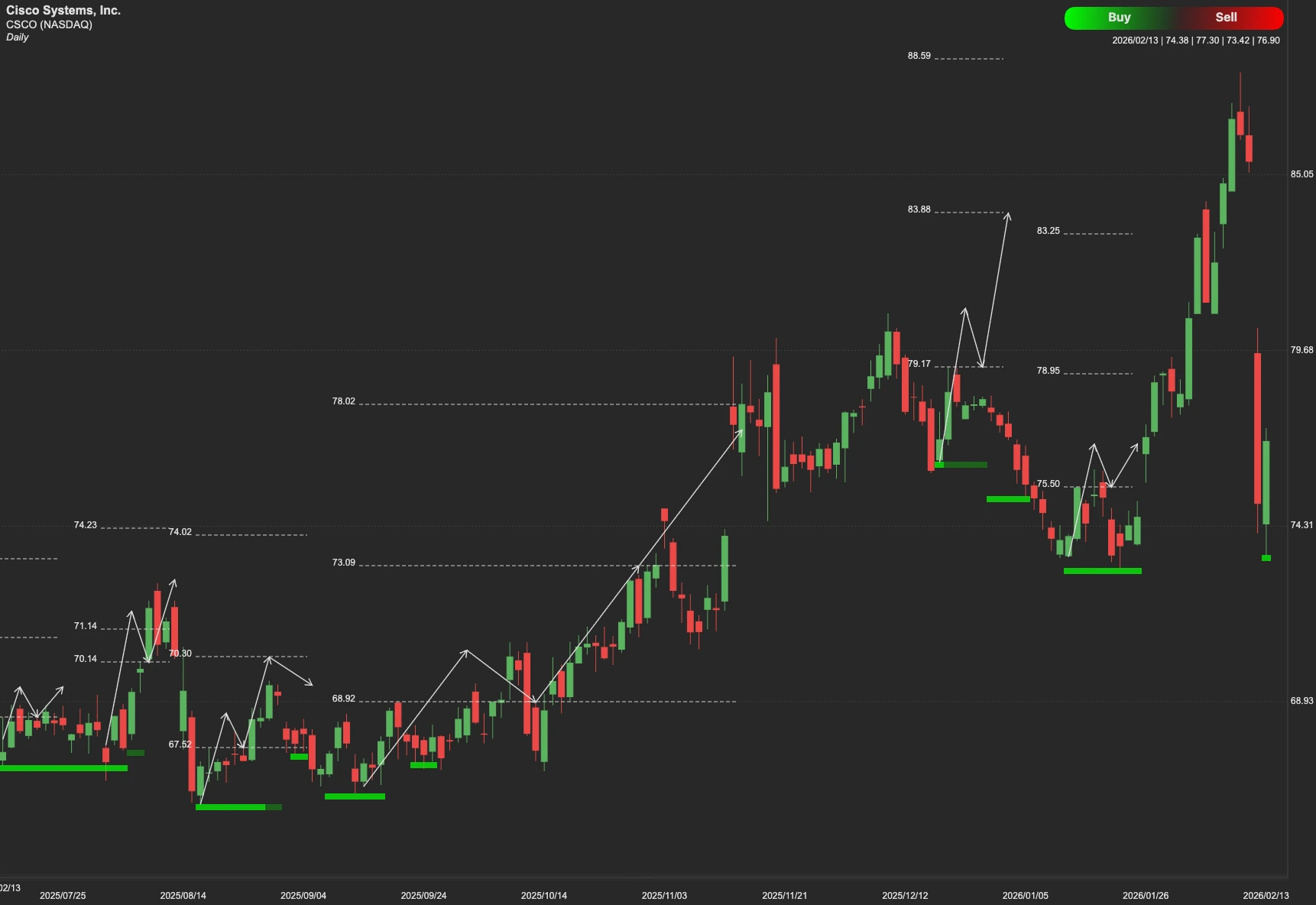
Cisco Stock Falls 10% After Strong Q2 FY2026 Results
Shares of Cisco Systems (NASDAQ: CSCO) declined approximately 10% following the release of its fiscal second-quarter 2026 results, despite the company delivering double-digit growth across both revenue and earnings and exceeding the high end of its guidance range. The market reaction suggests that expectations had been elevated heading into the report, particularly around AI-driven demand and margin expansion, leading investors to reassess near-term upside potential.
Revenue and EPS Growth Accelerate
For the quarter ended January 24, 2026, Cisco reported revenue of $15.3 billion, representing a 10% year over year increase. GAAP net income rose 31% year over year to $3.2 billion, translating into earnings per share of $0.80. On a non-GAAP basis, net income reached $4.1 billion, up 10% year over year, with EPS of $1.04, an 11% increase. Notably, EPS growth outpaced revenue expansion, reflecting improved profitability and disciplined cost management.
Total product revenue increased 14%, driven by continued strength in Networking and Collaboration, which grew 21% year over year and 6% year over year, respectively, while Security declined 4% year over year and Observability remained flat. Services revenue edged down 1%. Across geographies, revenue growth was broad-based, with the Americas up 8%, EMEA rising 15%, and APJC gaining 8%.
Gross Margin Trends: Stable GAAP, Moderate Non-GAAP Compression
Gross margins remained resilient overall, though year over year comparisons show slight compression on a non-GAAP basis.
On a GAAP basis, total gross margin was 65.0%, compared with 65.1% in the prior-year quarter. Product gross margin improved modestly to 63.9% from 63.7%, while services gross margin declined to 68.4% from 68.9%.
On a non-GAAP basis, total gross margin came in at 67.5%, down from 68.7% a year earlier. Product gross margin decreased to 66.4% from 67.7%, and services gross margin edged lower to 70.9% from 71.6%.
While non-GAAP margins narrowed modestly year over year, operating margins still exceeded guidance, indicating that expense discipline helped offset gross margin pressure.
GAAP operating income rose 21% to $3.8 billion, with operating margin at 24.6%, compared with 22.3% in the prior year. Non-GAAP operating income increased 9% to $5.3 billion, producing a 34.6% operating margin, compared with 34.7% a year earlier.
Demand Signals: AI Infrastructure and Order Momentum
Demand indicators were particularly constructive. Product orders rose 18% year over year, with networking product orders accelerating to more than 20% growth. AI infrastructure orders from hyperscalers totaled $2.1 billion, signaling meaningful traction in data center and AI-related deployments. The company also highlighted a major multi-year, multi-billion-dollar campus networking refresh cycle that is now underway, providing additional visibility into forward demand.
Balance Sheet and Capital Allocation
From a balance sheet perspective, Cisco ended the quarter with $15.8 billion in cash and investments. Remaining performance obligations (RPO) increased 5% to $43.4 billion; product RPO was up 8%, of which long-term RPO was $11.8 billion, up 11%; and services RPO was up 2%, reflecting steady backlog growth. The company returned $3.0 billion to shareholders through dividends and share repurchases during the quarter and increased its quarterly dividend by 2% to $0.42 per share, reinforcing its commitment to capital returns.
Forward Guidance
Looking ahead, Cisco guided third-quarter fiscal 2026 revenue between $15.4 billion and $15.6 billion, with non-GAAP EPS expected in the range of $1.02 to $1.04 and GAAP EPS between $0.73 and $0.77. Management’s Q3 non-GAAP gross margin guidance of 65.5% to 66.5% further signaled that gross margin might remain under pressure, while non-GAAP operating margin of 33.5% to 34.5%. For the full fiscal year 2026, management projects revenue of $61.2 billion to $61.7 billion and non-GAAP EPS of $4.13 to $4.17, and GAAP EPS between $3.00 and $3.08.
Technical Outlook: The Road Ahead
Despite these solid fundamentals, the CSCO stock’s sharp pullback has shifted attention to technical dynamics. The key near-term resistance level sits at $83. If shares can reclaim and sustain trading above $83, bullish momentum may resume, with the next technical objective around $90. However, failure to break above resistance increases the probability of a move toward the primary support level at $64. Should broader market weakness or negative sentiment persist, a deeper retracement toward secondary support near $58 becomes possible.