
CRM Stock Analysis: Salesforce’s AI Momentum, Massive Buybacks, and Key Price Levels to Watch
Salesforce (NYSE: CRM) has delivered a blockbuster Q1 Fiscal 2027 earnings report, presenting investors with a complex mix of surging AI adoption, an aggressive capital return program, and revised FY27 guidance.
The Fundamentals: AI Acceleration and Financial Growth
The company reported first-quarter revenue of $11.1 billion, up 13% year over year, supported by a $444 million contribution from Informatica and strong momentum in subscription and support revenue, which climbed 14% to $10.6 billion. Current remaining performance obligation was $33.6 billion, up 14% year over year, with remaining performance obligation of $67.9 billion, up 11% year over year.
Salesforce also posted gross profit of $8.6 billion, up from $7.6 billion a year ago, while sales and marketing expenses increased 9.9% to $3.8 billion. Operating income grew 17% to $2.3 billion. Profitability continued to improve as Salesforce expanded its first-quarter GAAP operating margin to 21.1%, up 130 basis points year over year, while non-GAAP operating margin improved to 34.8%, up 250 basis points. Net income surged to $2.1 billion from $1.5 billion in the prior-year quarter. Diluted earnings per share also impressed investors, with GAAP EPS rising 52% to $2.42 and non-GAAP EPS climbing 50% to $3.88.
Part of the earnings strength was supported by gains on strategic investments and the company’s aggressive share repurchase activity. During the quarter, gains on strategic investments added $0.49 to GAAP diluted EPS and $0.51 to non-GAAP diluted EPS. By comparison, strategic investments reduced diluted EPS by $0.05 in the same quarter last year. According to the company, the reduced share count increased Q1 GAAP EPS by $0.14 and non-GAAP EPS by $0.23.
Beyond earnings, Salesforce’s AI strategy appears to be gaining meaningful traction. The company said Agentforce and Data 360 annual recurring revenue reached nearly $3.4 billion, representing growth of more than 200% year over year, including $1.1 billion Informatica Cloud ARR and $1.2 billion Agentforce ARR.
Management highlighted strong execution in AI-related products, revealing that more than 50% of Agentforce and Data 360 bookings came from existing customers during the quarter. Salesforce also processed 3.8 billion Agentic Work Units to date across Agentforce and Slack, marking 111% sequential growth. In Q1, Data 360 ingested 52 trillion records, up 136% year over year.
Chair and CEO Marc Benioff emphasized that agentic AI remains Salesforce’s biggest growth opportunity, describing Agentforce as increasingly central to enterprise digital transformation initiatives. The company believes momentum in Sales, Service, Slack, Agentforce, and Data 360 could support accelerating organic revenue growth in the second half of fiscal 2027.
Balance Sheet and Capital Allocation
Salesforce also made headlines for its capital allocation strategy. During the quarter, the company returned $27.5 billion to shareholders, including $27.1 billion in share repurchases and $365 million in dividends. Notably, Salesforce launched a massive $25 billion accelerated share repurchase (ASR) program, with upfront share delivery of 103 million shares representing approximately 80% of total shares expected to be repurchased, with final settlement expected in Q3 FY27.
To fund the buyback program, Salesforce issued approximately $24.8 billion in new debt, lifting total debt to $39.28 billion at quarter end. However, the company maintained a healthy liquidity position with $8.9 billion in cash and generated $6.7 billion in operating cash flow and $6.6 billion in free cash flow during the quarter.
Mixed Guidance
“Our Q2 and FY27 revenue guidance reflects continued momentum in Agentforce, Data 360, and Slack, partially offset by ongoing weakness in marketing and commerce and increased softness in Tableau bookings and renewals. We also expect greater license revenue volatility with the addition of Informatica revenue to our business.” Robin Washington, Salesforce’s CFO, said on the company’s earnings call.
For the second quarter of fiscal 2027, Salesforce expects revenue between $11.27 billion and $11.35 billion, representing 10% to 11% year-over-year growth. The company forecast GAAP diluted EPS of $1.74 to $1.76 and non-GAAP diluted EPS of $3.25 to $3.27.
Salesforce also raised the midpoint of its full-year fiscal 2027 revenue guidance, now expecting revenue between $45.9 billion and $46.2 billion, compared with prior guidance of $45.8 billion to $46.2 billion. The company maintained its subscription and support revenue growth outlook at slightly under 12% year over year.
However, Salesforce modestly lowered its full-year GAAP operating margin guidance to 20.6%, down from 20.9% previously, while maintaining its non-GAAP operating margin target of 34.3%.
The company also revised expectations for operating cash flow growth and free cash flow growth to approximately 4% to 5% year over year, down from prior guidance of 9% to 10%, primarily reflecting the impact from the $25 billion debt issuance tied to the accelerated share repurchase program.
Salesforce maintained its expectation for capital expenditures at approximately 1.5% of revenue for fiscal 2027.
CRM Stock Technical Analysis
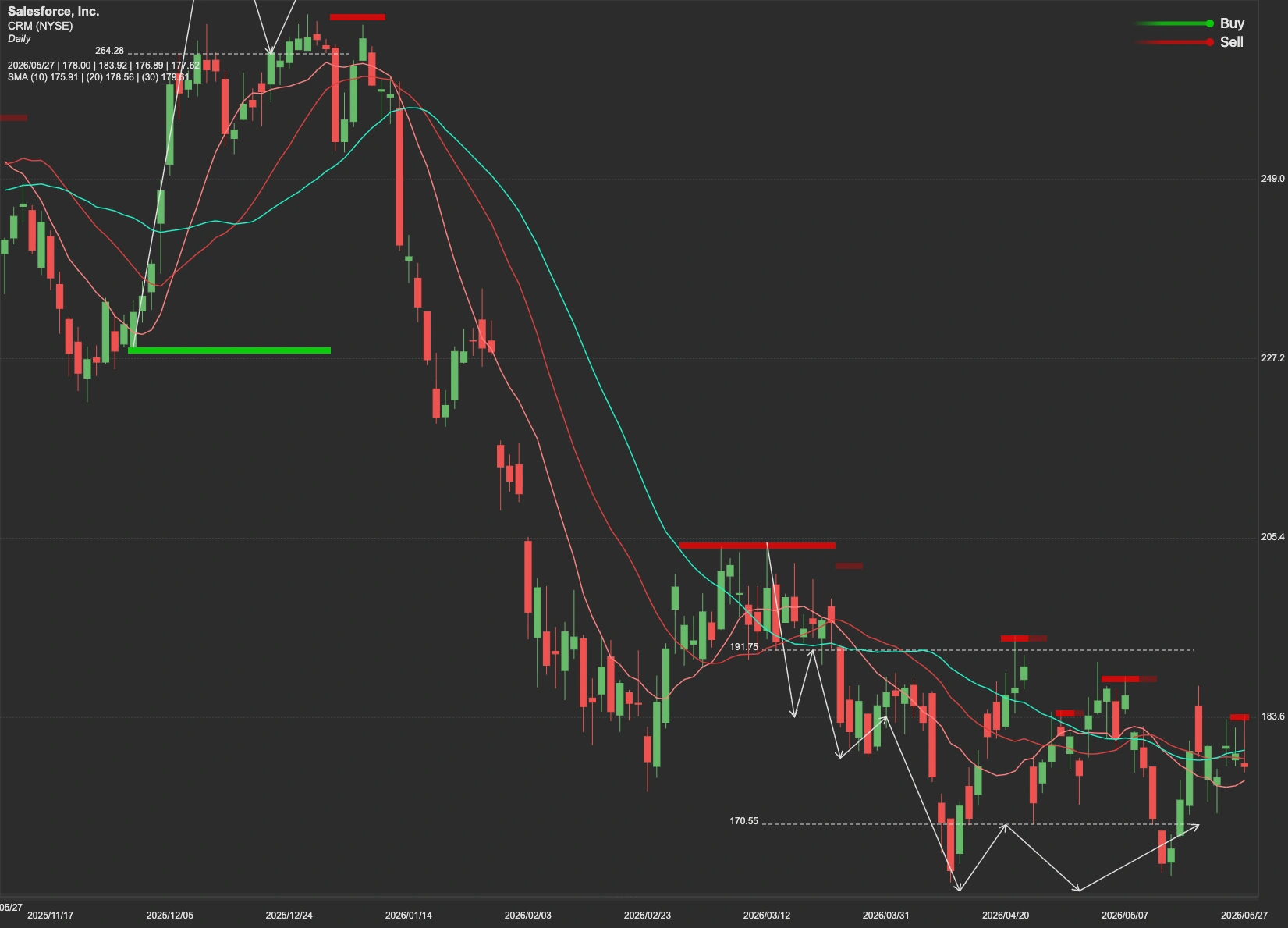
From a technical perspective, the immediate resistance level to watch stands at $204. A sustained breakout above this level could signal improving bullish momentum and potentially open the door toward the next major resistance zone around $231. If Salesforce stock successfully establishes support above $231, the next upside target could emerge near $257.
On the downside, failure to maintain momentum above current levels could send CRM stock back to test support around $163. If bearish pressure intensifies, the next important downside support sits near $151.