
Disney Stock Analysis: Strong Q3 Results Reinforce Long-Term Story, But Technical Resistance at $118 Remains the Key Test
The Walt Disney Company (NYSE: DIS) delivered a strong fiscal third-quarter 2026 performance, demonstrating the strength of its diversified business model despite a mixed macroeconomic backdrop. Robust growth across its Experiences segment, continued momentum in streaming, and expanding consumer engagement helped drive higher revenue, profits, and free cash flow, while management reaffirmed its optimistic outlook for both fiscal 2026 and 2027.
However, mixed signals in film box office performance, advertising softness in domestic direct-to-consumer (DTC), and sports rights cost pressures present headwinds that investors must weigh against Disney's long-term transformation strategy.
Q3 FY2026 Earnings Highlights
For the quarter ended June 27, 2026, Disney reported revenue of $25.25 billion, an increase of 7% year over year, while income before income taxes rose 14% to $3.65 billion.
Total segment operating income climbed 21% to $5.56 billion, reflecting improving profitability across the company's core businesses.
Adjusted earnings per share increased 28% to $2.06, comfortably exceeding the prior year's adjusted EPS of $1.61. GAAP EPS declined 48% to $1.51, primarily due to an $812 million impairment charge related to Disney's investment in A+E Global Media. The prior-year quarter, by contrast, was inflated by a $3,277 million non-cash tax benefit from the change in Hulu's U.S. tax classification.
Cash generation also improved significantly. Operating cash flow increased 33% to $4.87 billion, while free cash flow surged 63% to $3.07 billion.
The company ended the quarter with cash and cash equivalents of $5.19 billion and total debt of $46.04 billion.
Experiences Continues to Lead Growth
Experiences segment revenue increased 10% to $9.97 billion, while operating income climbed 20% to $3.02 billion. The business benefited from higher attendance at domestic theme parks, increased guest spending, expanding Disney Cruise Line capacity, and robust consumer products demand. The successful launches of Disney Destiny and Disney Adventure significantly increased cruise capacity during the quarter, while the box office success of Toy Story 5 supported strong merchandise licensing revenue. Strength at domestic parks, Disney Cruise Line, Consumer Products, and Disneyland Paris helped offset softness at Asia parks, which Disney expects to continue in fiscal Q4. Management also reported roughly $100 million of tariff refunds landed in the quarter, worth about four points of the Experiences segment's 20% operating income growth. Ex-refund, the underlying growth is closer to 16% — still strong.
Entertainment Business Continues Improving
Entertainment segment revenue increased 6% to $11.35 billion, while operating income jumped 64% to $1.68 billion. Subscription and affiliate fee revenue benefited from higher subscriber numbers, pricing improvements, favorable foreign exchange, and contributions from the Fubo transaction. Streaming continued to gain momentum as Disney+ recorded lower churn and stronger subscriber engagement. Advertising demand softened during the quarter; the theatrical performances of Star Wars: The Mandalorian and Grogu and the live-action Moana fell short of expectations.
Sports Faces Higher Costs
Sports segment remained profitable but faced margin pressure as higher programming and production costs offset revenue growth. Revenue increased 4% to $4.50 billion, supported by subscription and affiliate fee growth and the NFL transaction completed earlier this year. However, operating income declined 17% to $858 million, was modestly steeper than the prior guidance of approximately 14%. Contributing to the lower-than-expected operating income were four-game sweeps in early rounds of the NBA Playoffs and the impact of a network carriage dispute.
Capital Allocation
Management continues to aggressively return capital to shareholders. Disney now expects to repurchase at least $9 billion of stock during fiscal 2026, an increase from previous expectations. The company also announced the sale of its 50% ownership stake in A+E Global Media for approximately $1.2 billion, with proceeds expected to fund additional share repurchases.
Business Outlook
Management reaffirmed its confidence in Disney's long-term strategy by maintaining its fiscal 2026 earnings outlook. The company continues to expect adjusted earnings per share to grow approximately 12% excluding the additional 53rd week, or approximately 16% including the extra week. Disney also continues to expect double-digit growth in adjusted EPS in fiscal 2027, excluding the impact of the 53rd week.
DIS Stock Technical Analysis
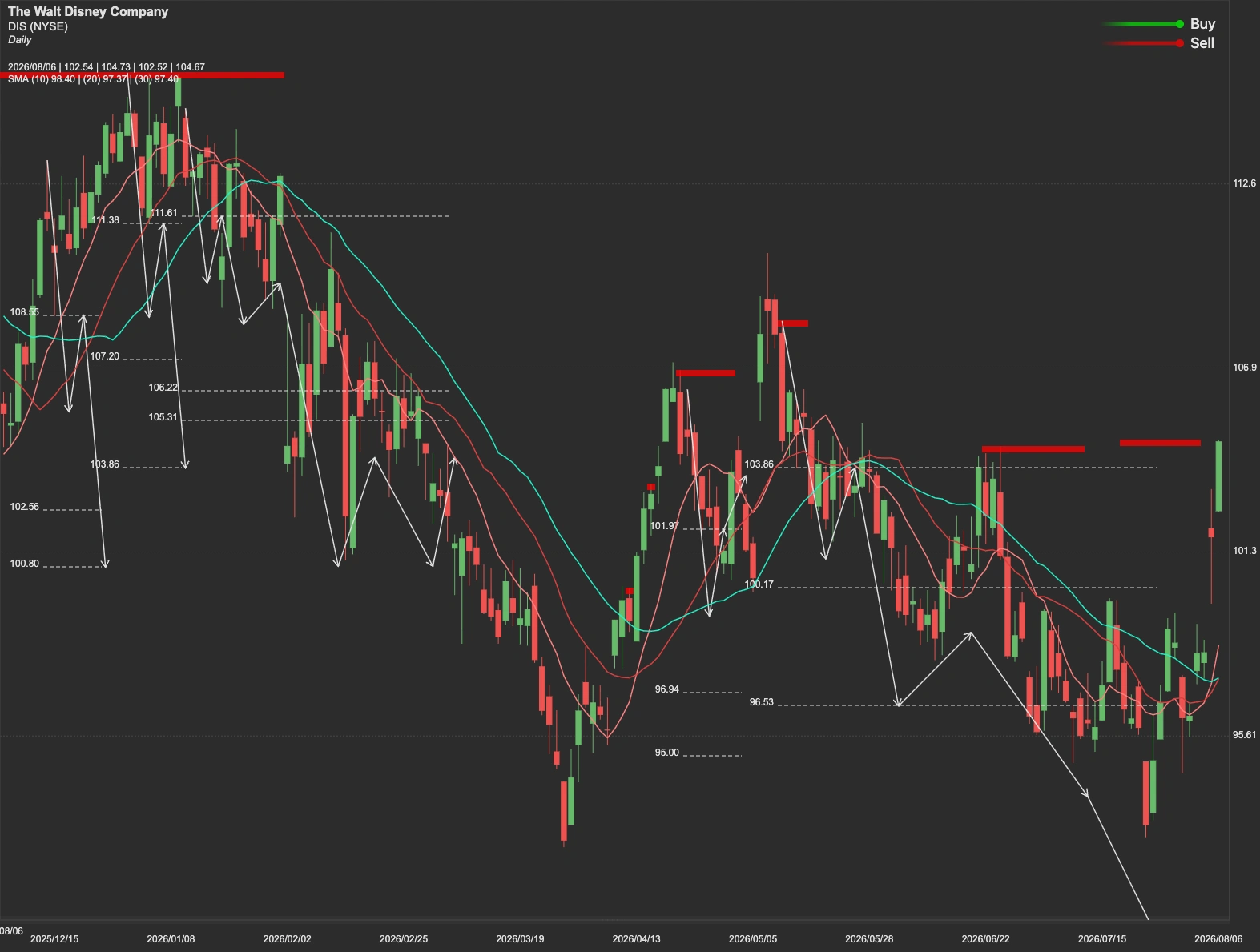
From a technical perspective, Disney’s post-earnings rally improved momentum, but the stock still faces meaningful resistance ahead. The first key resistance level sits around $118. A decisive breakout and sustained move above $118 could open the path toward the next major resistance near $128.
However, failure to maintain momentum above current levels may trigger consolidation or downside pressure. Initial support sits near $95, while a deeper pullback could send shares toward the stronger support area around $85.