
Disney Stock Analysis: Strong Revenue Lifts Shares, but Key Resistance Levels Still Ahead
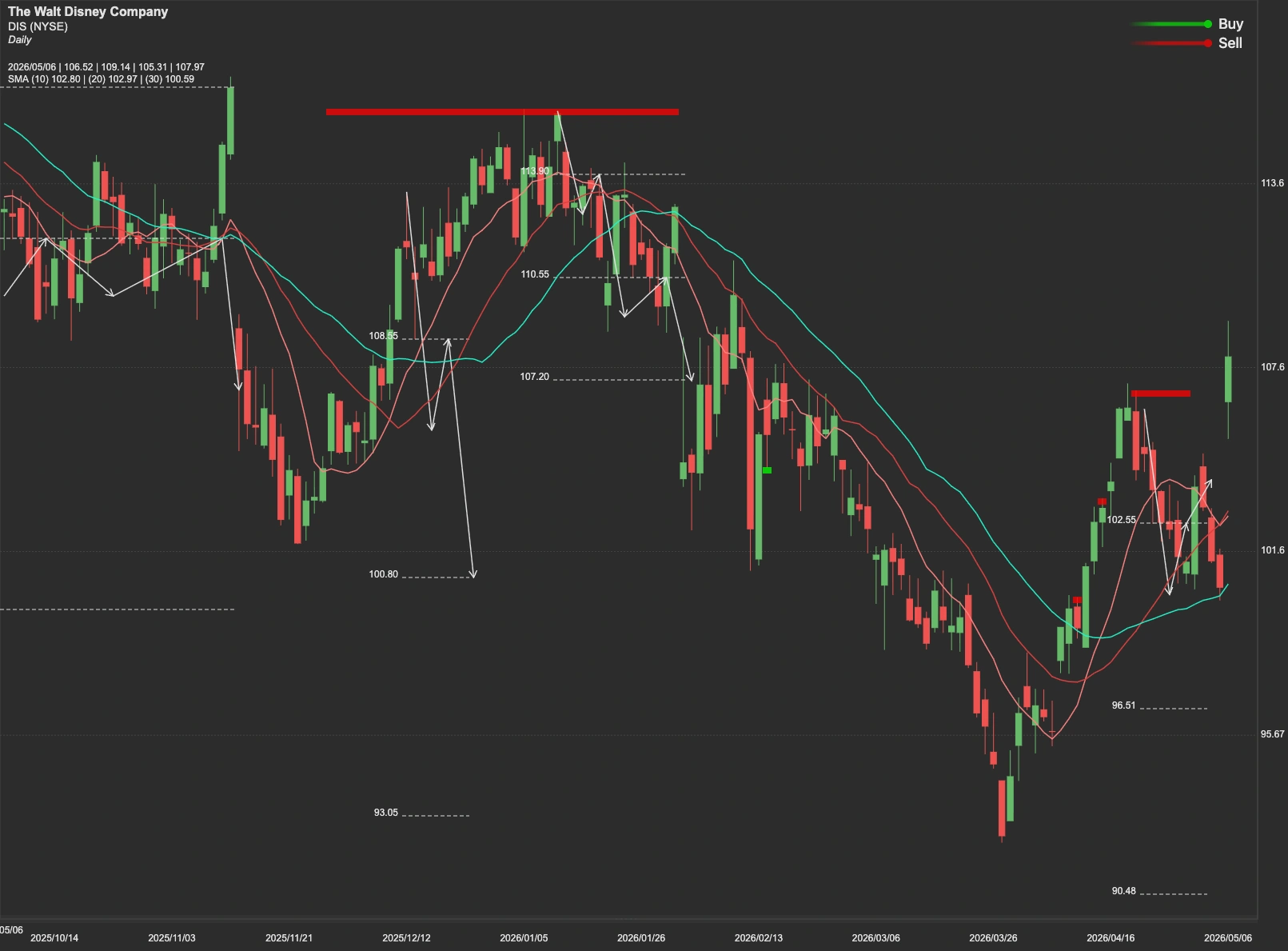
Shares of DIS surged 7.5% after Disney released its fiscal Q2 2026 earnings report, as investors reacted positively to stronger-than-expected revenue growth, accelerating streaming profitability, and improving guidance for the remainder of the year.
Q2 Fundamental Performance
Disney delivered solid top-line growth in the quarter, with revenue rising 7% year over year to $25.2 billion. Total segment operating income climbed 4% to $4.6 billion from $4.4 billion in Q2 fiscal 2025. Income before income taxes increased 9% year over year to $3.4 billion, while net income decreased 28% to $2.5 billion. Income taxes payment was $902 million, compared to income taxes benefit of $314 million in Q2 fiscal 2025.
Adjusted EPS increased 8% to $1.57, while diluted earnings per share (EPS) decreased 30% to $1.27 from $1.81 in Q2 fiscal 2025.
Cash Flow and Balance Sheet
Despite the strong earnings report, Disney’s balance sheet and cash flow trends remain an area investors should monitor carefully. Operating cash flow declined to $7.6 billion during the first six months of fiscal 2026 from nearly $10 billion a year earlier due to higher income tax payments and, to a lesser extent, an increase in spending on content at Entertainment and Sports. Investments in parks, resorts and other property increased to $5.0 billion from $4.3 billion due to higher spending on cruise ship fleet expansion and new theme park attractions at the Experiences segment. Free cash flow fell sharply to $2.7 billion, down from $5.6 billion a year earlier.
Gross new borrowings totaled approximately $8.5 billion during the six-month period, while net debt increased by roughly $5.0 billion. The additional capital likely supported aggressive shareholder returns, including $5.5 billion in share repurchases, alongside elevated capital expenditures and dividends.
Disney ended the quarter with total debt of approximately $47.4 billion and cash, cash equivalents and restricted cash of $5.8 billion.
Segment Performance Highlights
The strongest area of improvement came from Disney’s streaming business. Entertainment SVOD revenue growth accelerated to 13% in Q2 compared to the prior-year quarter, up from 11% in Q1, with operating income nearly doubling to $582 million from $310 million a year earlier. The company currently generates more Entertainment subscription and affiliate fees and advertising revenues from SVOD than linear TV, and it expects the mix shift from linear toward streaming to continue.
Experiences segment revenues and operating income in Q2 were fiscal second-quarter records, with growth of 7% and 5% year over year, respectively, supported by higher guest spending, cruise expansion, and continued demand at domestic parks. New attractions such as the World of Frozen in Disneyland Paris and the launch of the Disney Adventure cruise ship highlight Disney’s aggressive long-term expansion strategy in global tourism and experiential entertainment.
Sports remained a mixed area. ESPN subscription and affiliate revenues grew 6% in the quarter compared to the prior-year quarter, with the NFL transaction contributing 3%. Advertising revenues at ESPN declined 2% year over year. Sports segment operating income declined 5% year over year, driven primarily by higher rights fees and higher marketing costs. Disney expects Sports operating income to decline approximately 14% in Q3, driven by a double-digit percentage increase in programming expenses.
Business Outlook
For fiscal 2026, Disney now expects:
-
Adjusted EPS growth of approximately 12%, excluding the impact of the 53rd week
-
Adjusted EPS growth of approximately 16%, including the impact of the 53rd week
-
At least $8 billion in share repurchases
-
Third-quarter total segment operating income of approximately $5.3 billion
The company also reiterated that domestic parks and resorts demand remains healthy despite broader macroeconomic uncertainty.
Looking further ahead, Disney maintained its fiscal 2027 outlook for double-digit adjusted EPS growth, excluding the impact of the 53rd week.
Disney has also announced it will not proceed with its previously planned investment in OpenAI following OpenAI’s decision to shut down Sora.
Technical Analysis
From a technical perspective, Disney’s post-earnings rally improved momentum, but the stock still faces meaningful resistance ahead. The first key resistance level sits around $118. A decisive breakout and sustained move above $118 could open the path toward the next major resistance near $128.
However, failure to maintain momentum above current levels may trigger consolidation or downside pressure. Initial support sits near $95, while a deeper pullback could send shares toward the stronger support area around $85.