
Duolingo Delivers Strong Q1 Growth, but DUOL Stock Still Faces Key Technical Resistances
Duolingo, Inc. (NASDAQ: DUOL) reported strong first-quarter 2026 results, highlighted by accelerating revenue growth, expanding margins, and continued investment in artificial intelligence-driven product innovation. While the headline figures indicate a business growing its footprint, the stock itself faces a challenging climb back toward its previous highs.
Strategic Execution
In its first-quarter results, the company highlighted steady progress against its long-term strategy, particularly its push to deepen engagement through speaking-focused learning and AI-driven content expansion. That ambition is clear: Duolingo is targeting 100 million daily active users by 2028. Speaking practice—historically a weak point—has now become central to the platform, supported by features like Video Call, spoken tokens, and interactive scenarios. At the same time, Duolingo is leveraging AI to dramatically scale content production, publishing 20,500 course units in Q1 2026 alone. This level of output would have been unthinkable just a couple of years ago.
Chief Executive Officer Luis von Ahn said the company is prioritizing better teaching outcomes and deeper engagement over short-term optimization, arguing that stronger product effectiveness will ultimately translate into higher retention, broader adoption, and greater monetization over time.
Revenue Growth and Margin Improvement
Duolingo reported first-quarter revenue of $292.0 million, up 27% year over year, while Subscription revenue remained the primary growth engine, increasing 31% to $250.9 million, and Advertising revenue grew 15% to $20.6 million. Duolingo English Test revenue decreased 6% to $11.3 million, and In-App Purchases revenue down 11% to $8.4 million.
Daily active users (DAUs) grew 21% year over year to 56.5 million, lapping 49% growth in Q1 2025 when the company benefited from the 'Dead Duo' campaign. Paid subscribers at period end grew 21% year over year to 12.5 million. Total bookings grew 14% year over year, or 9% on a constant currency basis, to $308.5 million, driven by continued growth in subscribers and favorable advertising trends. Subscription bookings grew 15% year over year to $268.1 million.
Gross profit rose 30% year over year to $213.1 million, while gross margin expanded 190 basis points to 73.0%, primarily due to lower per-unit AI costs. Income from operations was $44.5 million, compared to $23.6 million in Q1 2025.
Net income reached $43.5 million; diluted net income per share was $0.89, up from $0.72 the prior year, while adjusted EBITDA increased to $83.4 million, representing a 28.6% adjusted EBITDA margin.
Cash Flow Remain A Strength
Net cash from operating activities for the quarter was $150.8 million. Free cash flow came in at $147.8 million, translating to an impressive 50.6% free cash flow margin.
The balance sheet remains exceptionally strong, with $1.1 billion in cash and cash equivalents.
Duolingo also repurchased approximately 514,000 shares for $50.6 million through May 1, 2026. This represents more than 100% of the 2025 net dilution from equity awards.
Guidance Signals Moderation
The updated outlook for 2026 reinforces both growth and near-term trade-offs. Management continues to guide for full-year bookings growth of about 10.5% and revenue growth of roughly 16.1%, broadly in line with its long-term targets. However, the trajectory is uneven. Q2 bookings are expected to grow just 5.8% year over year. Q2 faces a challenging bookings growth comparable, after which the company expects bookings growth to accelerate through the remainder of the year. Revenue growth in Q2 is projected at a stronger 17.1%, though management expects growth moderating through the back half of the year.
Margins are also expected to fluctuate. Gross margin is guided to around 71% in Q2, trending down toward approximately 69% by Q4 as AI-driven features expand across the products. Full-year adjusted EBITDA is expected to reach $310 million, implying a 25.7% adjusted EBITDA margin, with Q2 at around 24% and a dip in Q3 before recovery into year-end.
At the same time, dilution remains a factor. Stock-based compensation is projected to approach 15% of revenue in 2026, with fully diluted share count expected to increase by roughly 3.5–4%, partially offset by ongoing share repurchases.
DUOL Stock Technical Outlook
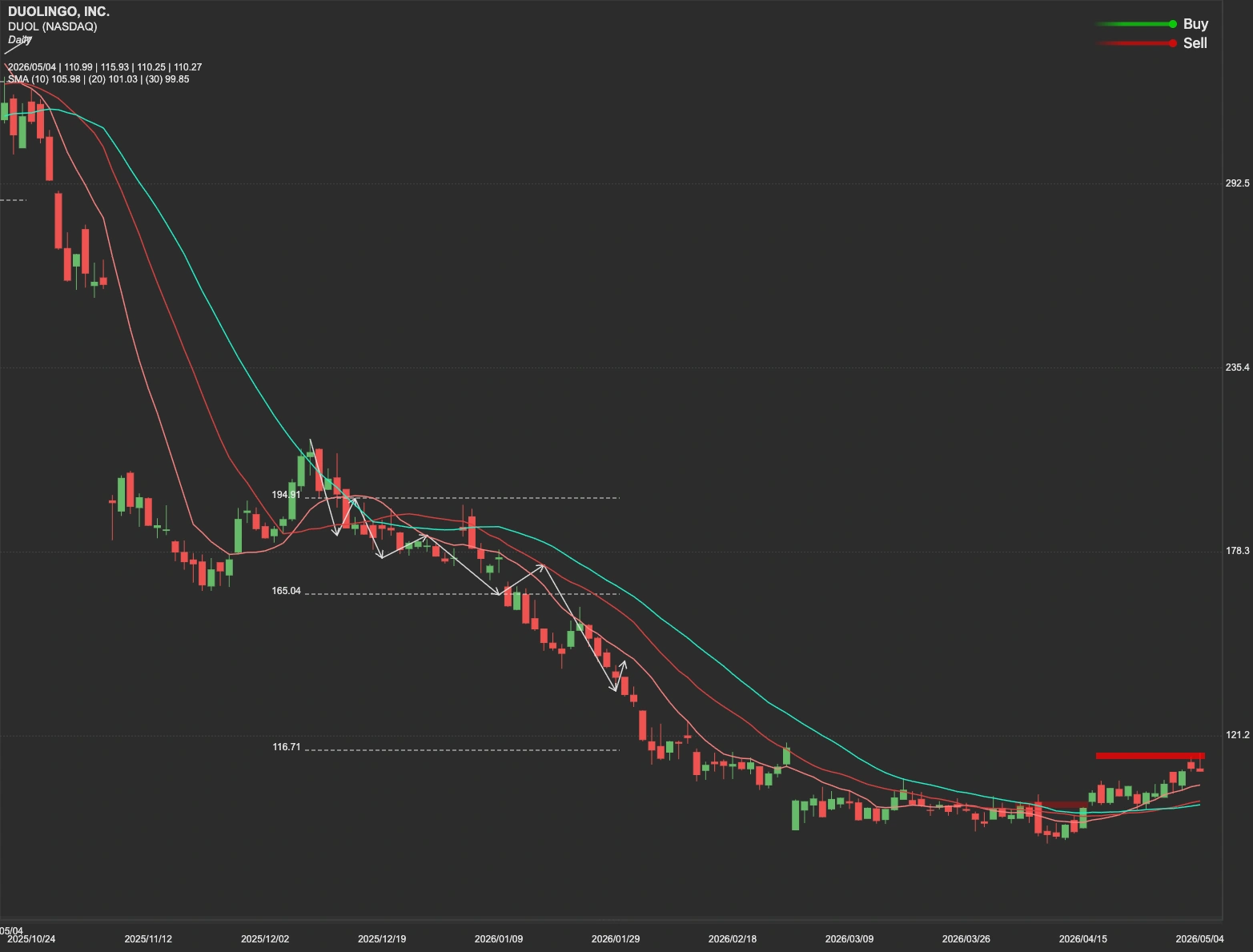
While the business is executing well fundamentally, DUOL stock still needs to clear several critical technical resistance levels before the market fully validates that strength.
In the short term, DUOL faces a key resistance level at $132. A sustained move above this level would be the first signal of strengthening momentum, opening the path toward $156. Until that happens, price action may remain range-bound or vulnerable to pullbacks.
Looking further out, the medium-term resistance stands at $181. Beyond that, the long-term ceiling sits near $275, which represents a much broader structural barrier and would likely depend on Duolingo successfully executing its multi-year growth strategy.