
FedEx Reports Solid Growth Amid Strategic Transformation Efforts
FedEx Corp. (NYSE: FDX) has delivered a robust third-quarter performance for fiscal 2026, signaling that its network and digital transformation and "DRIVE" cost-cutting initiatives are yielding tangible results. Despite a complex global macroeconomic backdrop and shifting trade policies, the Memphis-based logistics giant has raised its full-year fiscal 2026 outlook.
Fundamental Strength Driven by Yield and Cost Discipline
Total revenue increased 8% year over year to $24.0 billion in the third quarter, rising from $22.2 billion last year, driven primarily by strength in the core express business. Operating income climbed to $1.35 billion from $1.29 billion, representing a 4% increase, while operating margin edged slightly lower to 5.6% from 5.8%. Net income showed stronger momentum, rising 16% to $1.06 billion compared to $0.91 billion a year ago, and diluted earnings per share increased 17% to $4.41 from $3.76. Net income includes a tax benefit of $99 million ($0.41 per diluted share) from the recognition of certain foreign tax loss carryforwards.
The underlying performance was heavily supported by the Federal Express segment, which continues to act as the primary earnings driver. Segment revenue rose 10% year over year to $21.15 billion, while operating income increased 21% to $1.57 billion. Margins expanded to 7.4% from 6.7%, benefiting from higher U.S. domestic and International Priority package yields, alongside increased package volumes and sustained cost reductions from ongoing transformation programs.
In contrast, the FedEx Freight segment delivered a significantly weaker performance. Revenue declined 5% year over year to $1.99 billion, while operating income dropped sharply to just $8 million from $261 million in the prior year. This resulted in a steep margin contraction to 0.4% from 12.5%, reflecting the combined impact of spin-off related costs, softer shipment volumes, and higher wage expenses.
The “Other and eliminations” segment, which includes FedEx Office, FedEx Logistics, and FedEx Dataworks, also saw modest softness, with revenue declining 4% year over year to $855 million from $890 million.
Strong Cash Flow Signals Improving Financial Quality
Cash provided by operating activities rose to $5.66 billion for the nine-month period, up from $4.52 billion a year ago. Capital expenditures declined to $2.34 billion from $2.58 billion. As a result, free cash flow expanded meaningfully, giving FedEx greater financial flexibility.
On the financing side, the company generated $2.88 billion in cash for the first nine months. This was primarily driven by $4.69 billion in new debt issuance, partially offset by dividends and reduced share repurchases. Buybacks dropped significantly to $796 million from $2.52 billion in the same period last year.
Total cash, cash equivalents, and restricted cash increased to $11.69 billion at the end of February 28, 2026.
Strategic Catalysts: The Freight Spin-off and InPost Offer
The upcoming June 1, 2026, spin-off of FedEx Freight is on track. FedEx Freight recently completed a $3.7 billion debt offering, the net proceeds of which will be distributed to FedEx Corporation.
Furthermore, FedEx, together with Advent International, A&R Investments, and PPF Group, recently announced a conditional agreement on a recommended all-cash offer to take InPost private at €15.60 per share. Management expects this minority investment to be accretive to FedEx earnings in the first year, with incremental accretion thereafter.
Financial Outlook and Guidance Raise
Looking ahead, FedEx raised its full-year outlook, now expecting revenue growth of 6.0% to 6.5% and adjusted EPS of $16.05 to $16.85, or up to $20.10 when excluding transformation-related costs. The company continues to target over $1 billion in structural cost reductions, signaling confidence in its ongoing efficiency initiatives and Network 2.0 transformation. The company also noted that these forecasts are based on its current economic forecast and fuel price expectations and no additional adverse economic, geopolitical, or international trade-related developments.
Technical Analysis
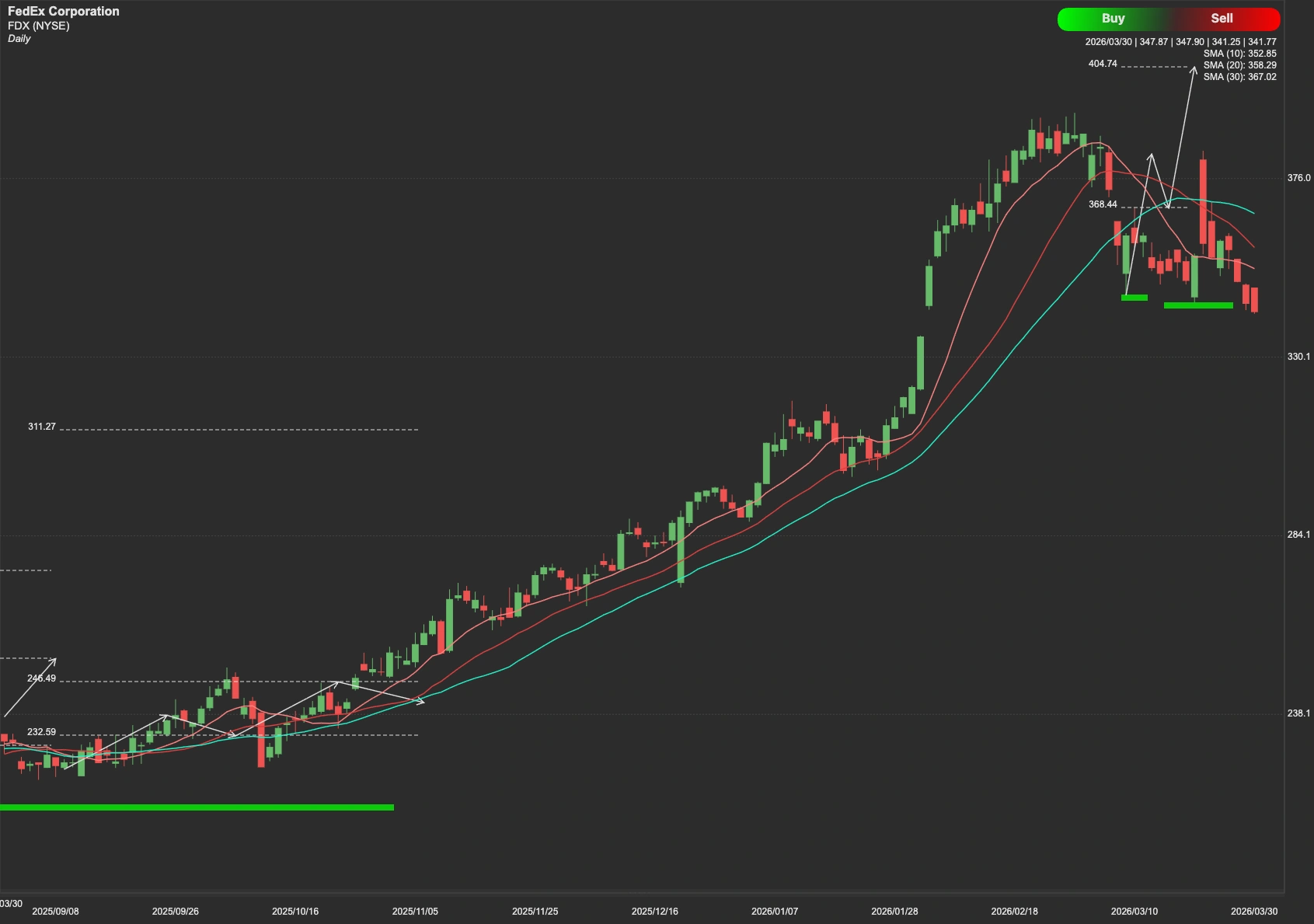
From a technical standpoint, the FDX stock faces a current immediate resistance at $370. If the stock can consolidate and hold above this level, the next technical objective is $392.
Conversely, failure to hold above this resistance zone could trigger a retracement. In that case, the stock may revisit the $287 support level, with further downside risk extending to $269 if selling pressure intensifies.