
General Mills Stock Analysis: Q4 FY2026 Meets Expectations, But Can Cost Savings and Innovation Drive a Breakout?
General Mills, Inc. (NYSE: GIS) delivered fourth-quarter fiscal 2026 results largely in line with management's expectations, providing investors with a mixed picture of operational resilience and significant accounting headwinds. Looking ahead, management is shifting its focus from pricing actions toward product innovation, brand renovation, and a multi-year efficiency program targeting $3 billion in cumulative cost savings by fiscal 2030. Whether these initiatives can restore sustainable revenue growth remains the key question for investors.
General Mills Delivers In-Line Fourth-Quarter Results
General Mills reported fourth-quarter net sales of $4.6 billion, up 1% year over year, including a 7-point benefit from the 53rd week, a 1-point benefit from foreign currency exchange, and a 7-point headwind from the net impact of divestitures and acquisitions. Organic net sales were essentially flat, as a 2-point decline in organic volume was fully offset by a 2-point increase in organic price/mix.
Gross margin increased 240 basis points to 34.8%, driven by favorable net price realization and mix and favorable mark-to-market effects, partially offset by higher input costs. Adjusted gross margin increased 150 basis points to 34.2%.
Adjusted operating profit increased 13% to $705 million, while adjusted diluted earnings per share rose 27% to $0.95, benefiting from higher adjusted operating profit, a lower adjusted effective tax rate, and lower net shares outstanding, partially offset by higher net interest expense.
However, reported results were heavily impacted by one-time charges. The company recorded an operating loss of $2.1 billion after recognizing $1.8 billion of non-cash goodwill and brand impairment charges, together with a $1.0 billion valuation loss related to the planned divestiture of its Brazil business. Net loss attributable to General Mills totaled $2.0 billion, and diluted loss per share was $3.74 during the quarter.
Full-Year Performance
For the full fiscal year, General Mills generated $18.4 billion in net sales, down 5%, while organic net sales declined 2%, due in part to weaker consumer sentiment and significant volatility that weighed on category volume growth and drove a higher share of consumer purchases on promotion.
Gross margin was down 100 basis points to 33.6%, and adjusted gross margin was down 100 basis points to 33.5%.
Operating profit declined 73% to $886 million, driven primarily by the goodwill and brand intangible asset charges, the valuation loss, and lower gross profit dollars, partially offset by a $1.0 billion gain on the yogurt divestitures. Adjusted operating profit declined 16% to $2.8 billion, and adjusted diluted EPS fell 16% to $3.55. On a GAAP basis, the company reported a net loss of $88 million, and diluted loss per share was $0.16.
Cash Flow and Balance Sheet
During fiscal 2026, General Mills generated $2.2 billion in operating cash flow, invested $540 million in capital expenditures, and returned $1.3 billion to shareholders through dividends while repurchasing $500 million of stock.
The General Mills board of directors declared a quarterly dividend at the prevailing rate of $0.61 per share, payable August 3, 2026, to shareholders of record July 10, 2026.
General Mills ended fiscal 2026 with cash and cash equivalents of $453.8 million and total debt of $13.54 billion.
Management Targets $3 Billion in Cost Savings
The biggest announcement from the earnings report was General Mills' long-term efficiency initiative.
The company plans to generate $3 billion in cumulative cost savings by fiscal 2030 through:
- Holistic Margin Management (HMM) productivity initiatives.
- Global transformation programs.
- Supply chain optimization.
- Streamlined business processes.
- Additional enterprise-wide efficiency improvements.
Management expects at least $750 million of savings to be realized during fiscal 2027. These savings are intended to offset inflation while funding increased investment in product innovation, marketing, and brand renovation.
Fiscal 2027 Outlook Remains Conservative
Despite confidence in its long-term strategy, General Mills issued cautious guidance for fiscal 2027.
The company expects:
- Organic net sales between -1.5% and +0.5%.
- Adjusted operating profit to decline 8%-13% in constant currency.
- Adjusted diluted EPS between $3.00 and $3.20.
- Free cash flow conversion of approximately 95% of adjusted after-tax earnings.
GIS Stock Technical Analysis
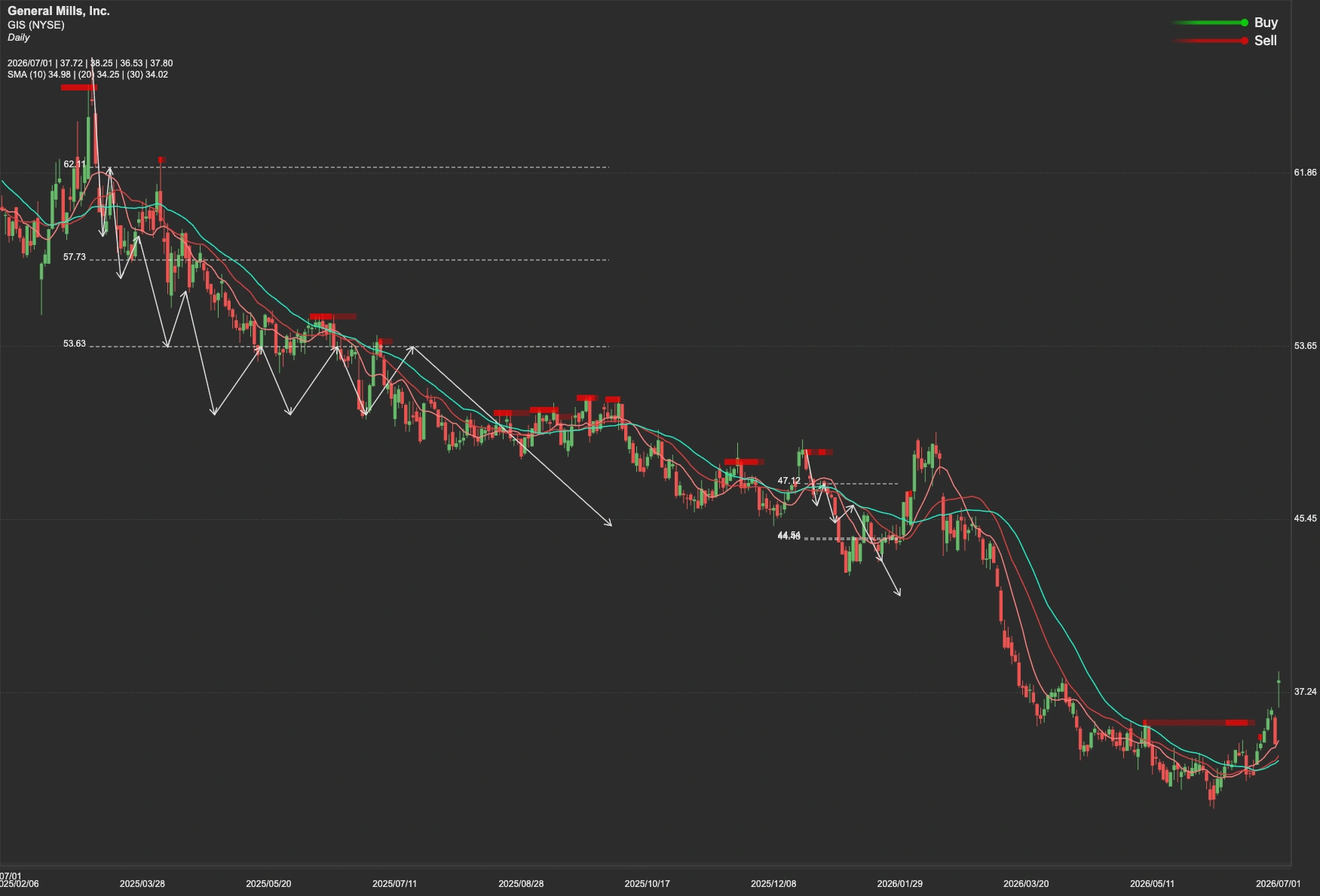
From a technical perspective, the key resistance level for GIS stock to watch is $53. A decisive breakout and sustained close above $53 would represent an important improvement in market sentiment. If buyers successfully establish support above this level, the next major resistance area sits near $63.
However, investors should remain cautious until these resistance levels are convincingly cleared. Failing to break above $53 could lead the stock to retest the major support around $31. Should broader market weakness, the longer-term support near $25 becomes the next critical level to monitor.