
Home Depot Tops Q2 Estimates and Rolls Out 3-Hour Delivery
The Home Depot, Inc. (NYSE: HD) delivered stronger-than-expected second-quarter fiscal 2026 results, supported by steady demand for smaller home improvement projects and ongoing investments in customer service and fulfillment capabilities. The company also reaffirmed its full-year fiscal 2026 guidance while expanding its nationwide Express Delivery service to strengthen its competitive position in the home improvement market.
Q2 FY26 Financial Performance
For the quarter ended August 2, 2026, Home Depot generated revenue of $47.9 billion, up 5.7% year over year from $45.3 billion. Gross profit increased 6.5% to $16.1 billion, while gross margin improved to 33.7% from 33.4% a year earlier.
Operating income rose 4.3% to $6.8 billion, although operating margin eased slightly to 14.3% from 14.5% due to higher operating expenses. Net earnings increased 4.7% to $4.8 billion, with diluted earnings per share climbing to $4.79, compared with $4.58 in the prior-year quarter. On an adjusted basis, diluted EPS reached $4.92, up 5.1% year over year.
Beneath the headline, the picture was mixed but resilient. Comparable sales continued to improve, increasing 1.7%, while comparable U.S. sales gained 1.3%. Comparable customer transactions declined 1.0%, reflecting a cautious consumer environment, but the average ticket increased 2.8%. Total customer transactions were 443.2 million, down slightly from 446.8 million last year, while average ticket rose to $92.50.
In the words of CFO Richard McPhail, "We saw broad based demand across the business as customers continued to engage in smaller projects," a pattern that continues to offset a sluggish, rate-sensitive housing market.
The company ended the quarter with cash and cash equivalents of $2.1 billion and total debt of $52.9 billion.
Express Delivery Expansion
Beyond earnings, Home Depot announced the nationwide rollout of Express Delivery, a new fulfillment service designed to strengthen its competitive advantage in convenience and speed. Available across U.S. markets for a small flat fee without requiring a subscription, the service enables customers to receive thousands of home improvement products in three hours or less.
The program utilizes more than 2,000 U.S. Home Depot stores as local fulfillment hubs, offering rapid delivery of products across categories including plumbing, electrical, paint, hardware, tools, and building materials. Coupled with free same-day delivery on qualifying orders over $25 and an expanded supply chain network that reaches 60% of the U.S. population with next-day appliance delivery, Home Depot is solidifying its position as the fastest delivery provider in the home improvement sector.
Guidance Reaffirmed for Fiscal 2026
Looking ahead, Home Depot reaffirmed its fiscal 2026 outlook, which assumes IEEPA tariff refunds will help absorb unplanned fuel, energy, and input costs. The company continues to expect total sales growth of approximately 2.5% to 4.5%, comparable sales growth ranging from flat to 2%, and plans to open approximately 15 new stores during the year.
Management forecasts gross margin of approximately 33.1%, operating margin between approximately 12.4% and 12.6%, and adjusted operating margin of approximately 12.8% to 13.0%. Diluted earnings per share are expected to grow between 0% and 4% from fiscal 2025 levels, while capital expenditures are projected at roughly 2.5% of total sales. Net interest expense is expected to be approximately $2.3 billion.
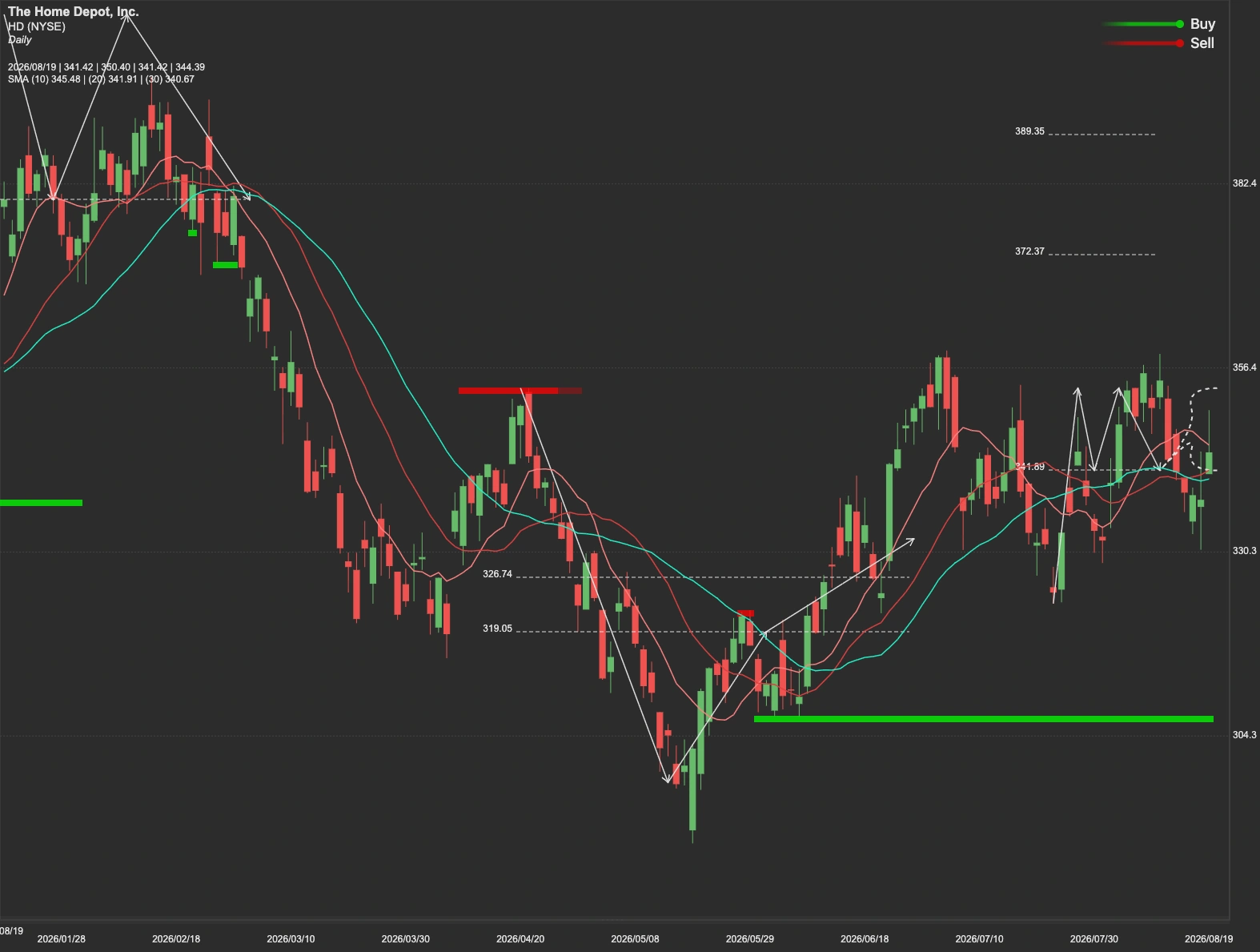
Technical Outlook: Key Levels to Watch
The Resistance Breakout ($371): The immediate hurdle for HD stock is the resistance level at $371. If bulls can push the price above this threshold and sustain it, it will signal strong buying momentum.
The Bullish Target ($395): A confirmed breakout above $371 opens the door for a rally toward the next major upside goal of $395.
The Downside Supports ($314 & $289): If the stock fails to clear the $371 resistance and faces rejection, it may pivot downward to seek support. The first critical safety net is resting at $314. Should selling pressure intensify and that level fail to hold, further downside support awaits at $289.