
IBM's Fundamental Strength Meets Market Skepticism: A Post-Q1 2026 Analysis
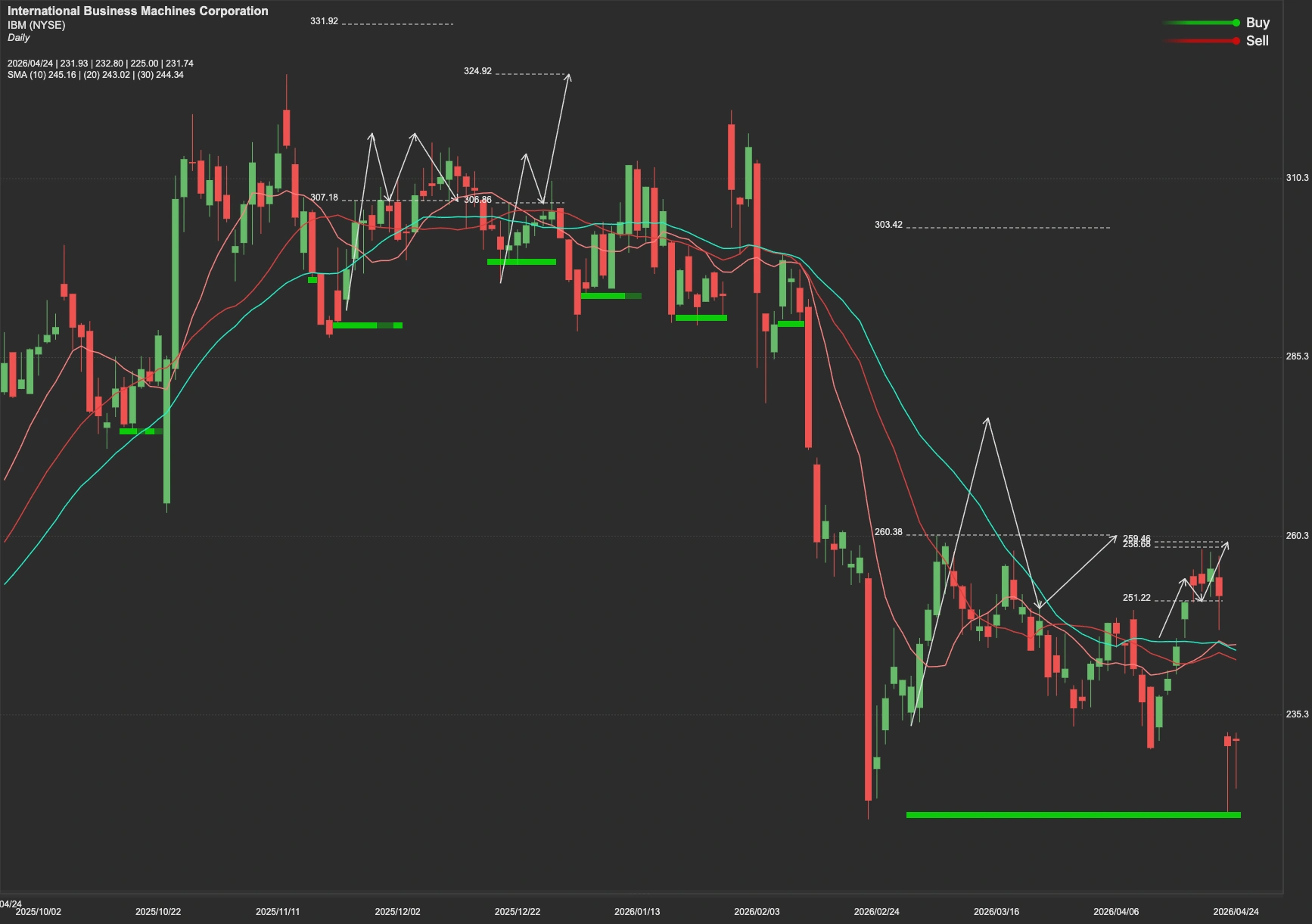
Despite reporting robust double-digit growth in its Software and Infrastructure segments, IBM (NYSE: IBM) saw its shares slide 8% following the release of its first-quarter 2026 financial results. The divergence between the company's solid operational performance and the immediate market sell-off has left investors questioning the stock's next technical move.
Strong Fundamentals Amidst AI Tailwinds
The company delivered a broadly positive quarter. Revenue rose 9% year-over-year to $15.9 billion, supported by double-digit growth in both Software and Infrastructure. Software—IBM’s highest-margin segment—grew 11%, driven by continued demand across hybrid cloud, automation, and data platforms. Infrastructure surged 15%, benefiting from strength in IBM Z systems, while Consulting posted modest 4% growth; Financing reported a 15% increase.
The profitability metrics were equally impressive. Gross profit rose to $8.95 billion, with margins expanding by 100 basis points to 56.2%. Software gross margin was 82.8%, down 80 basis points compared to 83.6% in Q1 2025. Consulting gross margin was 27.5%, up 20 basis points compared to 27.3%. Infrastructure gross margin was 56.9%, up 410 basis points compared to 52.8%. Financing gross margin was 43.4%, down 240 basis points compared to 45.8%.
Pre-tax income from continuing operations expanded to $1.39 billion, with pre-tax income margin of 8.7%, up 80 basis points compared to 8.0% a year earlier. Adjusted EBITDA climbed to $4.0 billion, lifting the adjusted EBITDA margin to 25.0%. Net income from continuing operations rose 15%, and diluted EPS increased 14% to $1.28.
Cash Flow and Balance Sheet
In the first quarter, the company generated net cash from operating activities of $5.2 billion, up $0.8 billion year to year. IBM’s free cash flow was $2.2 billion, up $0.3 billion year to year. The company returned $1.6 billion to shareholders in dividends in the first quarter and invested in the acquisition of Confluent. The company also declared an increase in the quarterly cash dividend to $1.69 per share, payable June 10, 2026 to stockholders of record as of May 8, 2026. maintaining its 31-year streak of dividend increases.
IBM ended the first quarter with $11.8 billion of cash, restricted cash and marketable securities, down $2.6 billion from year-end 2025. Debt, including IBM Financing debt of $12.8 billion, totaled $66.4 billion, up $5.1 billion year to date.
AI Momentum and Confident Full-Year Outlook
Management commentary further underscored confidence in the company’s growth. CEO Arvind Krishna described the quarter as “a strong start to the year with broad-based revenue growth,” emphasizing that IBM’s integrated portfolio continues to deliver value as enterprises scale AI use cases. He highlighted AI as an ongoing tailwind, with IBM increasingly positioned to help clients orchestrate, deploy, and govern AI across hybrid environments. Reflecting this momentum, the company reaffirmed its outlook for more than 5% constant currency revenue growth in 2026 and approximately $1 billion in year-over-year free cash flow expansion.
Technical Analysis
This is not the first time IBM's stock price has experienced such a large decline recently. Back in February, shares dropped over 13% in a single day after Anthropic said that its Claude Code tools could automate complex COBOL modernization work—a core area of IBM’s legacy strength.
From a technical analysis perspective, the stock is now at a critical juncture. The key resistance level sits at $278. A sustained move above this level would likely re-establish bullish momentum, opening a pathway toward the next upside target at $314.
However, failure to reclaim and hold above $278 increases the probability of further downside. Initial support is identified at $220-$198, a level that could attract buyers if sentiment stabilizes. Should that level fail to hold, the stock may seek a deeper floor in the $177 to $160 range.