
Intel Stock Analysis: AI Demand Fuels Strong Q2 Growth
Intel Corporation (NASDAQ: INTC) delivered a stronger-than-expected second quarter for 2026, reporting its fastest revenue growth in more than 15 years as accelerating AI infrastructure spending continued to drive demand across its CPU franchise, advanced packaging technology and vast wafer foundry network. The company also issued an optimistic third-quarter outlook while highlighting ongoing supply constraints and increased investment to expand manufacturing capacity.
Q2 2026 Financial Performance
Intel generated second-quarter revenue of $16.1 billion, an increase of 25% year over year, exceeding management's guidance by approximately $1.8 billion at the midpoint.
While Intel reported a GAAP loss of $11.0 billion, or $(2.16) per diluted share, the loss was primarily driven by significant non-operating items. Core operations showed meaningful improvement, supported by better factory yields, higher average selling prices, and disciplined expense management. Non-GAAP gross margin expanded to 41.8%, a 12.1 ppts improvement from the 29.7% posted in the year-ago quarter. Non-GAAP EPS reached $0.42, more than double the $0.20 the company had guided.
CEO Lip-Bu Tan said, "Strong demand for our products continues to outpace our growing supply, our design and manufacturing execution is improving, and the operating discipline we put in place fifteen months ago is beginning to show tangible results."
In the second quarter, Intel generated $7.0 billion in cash from operations. The company ended the quarter with approximately $30 billion of cash and short-term investments and $50.5 billion of total debt.
AI Businesses Continue to Drive Growth
The Data Center and AI (DCAI) segment generated $6.3 billion in revenue, rising 59% year over year and 24% sequentially, driven by strong demand across hyperscale and enterprise. Operating profit for DCAI reached $2.5 billion, representing a 40% operating margin and a roughly $1 billion sequential improvement. Xeon 6 continues to be one of the fastest-ramping products in Intel's history, while Intel also reported strong momentum in its purpose-built silicon product line — saw revenue nearly triple year over year.
On the client side, the Client Computing and Physical AI Group (CCPG) generated $8.9 billion in revenue, up 13% year over year and 15% sequentially. AI PC revenue grew 26% sequentially and now represents two-thirds of client revenue mix. Edge AI deployments, a newer growth vector, now account for roughly 10% of CCPG revenue, with 130 Series 3 design wins for edge AI applications including brain and control deployments for robotics.
Intel Foundry Shows Meaningful Progress
Intel Foundry reported revenue of $5.8 billion, up 31% year over year and 6% sequentially. External Foundry revenue was $293 million in the quarter. The operating loss narrowed to $2.1 billion, a $348 million sequential improvement driven by higher yields, improved cycle times, and increasing factory scale across Intel 4/3 and 18A.
The 18A narrative has shifted materially. Output was approximately 25% above target and up more than 50% quarter over quarter. The cost of Intel's primary Panther Lake SKU has been reduced by roughly 50% year to date, with an additional 20% reduction expected by year-end and further meaningful cuts planned for 2027. Intel Foundry also entered risk production for 18A-P and met critical milestones towards delivering the 0.9 PDK for Intel 14A in October. The company stepped up investments in Q2 for Intel 14A to prepare for risk production in 2027 and committed high volume ramps in 2028.
The advanced packaging story is equally compelling: customer interest in EMIB-T remains very high, the backlog is growing, and yield and reliability are hitting targets.
Business Outlook and Capital Spending
For the third quarter of 2026, Intel expects:
- Revenue between $15.8 billion and $16.8 billion
- GAAP Diluted EPS of $0.31
- Non-GAAP Diluted EPS of $0.38
- Non-GAAP gross margin of 42%
Management noted that the near-term linearity of supply growth is skewed toward the end of Q3 and into Q4, particularly for servers. PC consumption is expected to be sub-seasonal in the second half of the year and down low double digits percent for all of 2026, impacted by rising memory prices and constraints. Server CPU demand outlook, however, has improved again, with management forecasting strong double-digit unit growth for the industry in both 2026 and 2027, with momentum extending into 2028.
Intel raised its 2026 capex outlook to more than $20 billion, up significantly from earlier expectations, and signaled that 2027 capex will be "significantly above" 2026 levels.
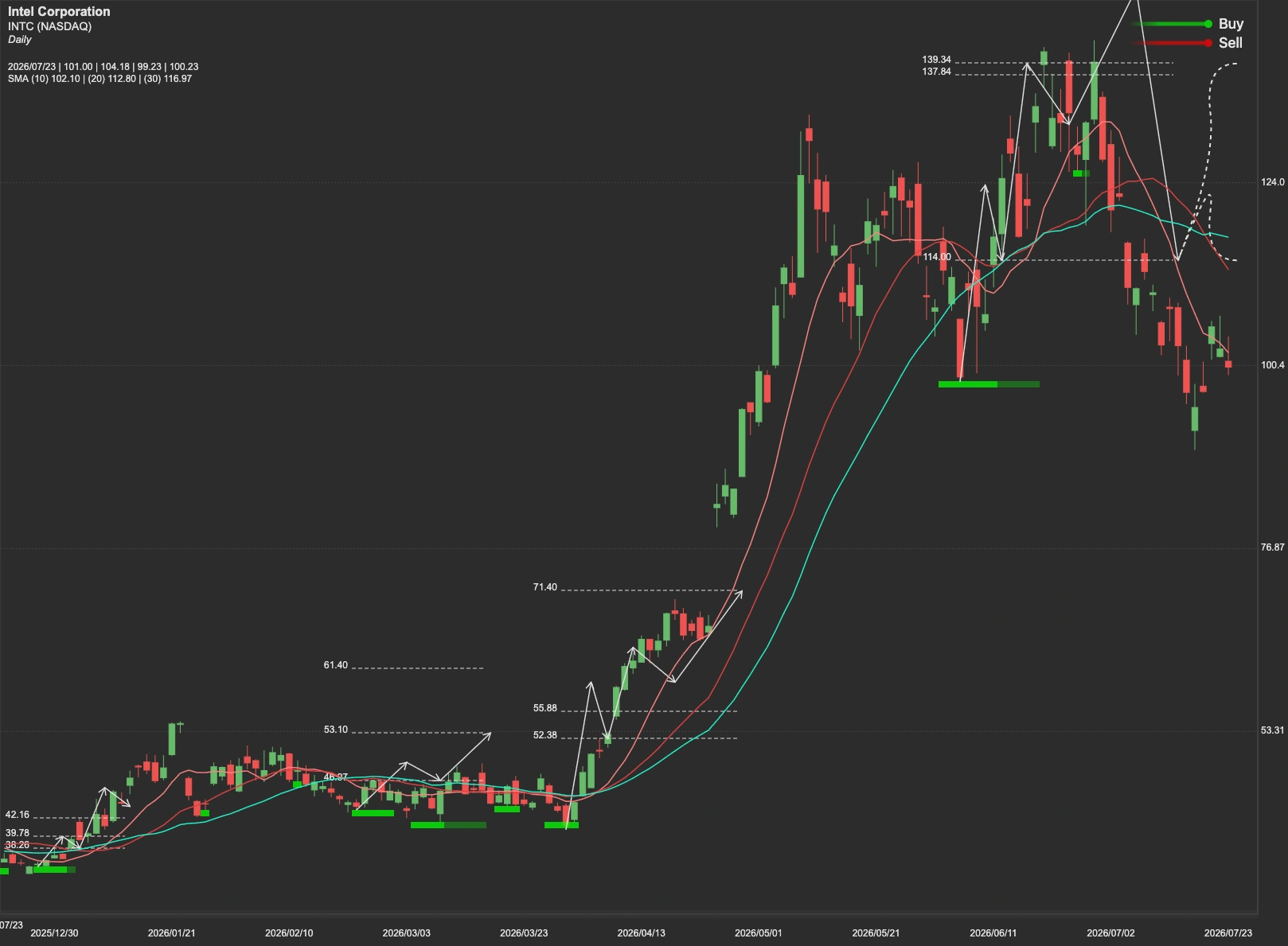
INTC Stock Technical Analysis
From a technical perspective, INTC stock is currently confronting crucial overhead resistance at $127. A decisive breakout and sustained move above this level would signal continued bullish momentum and could open the door toward the next major upside target near $153.
However, failure to overcome $127 may trigger a period of consolidation or profit-taking. In that scenario, the first important support lies near $87. If selling pressure intensifies, the next significant support sits near $75.