
Intel Stock Tumbles After Q4 2025 Earnings as Margins Strain and Near-Term Outlook Weakens
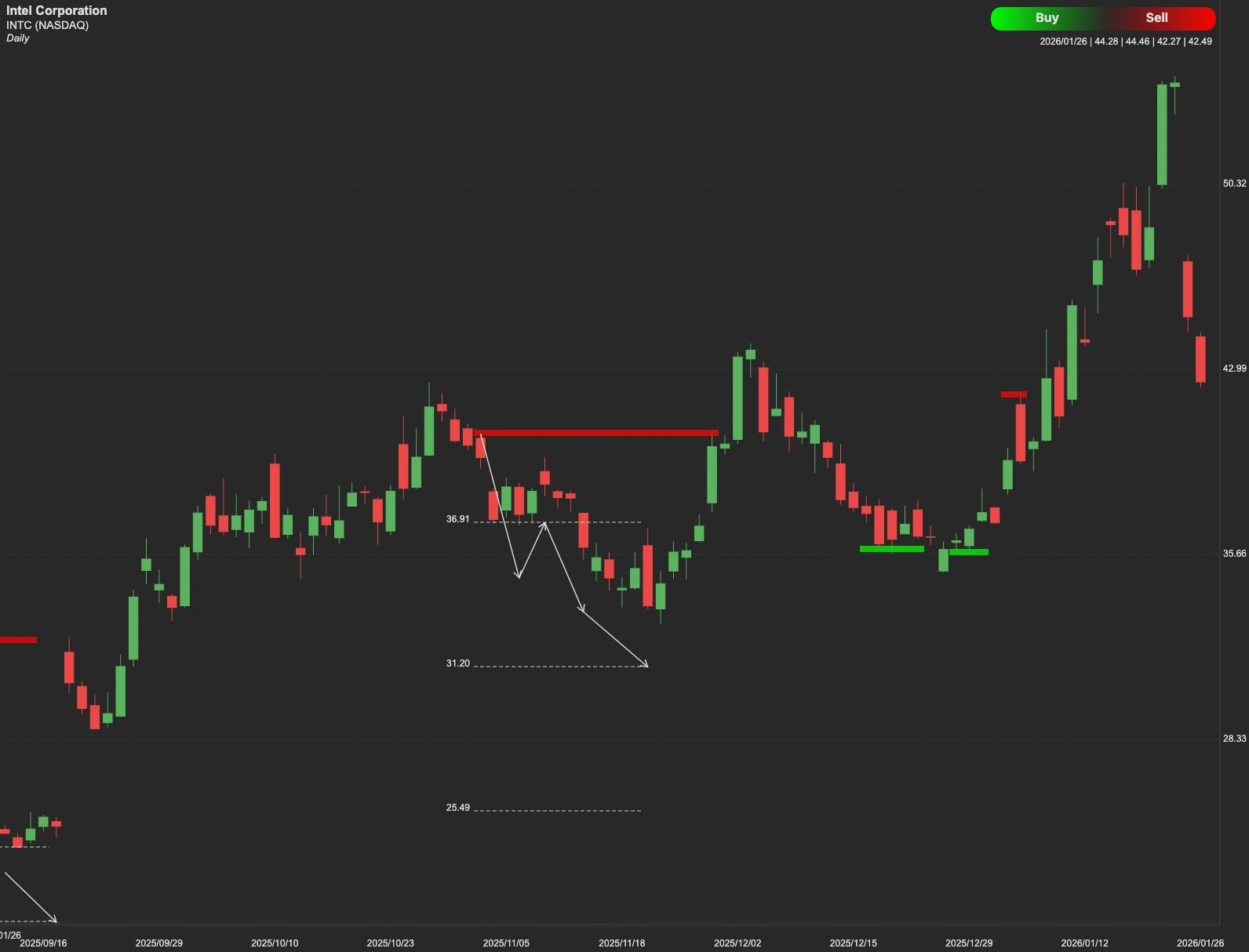
Intel (NASDAQ: INTC) shares plunged 22% after the company released its fourth-quarter and full-year 2025 financial results, as investors reacted to declining revenue, compressed margins, and a cautious outlook for early 2026 despite continued progress in artificial intelligence and advanced manufacturing.
Performance Overview
The semiconductor giant reported fourth-quarter revenue of $13.7 billion, representing a 4% year-over-year decline, while full-year revenue totaled $52.9 billion, essentially flat compared with 2024. The lack of top-line growth highlighted the ongoing struggle to reaccelerate Intel’s core markets as the company undergoes a multiyear transformation.
Profitability, however, remained under pressure. Intel’s fourth-quarter GAAP gross margin declined to 36.1% from 39.2% a year earlier, while non-GAAP gross margin slipped to 37.9% from 42.1%. Higher manufacturing costs weighed on near-term margins. For the full year, gross margin improved modestly as restructuring and cost reductions took hold; GAAP gross margin increased to 34.8% from 32.7% a year earlier, while non-GAAP gross margin grew to 36.7% from 36.0%.
Intel posted a GAAP net loss attributable to shareholders of $591 million in the fourth quarter, equal to a loss of $0.12 per share. For the full year, the company reported a small GAAP loss of $0.06 per share. On a non-GAAP basis, Intel remained profitable, generating $0.15 in earnings per share in the quarter and $0.42 for the full year.
Data Center and AI Show Resilient Growth Despite Client Computing Weakness
Weakness in Intel’s Client Computing Group remained a major drag on performance. Revenue from the PC-focused business fell 7% year over year in the fourth quarter to $8.2 billion, while full-year revenue declined 3% to $32.2 billion. Intel has launched its new Core™ Ultra Series 3 processor family, the company's first AI PC platform built on the Intel 18A process technology. Intel Core Ultra Series 3 is expected to be the most broadly adopted and globally available AI PC platform Intel has ever delivered.
Offsetting some of that softness was modest strength in the Data Center and AI segment. Revenue rose 9% year over year in the fourth quarter to $4.7 billion and increased 5% for the full year to $16.9 billion. Management reiterated that "demand fundamentals across core markets remain healthy as the rapid adoption of AI reinforces the importance of the x86 ecosystem as the world’s most widely deployed high-performance compute architecture." Intel Foundry also delivered a modest increase, with $4.5 billion of Q4 revenue, up 4% year over year, and $17.8 billion in revenue for the full year.
Cash Flow and Liquidity Position Strengthen
One area of improvement was cash flow and balance sheet strength. In the fourth quarter, Intel generated $4.3 billion in cash from operations and $2.2 billion in adjusted free cash flow. The company generated $9.7 billion in operating cash flow during 2025. Government incentives, partner contributions, and the partial divestiture of Altera helped strengthen liquidity, providing financial flexibility as Intel continues its capital-intensive push to regain leadership in semiconductor manufacturing.
Cautious Q1 2026 Guidance Raises Investor Concerns
Despite those improvements, the company’s near-term outlook disappointed the market. CFO David Zinsner warned that internal supply shortages would reach their "lowest level" in Q1 2026 before improving in Q2 and beyond, leading to a forecast of $11.7 billion to $12.7 billion in revenue, implying a sequential decline, and projected a GAAP loss of $0.21 per share with break-even non-GAAP earnings. Management also expects gross margins to fall again in the coming quarter.
Technical Analysis
The sharp post-earnings sell-off has reset the technical landscape for INTC. Currently, $49 stands as the immediate ceiling. If the stock can regain its footing and consolidate above this mark, the next target for a recovery rally is $55.
If the $49 resistance proves too heavy and the supply shortages in the first quarter bite harder than expected, the stock is likely to seek support. The first major safety net sits at $36. Should that fail to hold, the "floor" drops to a much deeper support level at $26.