
Intuit Stock Slips Post-Q4 Earnings as Growth Guidance Decelerates
Intuit Inc. (Nasdaq: INTU) shares fell 3.4% following the company’s release of fourth-quarter and full-year fiscal 2026 results, as investors focused on a more moderate growth outlook for fiscal 2027 despite another year of double-digit revenue and earnings growth.
Intuit Delivers Strong Fiscal 2026 Results
For the fourth quarter ended July 31, 2026, Intuit generated $4.4 billion in revenue, representing a 14% increase from the prior year. GAAP operating income rose to $475 million from $339 million, while non-GAAP operating income increased 43% to $1.4 billion.
Net income was $363 million, compared with $381 million a year earlier, while GAAP diluted earnings per share came in at $1.34 versus $1.35 last year. On a non-GAAP basis, diluted EPS increased 47% to $4.03.
For the full fiscal year, revenue increased 14% to $21.4 billion, allowing Intuit to surpass the $20 billion annual revenue milestone. GAAP operating income rose 20% to $5.9 billion, while non-GAAP operating income increased 18% to $8.9 billion. GAAP EPS climbed 20% to $16.46, and non-GAAP EPS increased 20% to $24.27.
Intuit repurchased $2.1 billion of stock in the fourth quarter alone and $5.5 billion for the full year — up 96% versus the prior year — enough to shrink weighted-average diluted shares by 2%. The company still has $7.9 billion remaining under its share repurchase authorization. Its board also approved a quarterly dividend of $1.38 per share, representing a 15% increase from the previous year.
Intuit ended fiscal 2026 with $7.2 billion in cash and investments and $7.7 billion in total debt. The company issued $1.75 billion of senior notes in June, strengthening liquidity ahead of debt maturities in fiscal 2027.
Intuit is increasingly positioning itself as an AI-driven expert platform. Management said its "Big Bets — Assisted Tax, Money, and Mid-Market" collectively grew 34% in fiscal 2026 and accounted for 30% of full-year revenue. The company aims to use AI and automation to create what it describes as a financial system of intelligence capable of doing more of the work for consumers, businesses, and accountants.
QuickBooks and Online Ecosystem Remain Key Growth Engines
Global Business Solutions revenue increased 14% to $3.4 billion during the fourth quarter. Excluding Mailchimp, growth was stronger at 15%.
Online Ecosystem revenue rose 17% to $2.6 billion, or 20% excluding Mailchimp. QuickBooks Online Accounting revenue increased 20%, supported by higher effective prices, customer growth, and mix shift. Online Services revenue increased 15%, driven by growth in money and payroll services. Excluding Mailchimp, Online Services growth accelerated to 21%. Total international online revenue increased 10% on a constant currency basis.
Mailchimp was a notable exception. Fourth-quarter revenue declined slightly year over year.
Credit Karma Leads Consumer Growth
Intuit’s Consumer segment generated $930 million in fourth-quarter revenue, up 14% year over year.
Credit Karma remained the strongest contributor, with revenue increasing 16% to $743 million. Growth was supported by personal loans, auto insurance, and credit cards.
TurboTax revenue increased 3% to $153 million, while ProTax revenue rose 6% to $34 million.
Although Credit Karma delivered solid fiscal 2026 growth, Intuit expects the business to expand at a slower rate in fiscal 2027, reflecting "a prudent stance" on further share gains after strong FY26.
Fiscal 2027 Guidance Points to Slower Revenue Growth
Intuit expects fiscal 2027 revenue of $23.279 billion to $23.512 billion, representing growth of 9% to 10%, compared with 14% growth in fiscal 2026. Management explicitly acknowledged that revenue growth will decelerate as the company makes deliberate investments to accelerate customer growth, increase market share, and strengthen the durability of its long-term growth model. The deceleration from the prior year is primarily driven by Desktop Ecosystem, TurboTax, and Credit Karma.
Global Business Solutions Segment: Projected growth of 13% to 14%. Online Accounting and Online Services remain primary growth driven by ARPC expansion due to higher effective prices and increased adoption of services — with increased investment in "new-to-the-franchise customers." Desktop Ecosystem revenue is expected to decline in the low single digits as customers migrate to online offerings including QBO Advanced.
Consumer Segment: Projected growth of 4% to 6%. TurboTax revenue is expected to grow 2% to 3%, impacted by lower tax ARPC as the company works to improve its price-to-value equation in DIY offerings and increase Intuit's share of IRS e-filers. Credit Karma revenue is forecasted to grow 11% to 13%. ProTax growth is set at approximately 2%.
Mailchimp: flat to down 1%, with higher effective prices "expected to offset the increased churn." Mailchimp is separated from Global Business Solutions to run as an independent operating segment beginning in fiscal 2027.
Margin expansion is expected to come from "savings from the workforce changes announced last quarter" plus efficiency gains, partly offset by higher spend on sales, marketing, and product innovation. GAAP diluted EPS is guided to $20.12–$20.36 (up 22% to 24%); non-GAAP diluted EPS to $22.88–$23.12.
Longer term, Intuit expects Global Business Solutions Segment revenue to grow at a CAGR of 10% to 15%, and Consumer Segment to grow at a CAGR of 4% to 8% over the next three years.
INTU Stock Technical Analysis
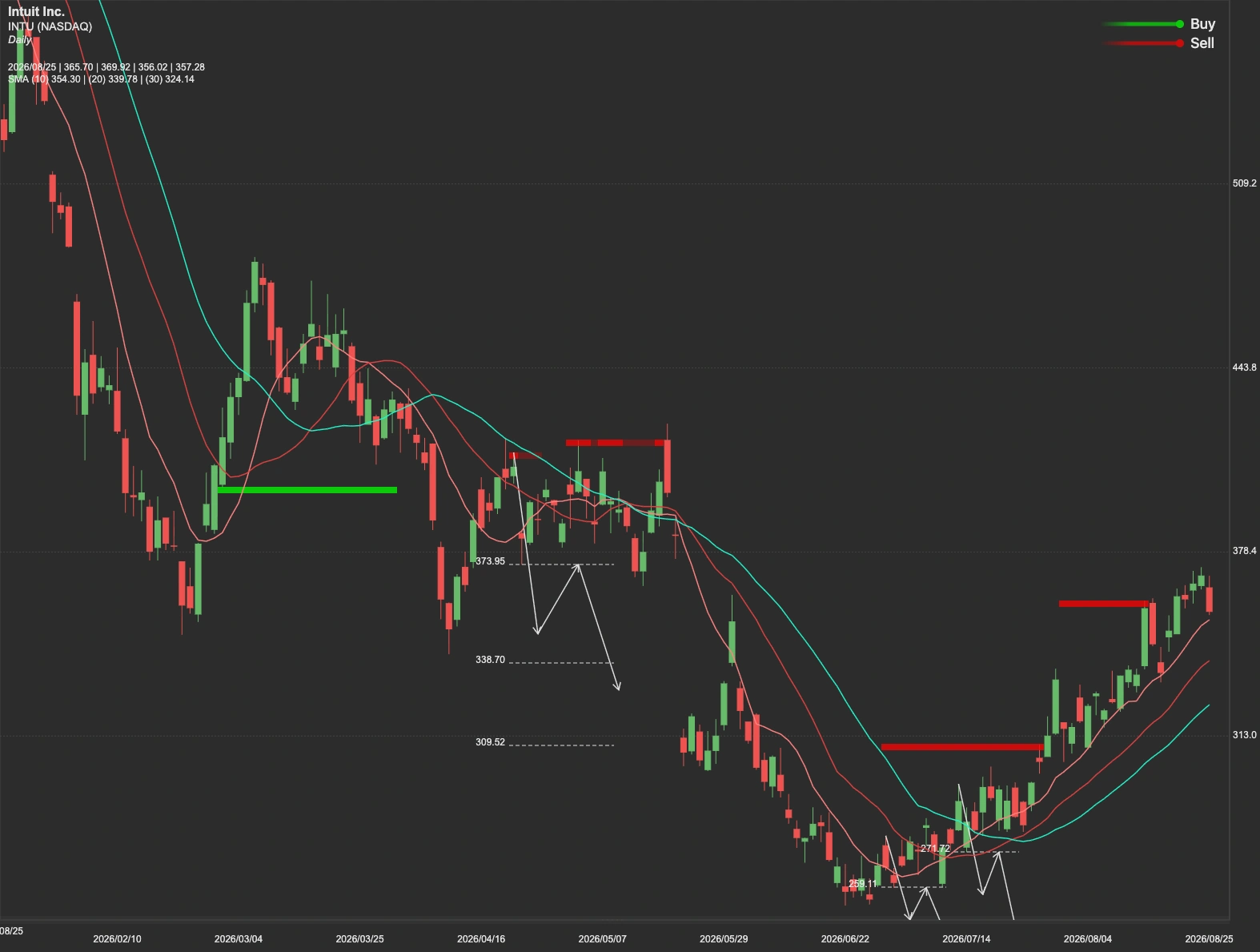
From a technical perspective, the post-earnings decline has brought the stock to an important decision point. In the short term, $383 is the key resistance level. If INTU can reclaim and hold above $383, the next major resistance is around $428. A sustained move above that level would improve the short-term technical picture.
For the medium term, $492 represents the key resistance level. Over the long term, $569 remains the major resistance level.