
Jabil Stock Analysis: AI Tailwind Drives Blowout Q3 Results
Jabil Inc. (NYSE: JBL) recently delivered an impressive set of fiscal third-quarter 2026 results, with strong demand for artificial intelligence infrastructure helping drive double-digit revenue growth, expanding profitability, and a higher full-year outlook.
The Fundamentals: AI Infrastructure Fuels Growth
For the third quarter of fiscal 2026, Jabil reported revenue of $8.8 billion, up 12% from $7.8 billion a year ago. Gross profit increased to $828 million from $681 million, while gross margin expanded to 9.46% from 8.70%.
GAAP operating income rose to $445 million, compared with $403 million in the prior-year period. Operating margin was 5.09%, roughly in line with last year's 5.15%. Net income climbed to $275 million, resulting in GAAP diluted earnings per share of $2.59, up from $2.03 a year earlier.
On an adjusted basis, the company continued to outperform. Core operating income increased to $504 million from $420 million, producing a core operating margin of 5.8%. Core earnings reached $336 million, while core diluted EPS jumped to $3.16, representing nearly a 24% increase from $2.55 in the same quarter last year.
Chief Executive Officer Mike Dastoor attributed the strong performance primarily to accelerating AI infrastructure demand, noting that the company's AI-related revenue outlook for fiscal 2026 has been raised meaningfully. He also highlighted improving conditions across several previously weaker end markets, particularly Automotive and Connected Living, demonstrating the benefits of Jabil's diversified manufacturing portfolio.
Segment performance reflected broad-based strength across the business. Intelligent Infrastructure remained the primary growth engine, with revenue increasing 21% year over year and delivering a 6.1% core operating margin. Regulated Industries posted 4% revenue growth with a 5.6% core margin, while Connected Living & Digital Commerce also reported positive growth with revenue increasing 5% and delivering a 4.9% core margin.
Cash Flow and Balance Sheet
Cash generation remained another major highlight. Operating cash flow reached $535 million during the quarter. After capital expenditures of $176 million, adjusted free cash flow totaled $359 million. Core EBITDA came in at $654 million, while Jabil continued its shareholder-friendly capital allocation, executing $291 million in share repurchases.
Jabil finished the quarter with a healthy balance sheet, holding $1.36 billion in cash and cash equivalents against $3.38 billion of total debt.
Raised FY2026 Outlook
Management also raised its outlook for the remainder of fiscal 2026. For the fourth quarter, Jabil expects revenue between $9.2 billion and $10.0 billion, GAAP operating income of $526 million to $586 million, and GAAP diluted EPS of $3.24 to $3.64. On a non-GAAP basis, the company forecasts core operating income of $589 million to $649 million and core diluted EPS between $3.80 and $4.20. Net interest expense is expected to be $80 million.
For the full fiscal year, management now expects $35 billion in revenue, a 5.8% core operating margin, $12.70 in core diluted EPS, and more than $1.4 billion in adjusted free cash flow.
JBL Stock Technical Analysis
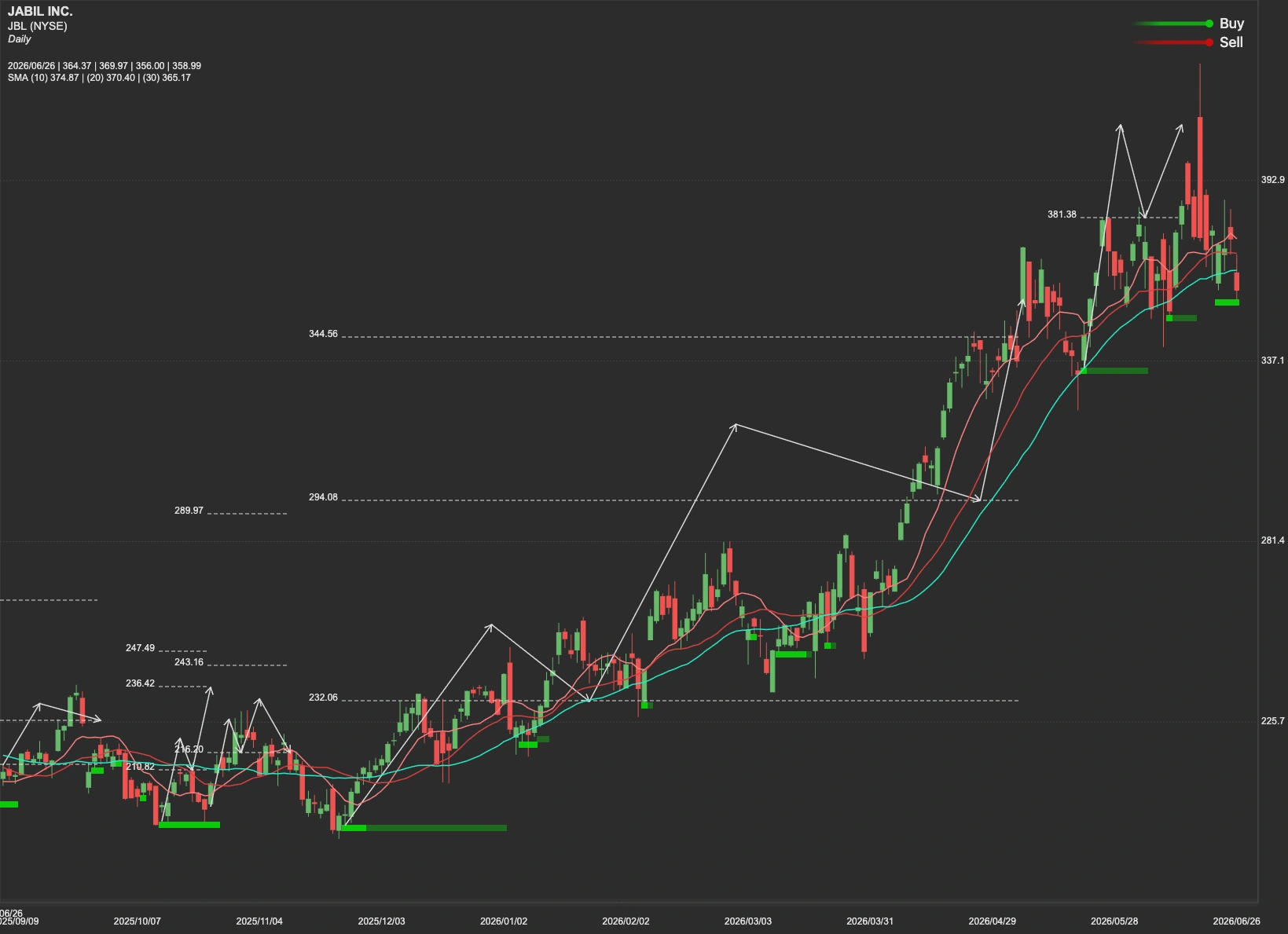
Following the earnings-driven rally, JBL stock continues to trade within a strong long-term uptrend, with investors closely watching several important technical levels.
The first major resistance sits at $374. A decisive breakout and sustained move above this level would strengthen bullish momentum and open the door toward the next resistance around $395. Should buyers successfully push the stock above $395, the next upside target would be approximately $428.
However, failure to maintain bullish momentum could trigger a pullback toward the initial support level near $316. If selling pressure intensifies, investors should monitor the broader support zone between $306 and $277.