
Johnson & Johnson Stock Analysis: Strong Q2 Earnings and Raised Guidance
Johnson & Johnson (NYSE: JNJ) delivered an impressive operational performance in the second quarter of 2026, driven by robust portfolio demand and disciplined execution across its core business units. The company reported second-quarter 2026 revenue above $25 billion, raised its full-year financial guidance, and remains on track to surpass $100 billion in annual revenue for the first time in its 140-year history.
Strong Quarter Driven by Innovation
Johnson & Johnson reported second-quarter 2026 revenue of $25.3 billion, up 6.6% year over year, while operational sales increased 5.6%. Gross profit climbed 7.1% to $17.3 billion, with gross margin improving slightly to 68.2%.
On an adjusted basis, earnings continued to trend higher. Adjusted net earnings increased 5.7% to $7.1 billion, while adjusted diluted EPS rose 4.7% to $2.90. Adjusted income before tax margin was 34.2%, down from 34.5% a year ago. Although GAAP net earnings were essentially flat at $5.5 billion, the difference largely reflected higher litigation expenses, restructuring costs, and other one-time items.
Perhaps most impressively, year-to-date free cash flow surged to approximately $8.7 billion, a trajectory that puts the company on track for its full-year free cash flow target approaching $21 billion.
The balance sheet remained robust. Cash and marketable securities stood at $20.8 billion against $49.0 billion in debt, yielding a net debt position of approximately $28.2 billion. The company continued returning capital to shareholders, paying $3.3 billion in dividends while investing $3.7 billion into research and development during the quarter.
Innovative Medicine Continues to Lead
The Innovative Medicine segment was the standout performer, posting operational sales growth of 6.8% and generating $16.4 billion in revenue. The growth was broad-based, anchored by oncology powerhouses DARZALEX, CARVYKTI, TECVAYLI, and RYBREVANT/LAZCLUZE. TREMFYA and the broader Immunology portfolio contributed meaningfully, while neuroscience—led by SPRAVATO and CAPLYTA—added another growth pillar. These gains successfully offset revenue drag from biosimilar competition on STELARA (~760 bps impact) and REMICADE.
The segment's adjusted income before tax margin came in at 42.5%, a slight compression from 42.7% a year ago, largely attributable to unfavorable product mix and heavier investments supporting new product launches.
MedTech Faces Temporary Headwinds
MedTech delivered operational sales growth of 3.6%, with revenue reaching $8.9 billion. Growth was driven by wound closure and biosurgery in Surgery, electrophysiology and Shockwave in Cardiovascular, contact lenses in Vision, and trauma in Orthopaedics. The segment's adjusted income before tax margin was 22.0%, down from 22.2%—a modest decline reflecting increased commercial investments, higher R&D spending (up 12.5% year over year), and the impact of tariffs.
CFO Joseph Wolk acknowledged that Cardiovascular—specifically heart recovery—fell short of internal standards during the quarter. However, he emphasized confidence in the long-term outlook, pointing to multiple upcoming product launches including the OTTAVA robotic surgical system, VARIPULSE Pro, new Shockwave platforms, and continued expansion across electrophysiology and vision care.
J&J Raises Full-Year 2026 Guidance
J&J now expects operational sales growth of 6.5% to 7.1%, with a midpoint of $100.6 billion—an increase of $400 million from the prior outlook. Reported sales are projected at $100.8 billion to $101.4 billion, reflecting an estimated negative currency impact of $100 million based on current exchange rates.
Adjusted operational EPS was raised to $11.50–$11.65, with a midpoint of $11.58—representing 7.3% year-over-year growth. On a reported basis, adjusted EPS guidance is $11.60–$11.75, with a midpoint of $11.68 or 8.2% year-over-year growth. The company also lifted its adjusted pretax operating margin improvement target to approximately 75 basis points, up from the original guidance of more than 50 basis points, driven by operating efficiencies and the expected recoupment of certain tariff-related costs.
JNJ continues to invest heavily in platform expansions—including the planned acquisition of FireflyBio and a $1+ billion expansion in U.S. vision manufacturing capabilities.
JNJ Stock Technical Analysis
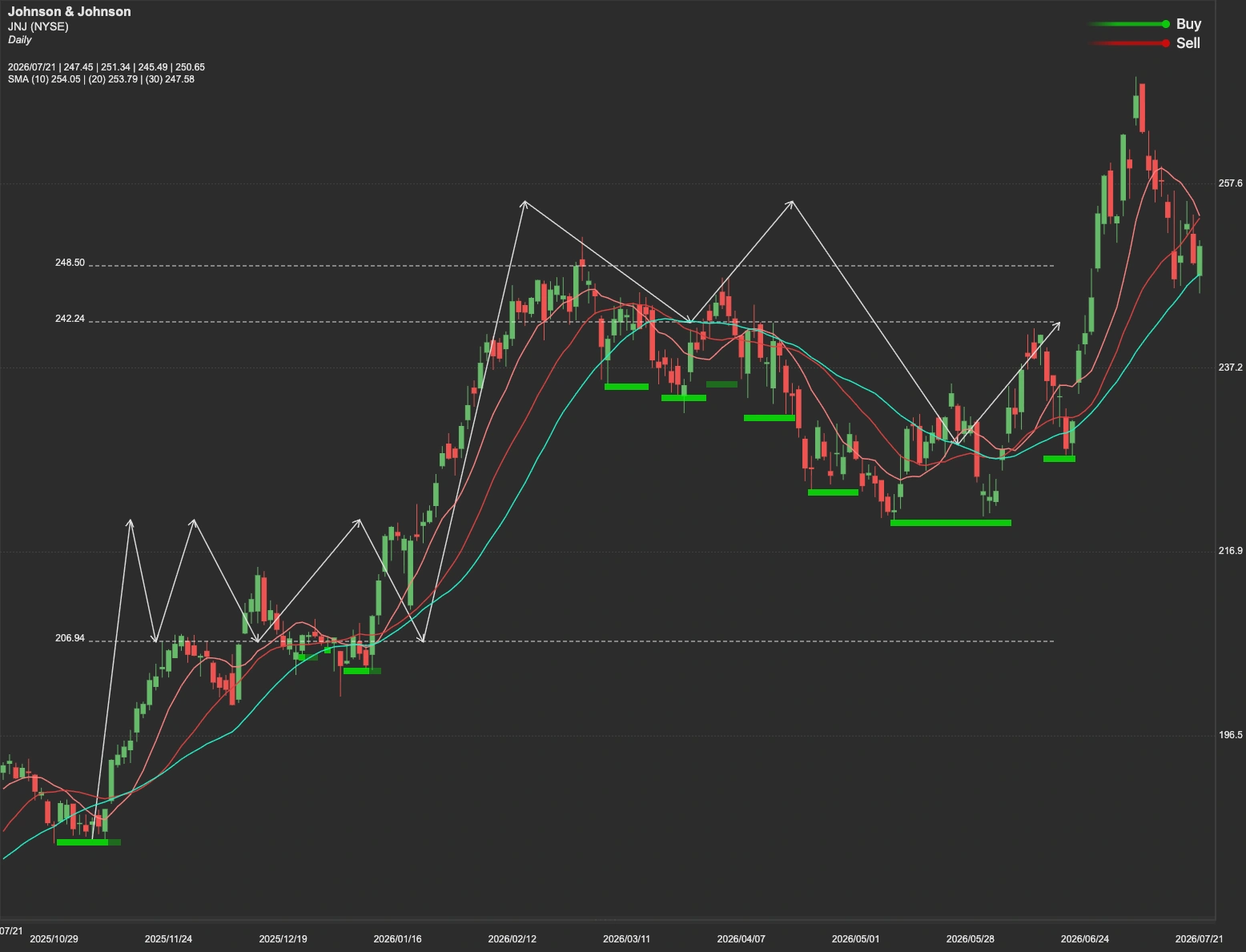
From a technical perspective, the primary resistance level sits near $268 for JNJ stock. A decisive breakout and sustained move above $268 would strengthen the bullish outlook and could open the door toward the next upside target around $286.
However, if buyers fail to push the stock above resistance, JNJ could enter another consolidation phase. The first major downside support is located around $234. If selling pressure increases and this level fails to hold, the next significant support zone lies between $214 and $203.