
Kroger Q1 2026 Earnings Analysis: Digital Growth and Margin Pressure
The Kroger Co. (NYSE: KR) delivered a solid first quarter for fiscal 2026, demonstrating continued resilience in a challenging consumer environment. While headline revenue, earnings, and digital grew, investors remain focused on margin trends, competitive pricing investments, and whether Kroger can sustain its momentum through the remainder of the year.
Revenue and Earnings Growth
Kroger reported first-quarter sales of $46.1 billion, up from $45.1 billion a year earlier. Excluding fuel and the divested Vitacost business, sales increased 0.5%, while identical sales excluding fuel rose 1.0%.
One of the most encouraging developments during the quarter was the continued momentum in Kroger's digital operations. Adjusted eCommerce sales surged 19%, led by under-one-hour delivery. Management noted that eCommerce, including its media business, reached profitability for the first time.
The company's alternative profit businesses also continued to perform well. Kroger Precision Marketing delivered profit growth of more than 20%, supported by strong on-site customer traffic and increased advertiser commitments.
Net earnings attributable to Kroger reached $903 million, compared with $866 million a year ago. Diluted earnings per share climbed to $1.46 from $1.29, reflecting both operational improvements and continued share repurchases.
Operating profit increased to $1.41 billion from $1.32 billion, while adjusted First-In First-Out (FIFO) operating profit reached $1.54 billion, up from $1.52 billion in the prior year.
Margin Pressures Remain a Key Watch Item
Gross margin declined modestly to 22.7% from 23.0% a year ago. Management attributed the pressure primarily to higher fuel sales, increased transportation costs, egg deflation, and planned price investments. However, favorable pharmacy mix, sourcing efficiencies, improved eCommerce profitability, and lower depreciation expenses partially offset those headwinds.
Cash Flow and Balance Sheet
Cash generation remained healthy. Kroger produced $1.77 billion in operating cash flow during the quarter and generated free cash flow of $324 million after capital expenditures. The company continues to invest aggressively in its business, with total capital investments reaching approximately $1.45 billion during the period.
The company expects to continue to pay its quarterly dividend and expects this to increase over time, subject to board approval. In December 2025, Kroger’s Board of Directors approved an additional $2 billion share repurchase authorization. Kroger expects to complete these repurchases by the end of fiscal 2026.
The company ended the quarter with $2.87 billion in cash and temporary cash investments and total debt of $16.99 billion. Net total debt stood at approximately $14.34 billion, while the net total debt-to-adjusted EBITDA ratio was 1.75.
Guidance Reaffirmed
Management reaffirmed its full-year 2026 guidance, projecting identical sales growth excluding fuel of 1.0% to 2.0%, FIFO operating profit between $5.0 billion and $5.2 billion, earnings per share of $5.10 to $5.30, free cash flow of $2.7 billion to $2.9 billion, and capital expenditures of $3.8 billion to $4.0 billion.
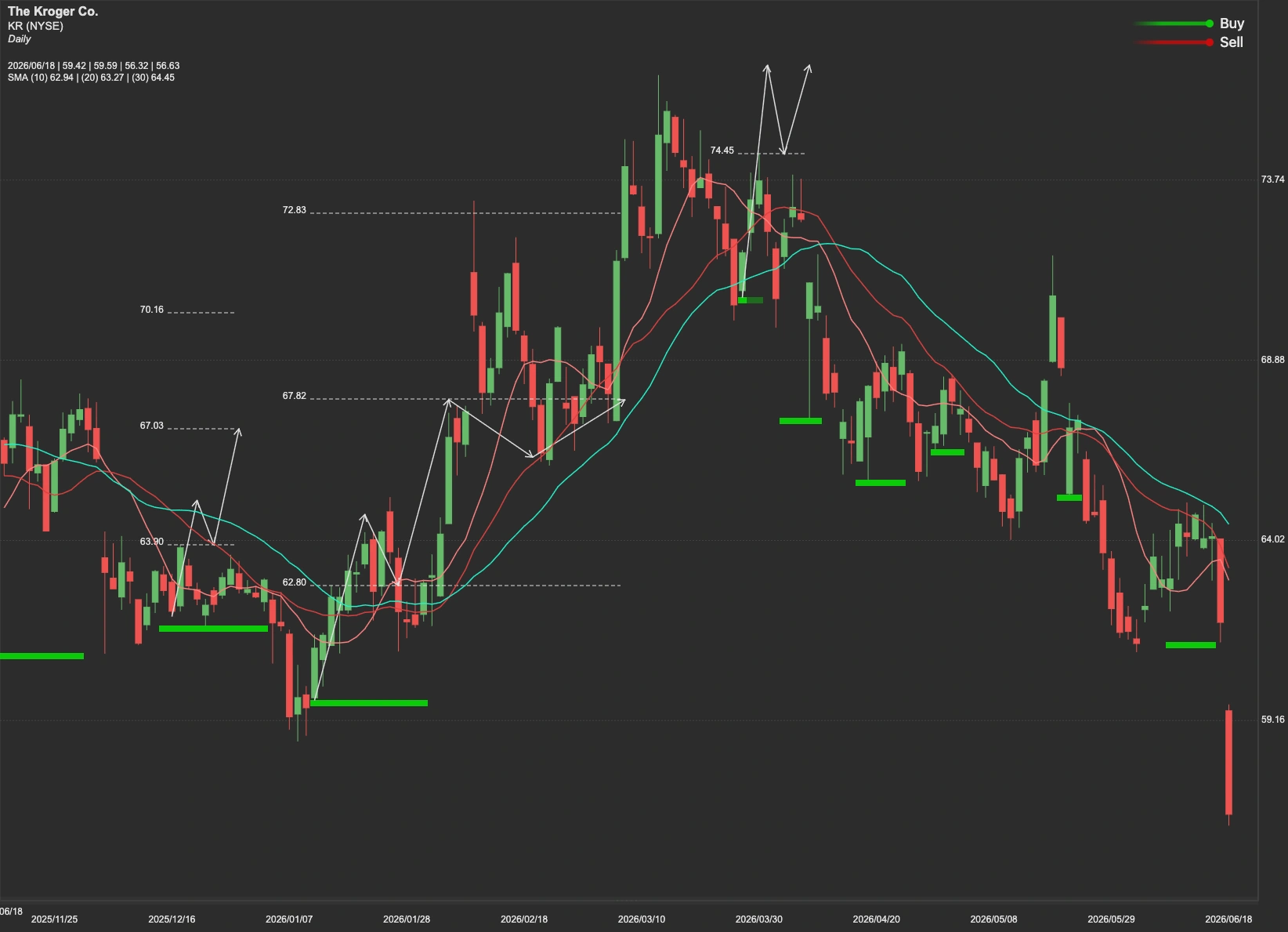
KR Stock Technical Analysis
From a technical perspective, the primary resistance level sits near $68 for KR stock. A decisive breakout and sustained hold above this level would signal renewed bullish momentum and could open the path toward the next major upside target around $78.
However, failure to break through resistance may trigger a period of consolidation or correction. In that scenario, investors should monitor the major support at $46. If market volatility intensifies and the first support fails, the further downside floor is solid at $43 to $36.