
Levi Strauss Delivers Strong Q1 as DTC Strategy Fuels Growth and Outlook Upgrade
Levi Strauss & Co. (NYSE: LEVI) delivered a strong start to fiscal 2026, reinforcing its confidence to raise full-year guidance as the company continues its transition toward a direct-to-consumer (DTC)-led business model. First-quarter results came in ahead of guidance, with broad-based growth across regions, channels, and product categories supporting both top-line expansion and improved profitability.
Q1 2026: Financial Highlights
Net revenues rose 14% year over year to $1.7 billion in Q1 2026, or 9% on an organic basis, reflecting solid momentum across the Americas, Europe, and Asia. Europe stood out with particularly strong reported growth of 24%, while Asia and the Americas posted gains of 13% and 9%, respectively. Importantly, the company’s strategic emphasis on DTC continues to gain traction, with DTC sales increasing 16% and accounting for 52% of total net revenues during the quarter. This milestone aligns with CEO Michelle Gass’s vision of transforming Levi’s into a DTC-first denim lifestyle brand, expanding beyond its traditional jeans business into a broader apparel offering.
However, despite strong top-line growth, margins showed some pressure. Gross profit was $1.08 billion during the quarter, up 13.8% year over year. Gross margin was 61.9%, slightly down compared to 62.1% in Q1 2025, primarily due to the impact of tariffs. Operating income increased to $198.7 million, though operating margin declined to 11.4% from 12.5% a year earlier, reflecting the impact of tariffs and planned increases in advertising. SG&A expenses rose significantly, driven by higher advertising spend and sales volume. Net income from continuing operations rose 26% to $177 million, and adjusted diluted EPS reached $0.42, compared to $0.38 in Q1 2025.
Cash Flow Strength and Balance Sheet Position
Cash flow generation improved materially, with operating cash flow rising to $211.5 million and adjusted free cash flow turning positive at $152.1 million. The balance sheet remains solid, supported by $717 million in cash and cash equivalents, and total liquidity of approximately $1.6 billion, providing flexibility for continued investment and shareholder returns. During the quarter, the company returned $214 million to shareholders through dividends and share repurchases, highlighting a commitment to capital returns. The company ended the quarter with total debt, including operating lease liabilities of $2.34 billion.
The Roadmap to 2026
Strategically, Levi Strauss has completed the divestiture of its Dockers® business in February 2026, sharpening its focus on its core Levi’s and Beyond Yoga® brands. The company also announced a leadership transition, with CFGO Harmit Singh planning to retire following a successor transition. LS&Co. has initiated a search for his successor.
Looking ahead, management raised its full-year 2026 guidance, now expecting reported net revenue growth of 5.5% to 6.5% and adjusted diluted EPS in the range of $1.42 to $1.48. The upgraded outlook reflects strong first-quarter performance and continued momentum in DTC and international markets, although management remains cautious of macroeconomic uncertainties, including tariffs and consumer spending pressures.
Technical Analysis
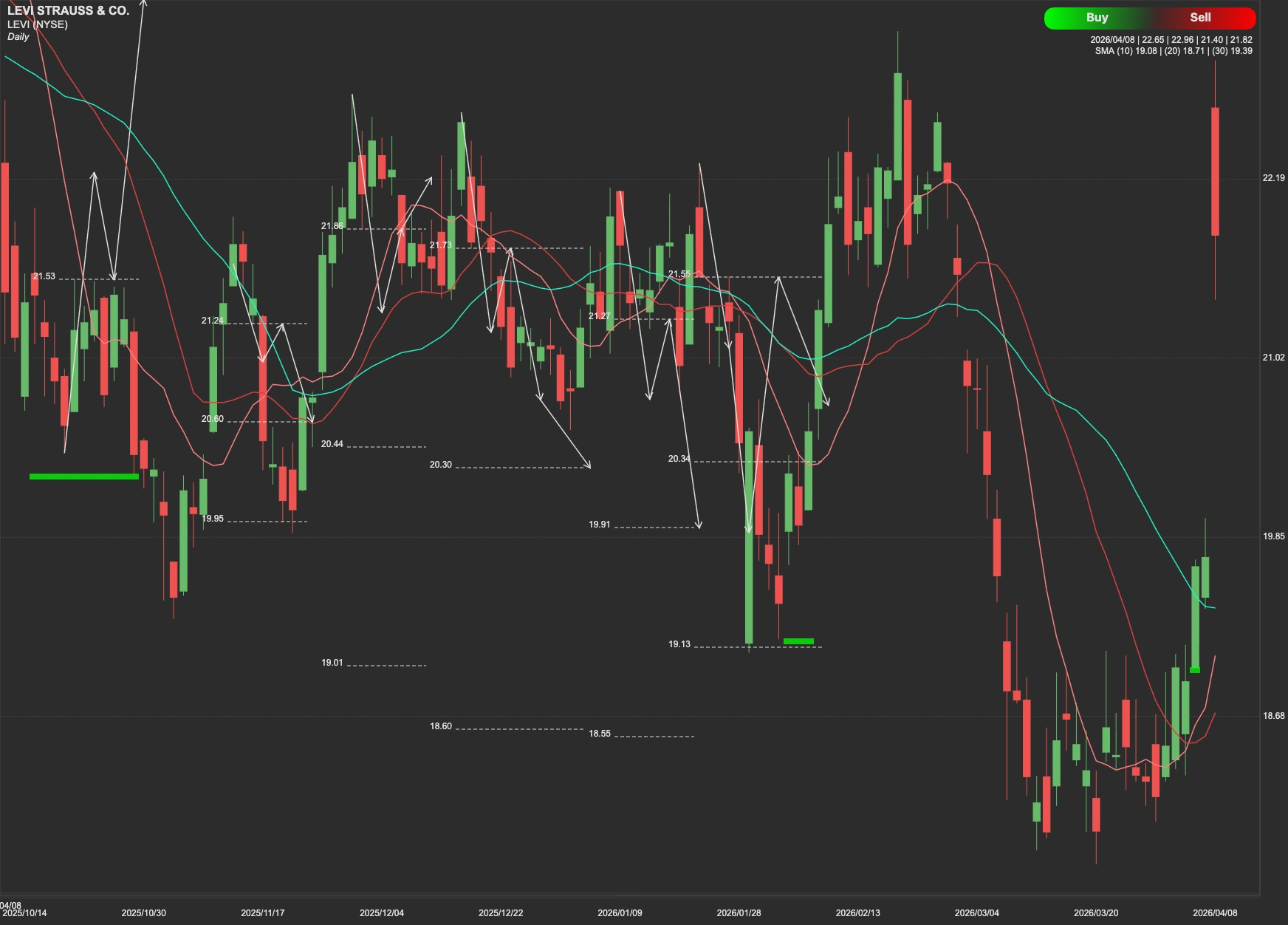
From a technical perspective, LEVI stock is currently testing a key resistance level of $26. A sustained breakout above this level could open the path toward the next target around $31, suggesting bullish continuation supported by improving fundamentals and DTC expansion. Conversely, failure to hold above resistance may lead to a pullback, with the stock potentially revisiting a broader support zone between $15 and $12.
Overall, Levi Strauss appears to be executing effectively on its transformation strategy, with strong DTC growth, improving cash flow, and disciplined capital allocation supporting its investment case. However, margin pressures and macroeconomic headwinds remain variables to watch as the company navigates the remainder of fiscal 2026.