
Levi Strauss Q2 2026 Earnings Analysis: Strong Execution Supports Growth Story as LEVI Raises 2026 Outlook
Levi Strauss & Co. (NYSE: LEVI) delivered another impressive quarter, reinforcing management's strategy of transforming the company into a direct-to-consumer (DTC)-first denim lifestyle brand. The second-quarter fiscal 2026 results exceeded expectations across revenue, profitability, and earnings, while management also raised full-year guidance and announced a higher dividend, reflecting growing confidence in the business.
Revenue Growth Across Markets
The apparel giant reported second-quarter net revenues of $1.6 billion, an increase of 8% year-over-year on a reported basis and 6% on an organic basis. Growth was broad-based across regions, channels and product categories, highlighting the strength of the Levi's brand despite a challenging global consumer environment.
The Americas remained the company's largest growth engine, with revenue increasing 9%, while the U.S. market delivered a solid 5% gain. Asia continued to outperform with 10% reported growth and 12% organic growth. Europe posted modest reported growth due to the impact of the company’s distribution center transition last year which resulted in a shift of shipments from Q1 2025 into Q2 2025.
Levi Strauss continues to benefit from its strategic shift toward higher-margin direct-to-consumer channels. DTC revenue rose 11% to $794 million and represented 51% of total company sales during the quarter. E-commerce revenue climbed an impressive 19%, while comparable DTC sales increased 6%, indicating healthy customer engagement both online and in physical stores.
Meanwhile, wholesale revenue also remained positive, increasing 5% to $768 million.
Margins Continue Expanding and Earnings Growth
Gross margin expanded 10 basis points to 62.7%, benefiting from lower product costs and pricing actions, even while tariffs and foreign exchange created headwinds during the quarter.
Operating income was $122 million, compared to $108 million last year. Operating margin improved from 7.5% to 7.8%, while adjusted EBIT margin expanded significantly from 8.3% to 9.0%. The company's disciplined cost control helped offset higher selling expenses, allowing operating leverage to continue improving as revenue scales.
Net income from continuing operations increased to $95 million from $80 million a year earlier, while adjusted net income climbed to $110 million. Diluted earnings per share from continuing operations rose 20% to $0.24, while adjusted diluted EPS climbed 27% to $0.28.
Balance Sheet and Capital Allocation
Levi Strauss generated strong cash flow during the quarter. Adjusted free cash flow increased to $230.9 million compared with $146.0 million in the prior year period, while inventories declined 7% year over year. The company finished the quarter with $849 million in cash and cash equivalents and approximately $1.8 billion in total liquidity. The long-term debt was $1.04 billion.
Management also continued rewarding shareholders. During the quarter, Levi Strauss returned $53.9 million in dividends to shareholders. The company declared a dividend of $0.16 per share, a 14% increase over prior year, payable on August 5, 2026, while its previously announced $200 million accelerated share repurchase program remains on track for settlement during the third quarter.
Raised Full-Year Outlook
Looking ahead, management raised full-year fiscal 2026 guidance, now expecting reported net revenue growth of 7.0% to 7.5% and organic net revenue growth of 5.5% to 6.0%. Adjusted diluted earnings per share guidance was increased to a range of $1.46 to $1.52, reflecting strong first-half execution and improving profitability trends.
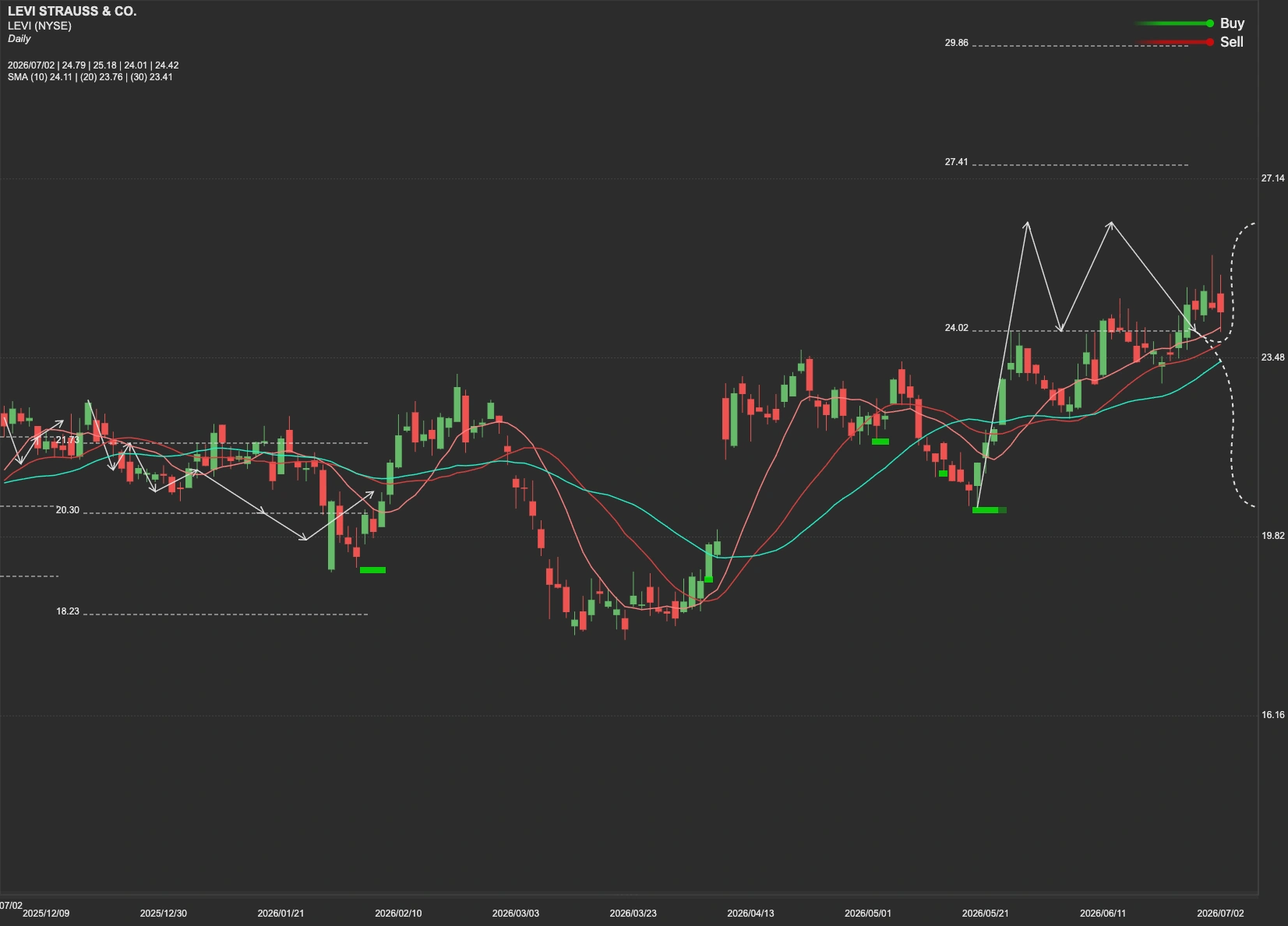
LEVI Stock Technical Analysis
From a technical perspective, the key resistance level remains at $29 for LEVI stock. A decisive breakout and sustained move above $29 could open the path toward the next major upside target near $35.
However, if the stock fails to overcome the $29 resistance, a rejection could trigger a pullback. In this scenario, the stock will likely descend to seek primary support around $19. In a broader market downturn or macro-economic slide, a breach of that level could expose further defensive support down at $15.