
Meta Stock Analysis: AI Investments Fuel Revenue Growth While Heavy Spending Weighs on Profitability
Meta Platforms (NASDAQ: META) delivered another quarter of exceptional revenue growth in the second quarter of 2026, demonstrating that its aggressive artificial intelligence strategy is already strengthening its advertising business and user engagement. While the company posted impressive top-line results, significantly higher AI infrastructure spending, legal charges, and restructuring costs reduced operating income and earnings compared with the same period last year.
Revenue Growth Remains Extremely Strong
Meta generated second-quarter revenue of $60.8 billion, representing a 28% year-over-year increase.
Second-quarter operating expenses increased 55% year over year to $42.0 billion, and included $2.4 billion in charges related to legal proceedings and $1.2 billion in severance expenses in connection with the May 2026 headcount reduction. Year-over-year growth was primarily driven by increases in employee compensation, infrastructure costs, legal-related costs, and third-party AI token costs.
As a result:
- Operating income declined 8% to $18.8 billion
- Operating margin fell from 43% to 31%
- Net income declined 14% to $15.8 billion
- Diluted EPS decreased 13% to $6.18
Management noted that excluding the legal and restructuring charges, operating income would have increased approximately 9% year over year.
Segment Performance
Family of Apps revenue climbed 28% year over year to $60.4 billion, while operating income dropped 6% to $23.4 billion. Advertising remained the primary growth engine, with ad revenue reaching $59.4 billion, up 27% from a year earlier. The performance reflected both higher engagement across Meta's platforms and continued improvements in advertising efficiency driven by AI.
Several key operating metrics highlighted the strength of Meta's advertising business:
- Ad impressions increased 14% year over year.
- Average price per advertisement rose 12%.
- Family daily active people reached 3.6 billion, up 3% from last year.
Meta also achieved an important milestone as Family of Apps other revenue exceeded $1 billion in a single quarter for the first time, growing 73% year over year, primarily driven by WhatsApp paid messaging and subscription services.
Reality Labs segment revenue was $431 million, up 16% year-over-year due to strong growth in AI glasses revenue, partially offset by lower Quest headset sales. Operating loss was ($4.62) billion, compared to ($4.53) billion last year.
Capital Spending Reaches Historic Levels
Capital expenditures, including principal payments on finance leases, reached $31.1 billion during the quarter, primarily for servers, data centers, and network infrastructure.
The company generated $31.9 billion in operating cash flow, but heavy capital spending reduced free cash flow to just $784 million, compared with $8.5 billion a year earlier.
Proceeds from issuance of long-term debt, net, were $24.91 billion during the quarter. Meta ended the quarter with
- $90.3 billion in cash and marketable securities
- $83.7 billion in long-term debt
Management also announced a strategic partnership with BlackRock to help finance future AI infrastructure expansion while maintaining financial flexibility.
Chief Executive Officer Mark Zuckerberg noted that "The opportunity in front of us is massive. First, we are now at a point where our investments in AI are accelerating every major part of our core business. They're improving the experience for people using our apps, driving better performance for advertisers, and helping our teams build new experiences and ship faster. Second, we're developing new personal agents that will be the foundation for our next wave of products and revenue lines in the months and years ahead. Third, we see a large enterprise opportunity to sell to businesses, including APIs, business agents, potentially selling compute directly, and other services that we're building for large customers."
Financial Outlook
For the third quarter of 2026, Meta expects revenue between $61 billion and $64 billion.
Although full year 2026 total expense guidance increased to the range of $165-169 billion because of legal charges, Meta still expects full-year operating income to exceed 2025 levels.
Management anticipates 2026 capital expenditures, including principal payments on finance leases, to be in the range of $130-145 billion, narrowed from the prior outlook of $125-145 billion.
Management also emphasized that "we continue to monitor active legal and regulatory matters that could significantly impact our business and financial results. For example, we continue to see scrutiny on youth-related issues in several markets and have a number of youth-related trials scheduled for this year in the US, which may ultimately result in a material loss."
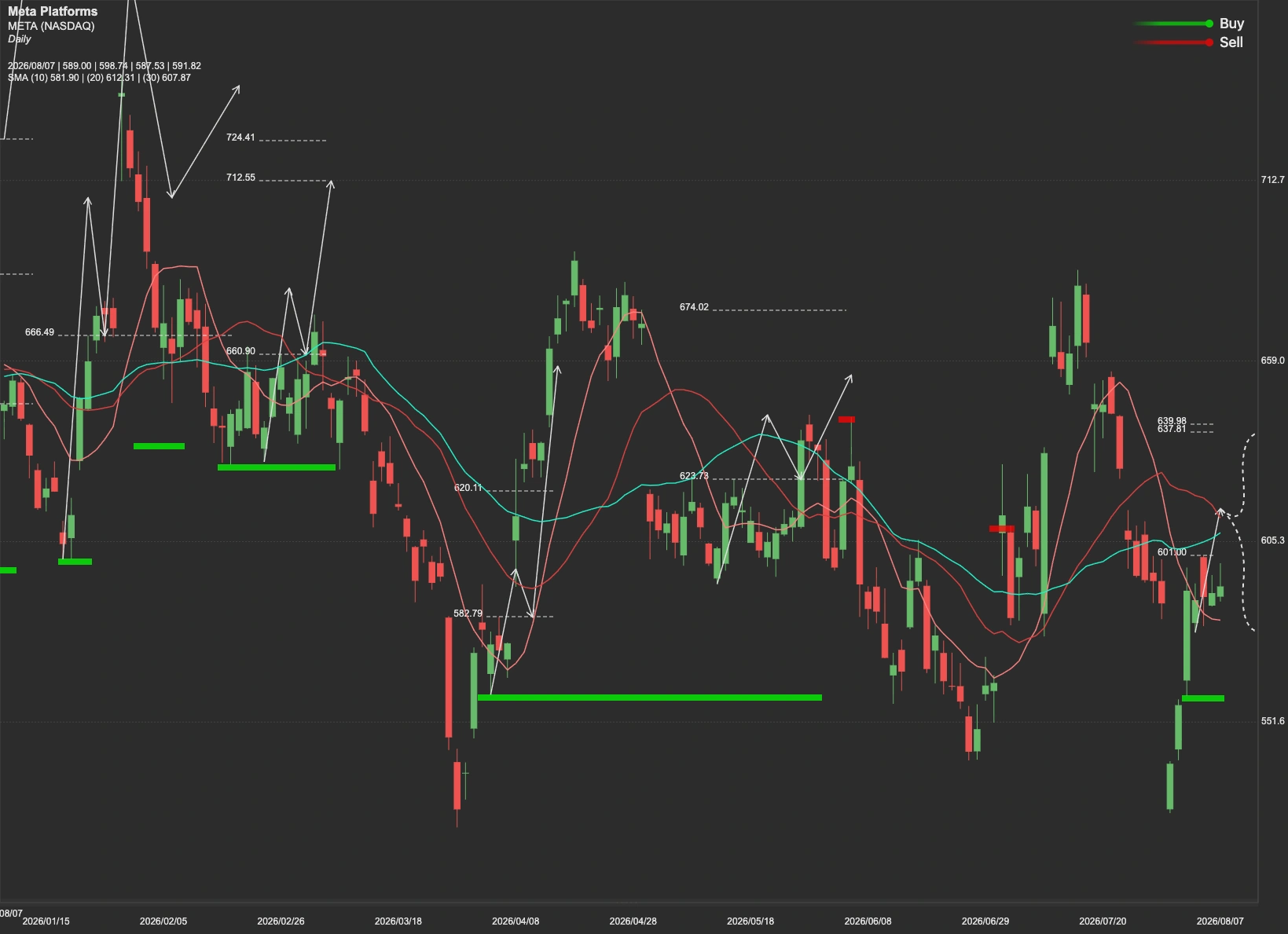
META Stock Technical Analysis
From a technical perspective, the first key resistance level is $632. A sustained breakout above this level would indicate renewed buying momentum and could open the path toward the next resistance at $649. If buyers successfully push the stock above $649, the next major upside target becomes $691.
On the other hand, failure to reclaim $632 could bring $536 into focus, with $520-500 representing the deeper support levels.