
Meta Stock Analysis: META Drops 19% After Q3 Results—What Next?
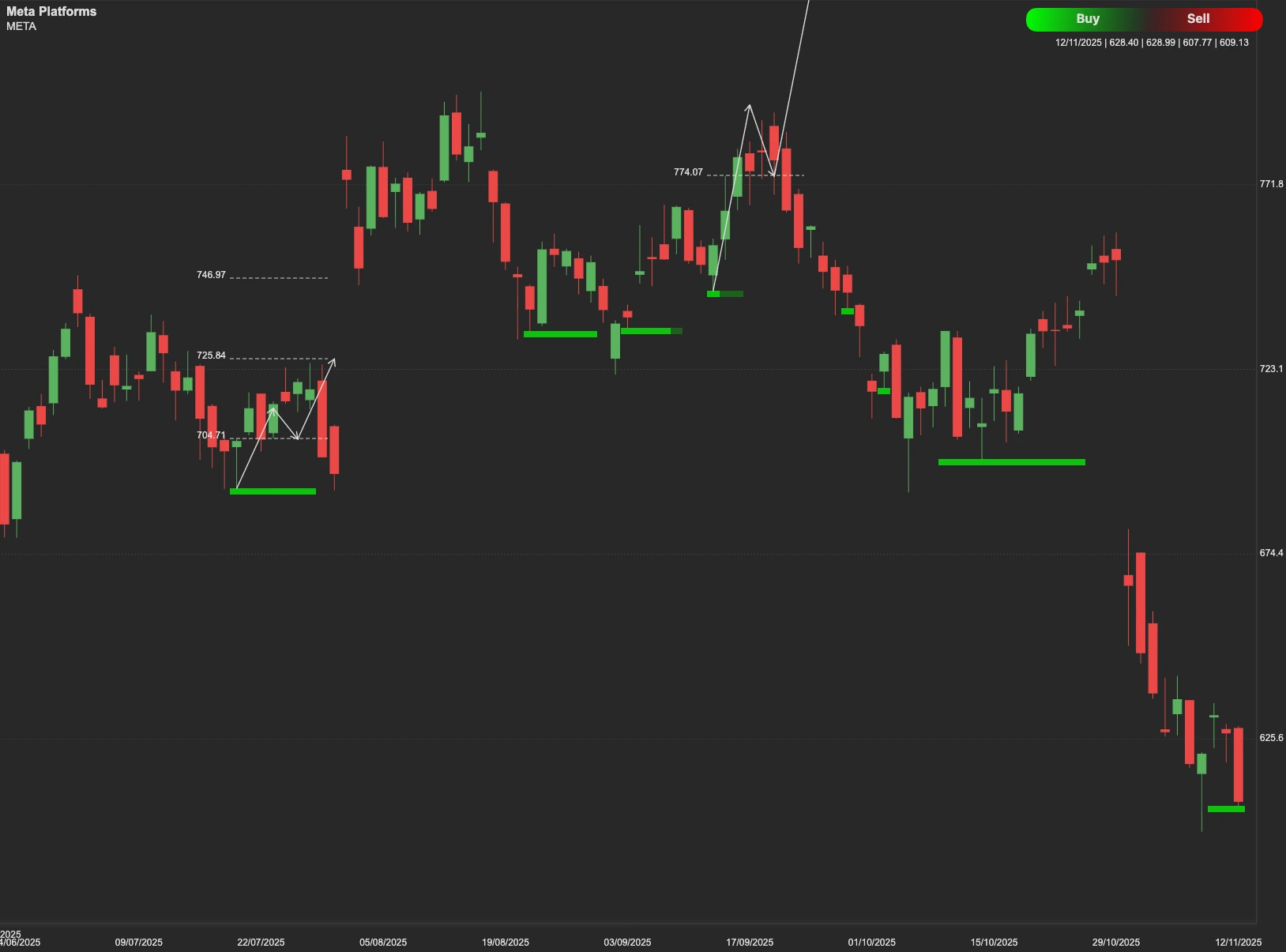
Meta Platforms, Inc. (NASDAQ: META) shares have fallen sharply, sliding 19% since October 29, 2025, following the release of its third-quarter financial results. Despite reporting robust top-line growth and a healthy core business, investor confidence was severely shaken by a massive one-time tax charge and, more critically, the company’s aggressive outlook for accelerating capital expenditures in 2026.
Tax Charge Impacts Profitability
The key driver of the profit plunge was a massive $15.93 billion one-time, non-cash income tax charge. This charge resulted from the implementation of the "One Big Beautiful Bill Act," requiring Meta to recognize a valuation allowance against U.S. federal deferred tax assets due to the U.S. Corporate Alternative Minimum Tax.
Consequently, GAAP net income plummeted 83% year-over-year to just $2.71 billion, resulting in diluted EPS of $1.05 (down 83% from $6.03 in Q3 2024).
Excluding this one-time charge, Meta’s adjusted net income would have been $18.64 billion, with diluted EPS of $7.25 and an effective tax rate of 14%—showcasing the company’s underlying strength.
Core Business Remains Strong
Meta's core Family of Apps (FoA) business—Facebook, Instagram, WhatsApp, and Messenger—demonstrated exceptional health and monetization success.
Revenue: Total revenue surged 26% year-over-year to $51.24 billion. Advertising revenue specifically grew from $39.89 billion to $50.08 billion.
User Engagement: Family Daily Active People (DAP) increased 8% year-over-year to 3.54 billion, showing Meta’s continued dominance in social media engagement.
Ad Impressions: Ad impressions grew by 14% year-over-year, and the average price per ad increased by 10% year-over-year.
Operating Profit: Income from operations rose 18% to $20.54 billion, with a healthy 40% operating margin, though slightly down from 43% a year ago. The FoA segment generated $24.97 billion in income from operations, up from $21.78 billion a year ago.
The Reality Labs (RL) segment, which includes virtual, augmented, and mixed reality related consumer hardware, software, and content, continues to represent a significant drag on earnings, posting a loss from operations of -$4.43 billion, largely flat year-over-year.
Looking ahead, Meta expects Q4 2025 revenue between $56–59 billion, with growth led by advertising but partially offset by softer Reality Labs sales.
The AI Investment
CEO Mark Zuckerberg highlighted that "Meta Superintelligence Labs is off to a great start," emphasizing the need for "infrastructure capacity."
2025 CapEx Hike: The 2025 capital expenditures (CapEx) guidance was raised to $70–72 billion (up from a prior outlook of $66–72 billion).
2026 Investment: Management announced that 2026 capital expenditures dollar growth will be "notably larger" than 2025, and total expenses will grow at a "significantly faster percentage rate" than 2025. This planned surge in spending is driven by the race to build AI infrastructure, expand compute capacity, and hire top AI talent for Meta Superintelligence Labs.
Regulatory and Legal Risks Ahead
In the European Union (EU), the company is negotiating with the European Commission regarding its "Less Personalized Ads" offering. Meta warned that the Commission could impose further changes to this offering as early as the fourth quarter of 2025, which could have a significant negative impact on European revenue. Furthermore, in the United States, several youth-related trials are scheduled for 2026, which may ultimately result in a material loss.
Technical Analysis
From a technical perspective, META stock currently faces a key resistance level of $684. If the price can stabilize and trade consistently above this point, the next target could be $726. However, failing to hold $684 could lead the stock to seek support levels. The primary support target is $568, with a further, deeper support level at $520.