
Meta Stock Drops 9% Despite Blowout Q1 FY26 Earnings as Investors Focus on AI Spending Surge
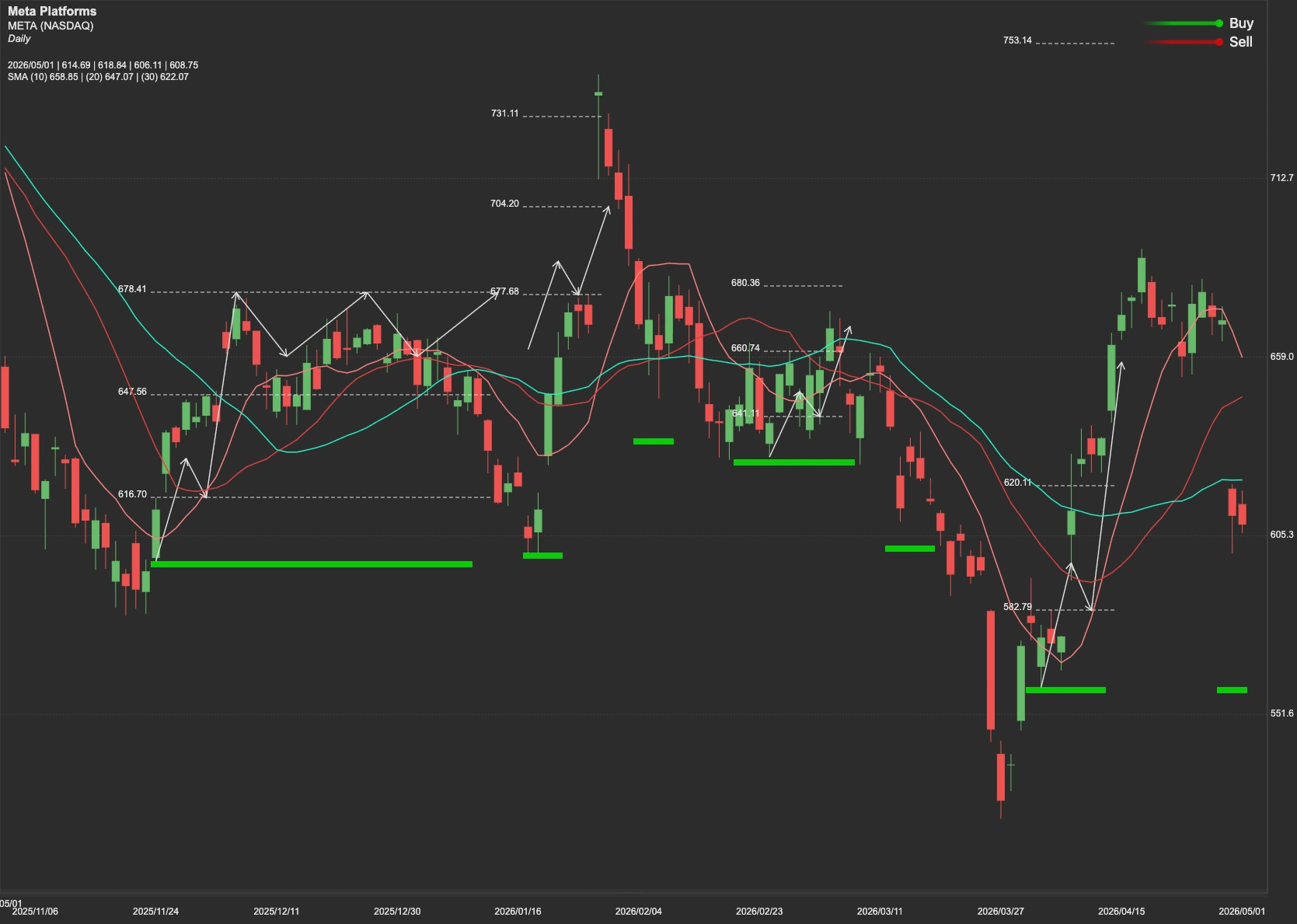
Meta Platforms (Nasdaq: META) delivered what appeared to be a blockbuster first quarter for fiscal 2026, posting stronger-than-expected revenue growth, surging profitability, and upbeat second-quarter guidance. Yet despite the impressive headline numbers, META stock fell roughly 9% following the earnings release as investors reacted to sharply higher capital expenditure plans and mounting AI infrastructure costs.
Strong Revenue Growth Driven by Advertising Momentum
Meta reported first-quarter revenue of $56.31 billion, up 33% year-over-year, with constant currency growth of 29%.
The company’s advertising engine remained the primary growth driver:
- Ad impressions delivered across the Family of Apps increased by 19% year-over-year.
- Average price per ad rose by 12% year-over-year.
- Family daily active people (DAP) reached 3.56 billion on average for March 2026, an increase of 4% year-over-year.
The slight quarter-over-quarter dip in DAP was attributed to internet disruptions in Iran and access restrictions to WhatsApp in Russia.
Profitability Remains Exceptional
Operating income climbed to $22.87 billion during the quarter, up 30% year-over-year, while operating margin held steady at 41%.
Net income surged 61% year-over-year to $26.77 billion, while diluted earnings per share rose 62% to $10.44.
A major contributor to this earnings jump was an $8.03 billion tax benefit linked to updated U.S. Treasury guidance regarding the Corporate Alternative Minimum Tax treatment of previously capitalized R&D costs.
Excluding this one-time benefit, diluted EPS would have been $7.31, up 13.7% compared to $6.43 in Q1 FY25.
Segment Breakdown
Meta's Family of Apps continue to exhibit massive scale and profitability:
-
Revenue: $55.91 billion, up from $41.90 billion in Q1 2025.
-
Ad Revenue: Dominated the segment at $55.02 billion.
-
Operating Income: Surged to $26.90 billion (a 23.6% increase year-over-year), representing an impressive operating margin for the segment.
Despite the focus on "Superintelligence," the Reality Labs division remains a significant drag on current earnings:
-
Revenue: $402 million, slightly down from $412 million in Q1 2025.
-
Operating Loss: Meta recorded a loss of $4.03 billion in this segment, slightly narrowed from the $4.21 billion loss in the prior year.
Balance Sheet and Capital Allocation
The company ended the quarter with cash, cash equivalents, and marketable securities of $81.18 billion, and long-term debt of $58.75 billion. Capital expenditures, including principal payments on finance leases, were $19.84 billion during the quarter. Despite the heavy AI investment, the company continued its capital return program, distributing $1.35 billion in dividend and dividend equivalent payments. Cash flow from operating activities was $32.23 billion, and free cash flow was $12.39 billion during the quarter.
AI Spending and Business Outlook
The more significant concern for investors lies in Meta’s forward spending trajectory. The company reaffirmed its full-year 2026 total expenses outlook but raised its capital expenditures (including principal payments on finance leases) expectations to between $125 billion and $145 billion, citing higher component pricing and additional data center costs to support future AI capacity.
At the same time, management’s outlook for the second quarter remains solid, with expected revenue between $58 billion and $61 billion and a modest foreign exchange tailwind. Meta also reiterated that full-year operating income should exceed 2025 levels, reinforcing confidence in the underlying business. The company also noted ongoing concerns around youth-related issues and upcoming legal proceedings that could ultimately result in material financial impact.
META Technical Analysis
Following the post-earnings drop, META is currently testing the resolve of bulls. The first major hurdle for the stock is the $648 resistance level. If shares can reclaim and hold above $648, momentum could rebuild toward the next resistance at $672, with a broader upside target near $712. On the downside, failure to stabilize may lead the stock to test support around $567, and a deeper pullback could extend toward $520 if selling pressure intensifies.