
Microsoft Q3 FY26: AI Momentum and Cloud Strength
Microsoft (NASDAQ: MSFT) has reasserted itself as one of the most closely watched names in artificial intelligence and cloud computing after delivering a strong fiscal third-quarter 2026 report. The narrative surrounding Microsoft has become a fascinating battleground between short-term capital expenditure anxiety and long-term artificial intelligence dominance.
Strong Q3 FY26 Results
The software giant posted revenue of $82.9 billion for the quarter ended March 31, 2026, up 18% year over year, supported by Microsoft Cloud growth of 29%.
Cost of revenue increased 22% year over year. Gross margin was $56.1 billion, an increase of 16% compared to $48.1 billion in Q3 FY25. Gross margin percentage decreased to 67.6% (vs. 68.7% in Q3 FY25) driven by continued investments in AI infrastructure and growing AI product usage.
Operating expenses were $17.7 billion and increased 9%, primarily driven by continued investments in R&D compute capacity, AI talent, and data to support product development across the portfolio.
Operating income increased 20% to $38.4 billion, with operating margin of 46.3%, compared to 45.7% in the prior year.
Net income was $31.8 billion, while diluted earnings per share grew 23% to $4.27.
Microsoft Cloud and AI Strength
Microsoft Cloud revenue of $54.5 billion increased 29%, reflecting strong demand across the Azure platform as well as first-party AI applications and services. Microsoft Cloud gross margin percentage decreased to 66%, compared to 69% in Q3 FY25.
The most important takeaway from the quarter was the scale of Microsoft’s AI business. CEO Satya Nadella revealed that Microsoft’s AI annual revenue run rate has now surpassed $37 billion, growing 123% year-over-year. This reflects customers building and running AI solutions on the Azure platform, including all revenue from frontier model companies, as well as revenue from first-party AI applications and services.
Commercial remaining performance obligation (RPO) grew 26% when excluding OpenAI. RPO of $627 billion increased 99%, with a weighted average duration of approximately 2.5 years, when including OpenAI.
Segment Performance
Revenue in the Productivity and Business Processes segment reached $35.0 billion, rising 17% year over year, fueled by strong momentum in Microsoft 365 Commercial Cloud (up 19%) and Microsoft 365 Consumer Cloud (up 33%).
The company’s Intelligent Cloud segment remained the primary growth engine. Revenue climbed 30% to $34.7 billion, driven largely by Azure and other cloud services, which surged 40% year over year.
Not every business line moved higher, however. Revenue in More Personal Computing declined 1% to $13.2 billion, reflecting lower hardware sales across Devices and Gaming.
Capital expenditures and Capital Allocation
Capital expenditures reached $31.9 billion during the quarter, up 49% year over year, with most of the spending directed toward GPUs, CPUs, data center infrastructure, and cloud capacity expansion. Cash paid for property and equipment was $30.9 billion, up 84%.
Microsoft returned $10.2 billion to shareholders in the form of dividends ($6.8 billion) and share repurchases ($3.4 billion) during the quarter.
Operating cash flow was $46.7 billion, up 26%, driven by strong cloud billings and collections. Free cash flow was $15.8 billion, down 22%, reflecting higher capital expenditures as the company invests against the strong demand signal and expansive cloud and AI opportunity.
Business Outlook
Microsoft forecast fiscal Q4 revenue between $86.7 billion and $87.8 billion, with capital expenditures expected to increase to over $40 billion. Intelligent Cloud revenue is projected to reach between $37.95 and $38.25 billion, while Productivity and Business Processes revenue is expected to be $37.0 to $37.3 billion and More Personal Computing projected revenue of $11.75 to $12.25 billion. Microsoft Cloud gross margin percentage is expected to be roughly 64%.
For the full calendar year 2026, the company expects capital expenditures to hit approximately $190 billion, including roughly $25 billion from higher component pricing. Azure revenue growth expected to show some modest acceleration in the second half of the year compared with half.
For fiscal year 2027: Revenue: total revenue expected to grow double-digits
Operating expenses: operating expenses expected to grow in mid- to high-single digits
Operating income: operating income expected to grow double-digits
The Ackman Catalyst: Buying the Pullback
On May 15, 2026, Pershing Square’s Bill Ackman revealed he had been aggressively building a "core holding" in MSFT since February after the stock declined following Microsoft's fiscal Q2 earnings.
MSFT Stock Technical Analysis
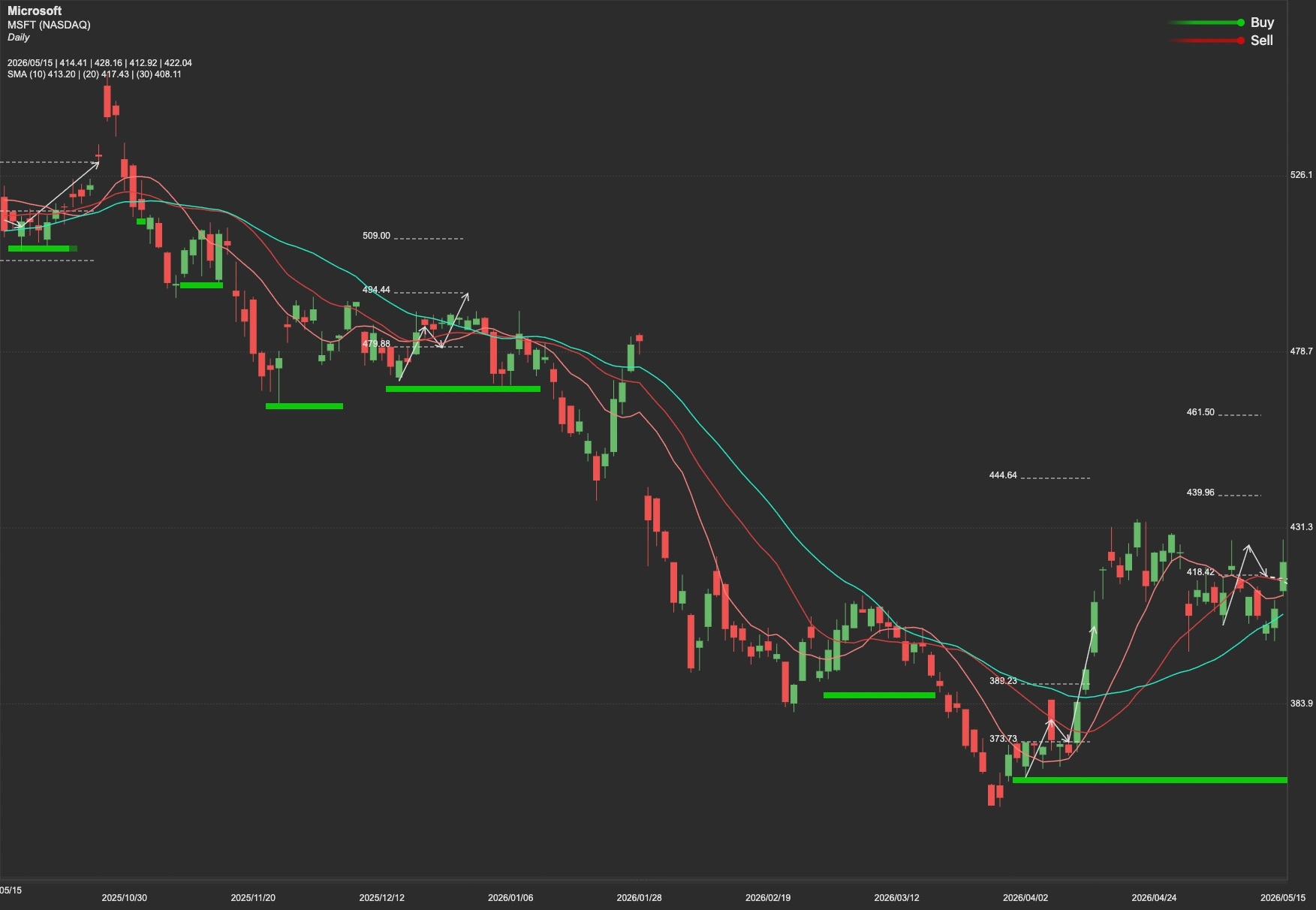
The key resistance level currently sits near $464. If MSFT can establish a sustained breakout above $464, momentum traders may begin targeting the next major upside zone around $522. A decisive move through resistance would likely reflect growing confidence that Azure acceleration and AI monetization can offset the enormous infrastructure spending currently underway.
However, failure to hold above $464 could trigger another consolidation phase. In that scenario, the first major support area sits near $398. If broader technology sentiment weakens or AI spending concerns intensify, a deeper retracement toward the stronger support around $356 becomes possible.