
Microsoft Stock Analysis: AI and Cloud Growth Fuel Fundamentals
Microsoft Corp. (NASDAQ: MSFT) closed out its fiscal year 2026 with another commanding quarter, driven by immense demand for its enterprise cloud infrastructure and rapidly expanding AI ecosystem. With full-year revenue reaching $331.8 billion—up 18% year-over-year—and Azure revenue surpassing the $100 billion milestone, Microsoft continues to demonstrate that its massive capital investments in artificial intelligence are translating into tangible top-line momentum.
Strong Revenue and Earnings Growth Beat Expectations
For the fourth quarter of fiscal 2026, Microsoft reported revenue of $90.0 billion, an 18% increase from the previous year. Gross margin increased 15%. Gross margin percentage was 67%, down year-over-year, driven by sales mix shift to Azure as well as continued investments in Al infrastructure and growing product usage, partially offset by efficiency gains across the Microsoft Cloud. Operating income also climbed 18% to $40.6 billion, while GAAP net income surged 31% to $35.8 billion. GAAP diluted earnings per share reached $4.81, representing 32% year-over-year growth. Excluding the impact of Microsoft's investment in OpenAI, non-GAAP earnings per share came in at $4.74, up 23%.
The quarter included several one-time items that boosted reported earnings. Microsoft recognized a $3.2 billion gain from its investment in Anthropic and lower-than-expected costs related to its voluntary retirement program which were partially offset by severance expense and impairment charges in XBOX. Even after excluding these discrete factors, management noted that revenue, operating income, and earnings all exceeded internal expectations due to strong demand and execution in the quarter.
The biggest story remained Microsoft's cloud business. Microsoft Cloud generated $59.3 billion in quarterly revenue, growing 27% year over year, reflecting strong demand across Azure and the first-party AI applications and services.
Commercial bookings grew 18% when excluding the impact from OpenAI driven by strong execution in the company's core annuity sales motions and reflecting broad customer demand across geographies and customer segments.
Commercial remaining performance obligation grew 84% to $678 billion. All sequential commercial RPO growth was driven by commitments from customers outside of frontier model companies. And RPO increased 25% when excluding OpenAI.
Segment Performance
Productivity and Business Processes revenue increased 14% to $37.8 billion, supported by healthy growth across Microsoft 365 Commercial cloud, Microsoft 365 Consumer cloud, LinkedIn, and Dynamics 365. Meanwhile, Intelligent Cloud revenue climbed 32% to $39.3 billion. In Azure and other cloud services, revenue grew 43%, against a prior year that included accelerating growth. Customer demand continues to exceed available capacity.
Not every business segment participated in the growth. Revenue from More Personal Computing declined 4% to $12.9 billion as weakness in the PC market weighed on Windows OEM. Xbox content and services revenue also declined 10%.
Aggressive Capital Expenditures
Microsoft continues investing aggressively to support future AI demand. Capital expenditures reached $41.0 billion during the quarter, up 70% from a year earlier. Approximately two-thirds of spending went toward short-lived assets such as CPUs and GPUs to expand Azure capacity, while the remaining investment supported long-term infrastructure, including new data centers. Although free cash flow declined 23% to $19.6 billion because of higher investment spending, operating cash flow remained exceptionally strong at $55.4 billion, increasing 30% year over year.
The company returned $10.2 billion to shareholders with $6.8 billion in dividends and $3.4 billion in share repurchases during the quarter.
Fiscal 2026 Results
For the full fiscal year 2026, Microsoft generated record revenue of $331.8 billion, an 18% increase from fiscal 2025. Operating income rose 21% to $155.2 billion, while GAAP net income increased 31% to $133.7 billion. Diluted earnings per share reached $17.95, up 32%. More significantly, Azure annual revenue surpassed $100 billion for the first time in the company's history.
Fiscal 2027 Outlook
Looking ahead, management expects another year of double-digit revenue and operating income growth in fiscal 2027. First-quarter guidance calls for revenue between $89.85 billion and $90.95 billion, representing growth of 16% to 17%. Azure revenue growth is expected to accelerate further to approximately 45% in constant currency.
Capital spending will remain elevated as Microsoft expands AI infrastructure. The company expects fiscal 2027 capital expenditures to exceed previous levels, with quarterly spending expected to surpass $50 billion in the first quarter alone.
Management also announced an accounting change that extends the useful life of data centers and office buildings from 15 years to 25 years. This change affects only the timing of future depreciation and is expected to have a minimal benefit to FY27 operating income. The greater impact is on capital expenditures as more of the future datacenter leases will shift from finance leases to operating leases as a result of this update.
MSFT Stock Technical Analysis
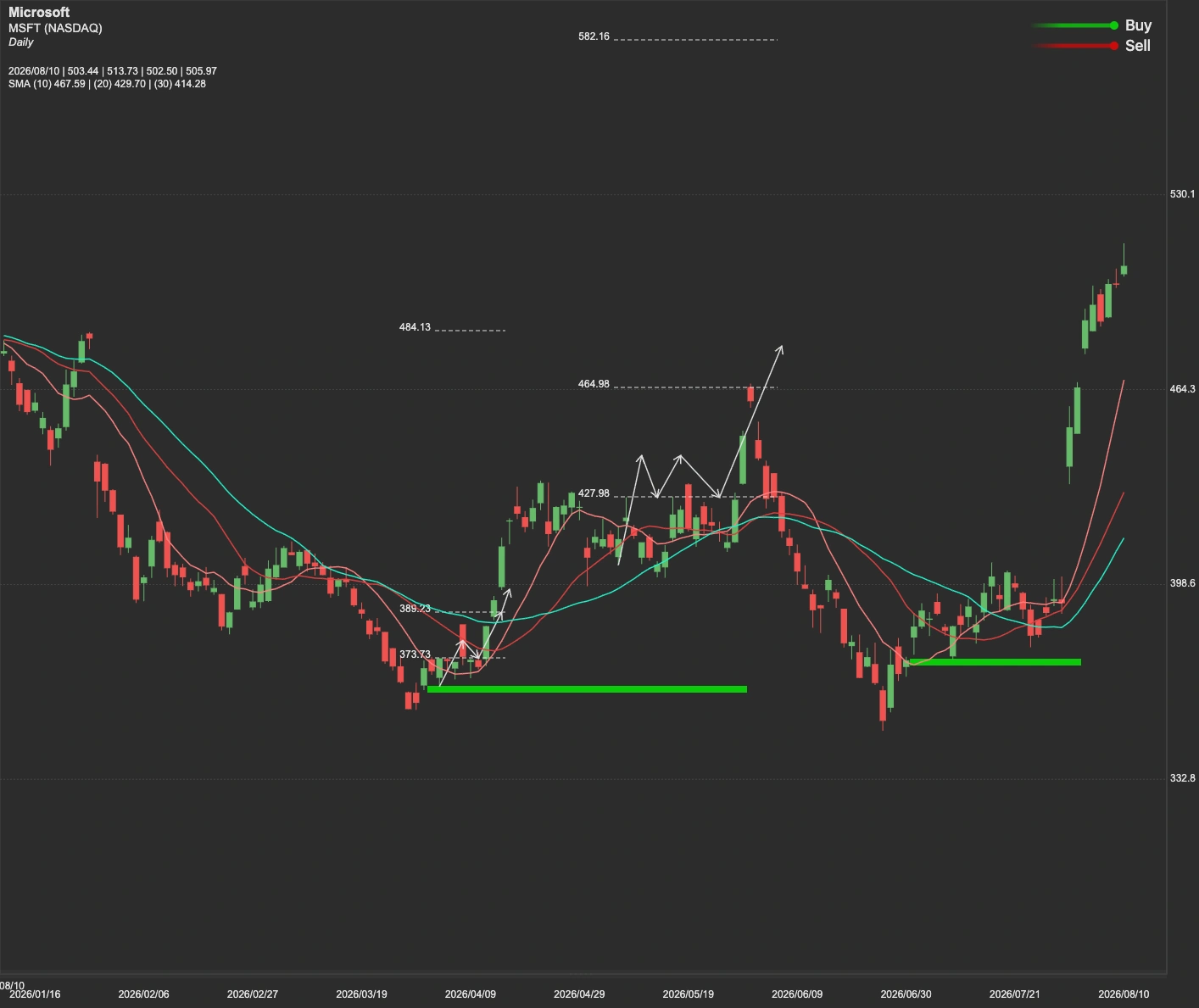
From a technical perspective, Microsoft stock remains in a constructive long-term uptrend. The key resistance level to watch is $551. A decisive breakout and sustained move above this level would strengthen bullish momentum and could open the way toward the next upside target near $580.
However, if buyers fail to push the stock above $551, profit-taking could send shares back toward the first major support around $448. Should broader market weakness intensify, the next significant support sits near $420.