
Microsoft Stock Analysis: AI-Led Cloud Momentum Powers Strong Quarter
Microsoft Corp. (NASDAQ: MSFT) delivered a powerful fiscal Q2 2026 performance, underscoring how deeply artificial intelligence and cloud offerings are reshaping the company’s growth profile. Strong execution across cloud, productivity software, and AI infrastructure drove solid top-line growth, expanding profitability and confident forward guidance.
Fundamental Momentum: Cloud and AI at Scale
Revenue for Q2 surged 17% year over year to $81.3 billion, while operating income climbed 21% to $38.3 billion. Gross margin increased 16% with growth across all segments. Gross margin percentage decreased slightly to 68%, driven by continued investments in AI infrastructure and growing AI product usage. Operating expenses were $17.0 billion, up 5%, driven by R&D investments in compute capacity and AI talent, as well as impairment charges in the Gaming business. Net income on a GAAP basis was $38.5 billion and increased 60%, and on a non-GAAP basis was $30.9 billion (excluding $7.6 billion in net gains from investments in OpenAI) and increased 23%.
The standout was Microsoft Cloud, which surpassed $50 billion in quarterly revenue, rising 26% year over year. Azure and other cloud services jumped 39%, supported by strong demand for the portfolio of services with continued growth across all workloads. Commercial bookings increased 230%, fueled by massive long-term commitments from OpenAI and Anthropic, pushing commercial remaining performance obligations (RPO) to a staggering $625 billion. Roughly 45% of the commercial RPO balance is driven by commitments from OpenAI.
Segment Performance
Productivity and Business Processes also posted solid growth, with revenue up 16% to $34.1 billion. Microsoft 365 Commercial and Consumer cloud revenues grew at double-digit rates, fueled by higher revenue per user and increasing adoption of premium offerings such as Copilot, and consumer subscriptions continued to expand. LinkedIn and Dynamics 365 continued to post steady growth, contributing to balanced segment performance.
The Intelligent Cloud segment remained the primary growth engine, rising 29% to $32.9 billion, though gross margin percentage compressed slightly as Microsoft aggressively invested in AI infrastructure.
More Personal Computing was softer, declining 3% to $14.3 billion, weighed down by weaker Gaming. However, search and news advertising continued to grow at a healthy pace, partially offsetting the gaming slowdown. Windows OEM revenue held up relatively well, benefiting from the ongoing Windows 10 end of support.
AI Infrastructure Spending Reshapes Cash Flow Profile
CEO Satya Nadella noted that Microsoft has built an AI business larger than some of its biggest franchises. However, this growth comes at a cost. Capital expenditures (including assets acquired under finance leases) hit $37.5 billion, surging 66% year over year. Roughly two-thirds of spending went toward short-lived assets, primarily GPUs and CPUs. The remaining capital was directed toward long-lived assets, expected to support monetization over the next 15 years and beyond.
Despite the heavy spending, operating cash flow jumped 60% to $35.8 billion, driven by strong cloud billings and collections. However, free cash flow declined 9% to $5.9 billion, reflecting higher capital expenditures to support its cloud and AI offerings.
Outlook Remains Strong as Azure and AI Demand Continue to Surge
Management guided for continued momentum into fiscal Q3 2026, with Azure and other cloud services revenue expected to grow between 37% and 38% in constant currency. Microsoft Cloud gross margin percentage is expected to remain under pressure in fiscal Q3 2026, roughly 65%. Overall revenue is projected to be between $80.65 billion and $81.75 billion.
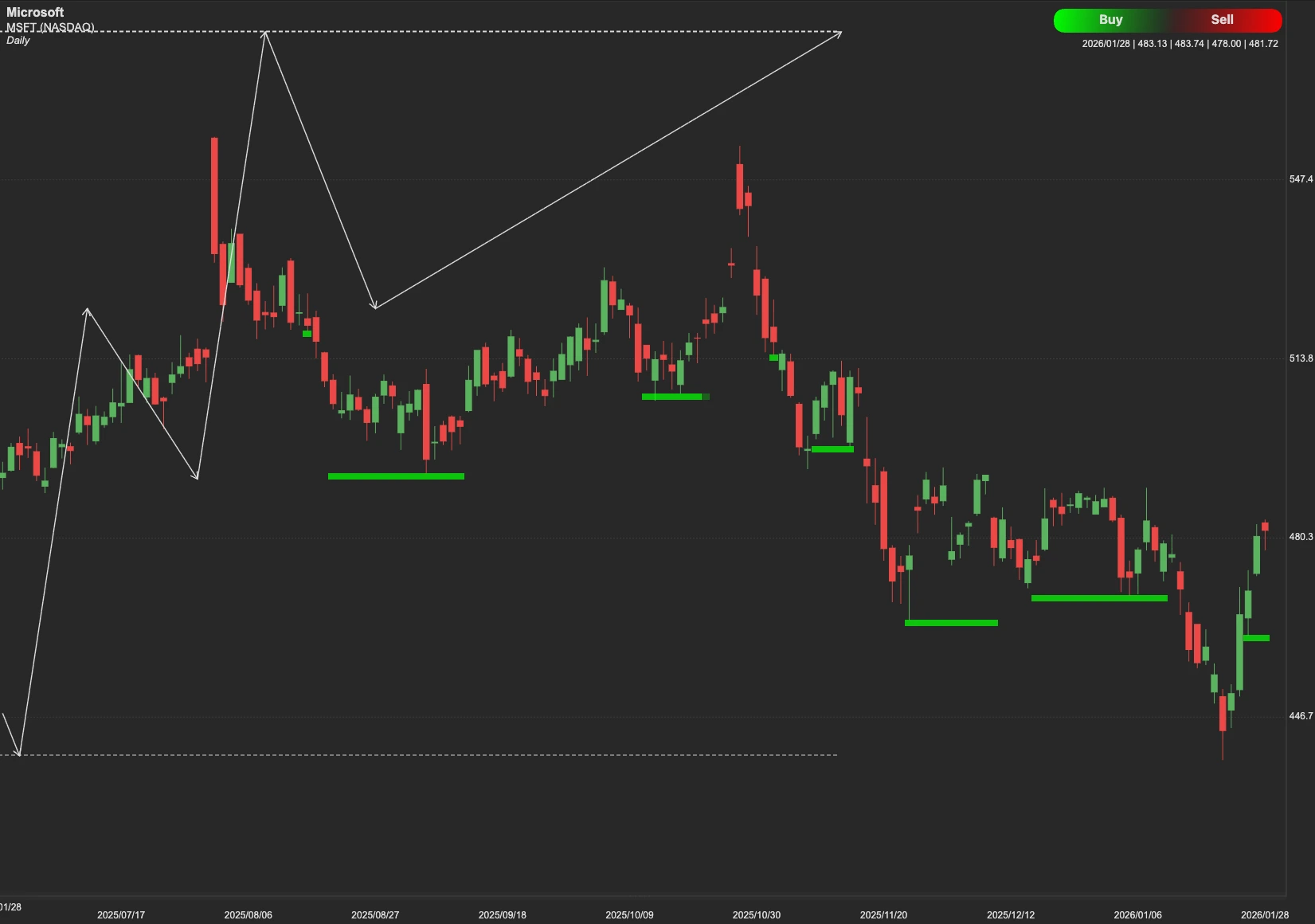
MSFT Stock Technical Outlook
From a technical perspective, the immediate ceiling for MSFT is at $501. A sustained move and hold above this level would likely trigger a momentum shift, clearing the path toward the next major objective at $533.
If MSFT fails to hold the current trajectory, the stock could retreat to find its footing. The primary support zone sits at $438. In a broader market correction, further structural support is identified in the $414–$400 range.