
Netflix Stock Analysis: Strong Fundamentals Overshadowed by Market Reaction
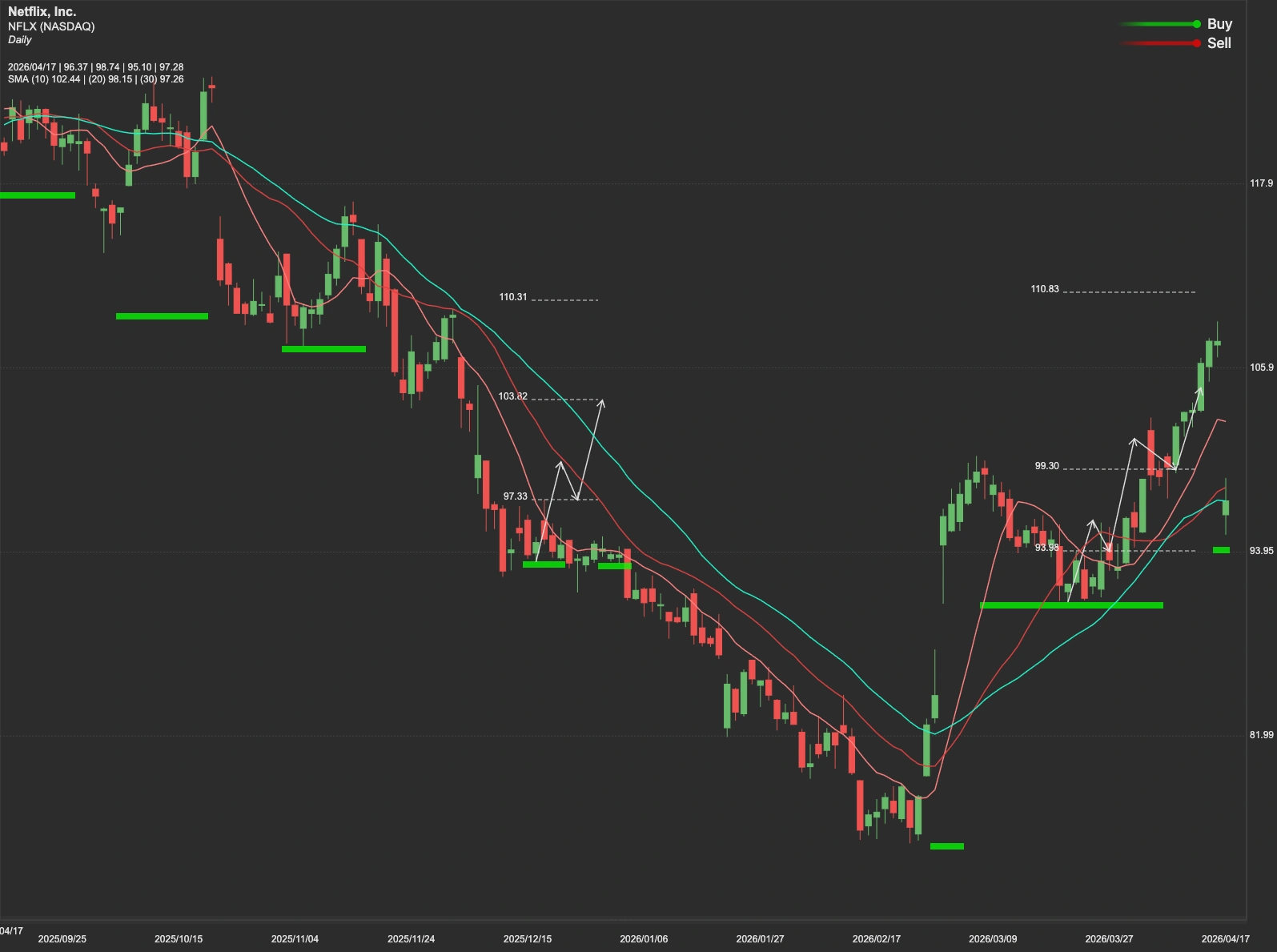
Despite a robust Q1 2026 earnings report that exceeded guidance across revenue and operating income, Netflix (NASDAQ: NFLX) shares have plummeted 9.6% following the release. Investors appear to be weighing a cautious Q2 margin outlook against the company's long-term pivot toward live events and ad-tier dominance.
Fundamental Performance
Netflix reported Q1 revenue of $12.25 billion, representing 16% year-over-year growth (14% FX-neutral), driven by continued membership expansion, higher pricing, and rising advertising revenue. Operating income climbed 18% year-over-year to $4.0 billion, with operating margin improving to 32.3%, ahead of guidance.
Net income surged 83% year-over-year to $5.28 billion, boosted in part by a $2.8 billion termination fee related to the Warner Bros. transaction. Diluted EPS came in at $1.23, up 86% compared to $0.66 in Q1 2025, significantly above forecasts.
Net cash generated from operating activities was significantly higher in Q1 2026 vs. Q1 2025, totaling $5.3 billion compared to $2.8 billion in the prior year. This increase was driven in part by a $2.8 billion cash receipt from the Warner Bros.-related termination fee. As a result, free cash flow rose to $5.1 billion in Q1 2026, up from $2.7 billion a year ago. The company ended the quarter with gross debt of $14.4 billion and cash and cash equivalents of $12.3 billion.
Alongside earnings, Netflix announced a major governance update: Reed Hastings, Netflix’s co-founder and current chairman, will not stand for re-election to the board at the upcoming annual meeting in June.
Strategic Positioning Remains Intact
Netflix operates in an extraordinarily vibrant and intensely competitive market, competing with major players such as Amazon, Apple, Disney, and Meta. The rapid evolution of content consumption, including short-form video and gaming, continues to reshape the competitive landscape. Although Netflix maintains a strong global brand and growing audience (approaching 1 billion viewers), it still accounts for only about 5% of global TV view share, leaving significant room for expansion.
Netflix continues to execute across three long-term pillars:
-
Content and Engagement Expansion: The company is deepening engagement through high-performing original content, live events (e.g., World Baseball Classic), and new formats such as video podcasts and gaming. Internal engagement metrics hit all-time highs, reinforcing the platform’s stickiness.
-
Technology and AI Integration: Ongoing investment in AI-driven personalization and content tools—including the acquisition of InterPositive—signals a push toward both user experience enhancement and production efficiency.
-
Monetization Growth: Advertising revenue is expected to reach $3 billion in 2026, doubling year-over-year.
2026 Guidance Reaffirmed
Netflix maintained its full-year 2026 outlook, forecasting 2026 revenue of $50.7 billion-$51.7 billion, which represents 12%-14% growth (11%-13% F/X neutral), driven by continued healthy membership growth, pricing and a projected rough doubling of ads revenue. The company still targets an operating margin of 31.5% for 2026 based on F/X rates as of January 1, 2026, vs. 29.5% in 2025.
For Q2, Netflix expects revenue growth of 13% (or 12% F/X neutral) to $12.57 billion, while it expects operating margin to dip to 32.6% in Q2 (down from 34.1% a year ago) due to growth in content amortization.
Technical Outlook
From a technical perspective, NFLX stock is now trading in a critical range following its post-earnings decline. The first hurdle for any recovery sits near $109. If bullish momentum strengthens and the price can push through this level, the next key resistance stands at $116. A sustained move above $116 would be significant, as it could open the path toward a broader upside target around $130.
On the downside, if the stock fails to regain traction and remains below resistance, downside risk remains in play. The first area of support is around $81. If selling pressure intensifies and this level does not hold, the stock could extend its decline toward a deeper support zone near $68.