
Nike Q4 FY2026 Results Show Early Signs of Stabilization, But NKE Stock Still Faces a Long Road Higher
Nike, Inc. (NYSE: NKE) delivered fiscal fourth-quarter 2026 results that met management's expectations, supported by strong margin expansion and disciplined cost controls. While the company is making progress in rebuilding its business under CEO Elliott Hill's "Sport Offense" strategy, management acknowledged that revenue growth remains under pressure as consumer demand, retail traffic and macroeconomic conditions remain challenging.
Fourth Quarter Results Show Improving Execution
For the fourth quarter ended May 31, 2026, Nike reported revenue of $11.0 billion, down 1% year over year on a reported basis and 4% on a currency-neutral basis.
The company's wholesale business continued to improve, with revenue rising 4% to $6.6 billion, driven primarily by strength in North America. However, Nike Direct revenue declined 7% to $4.1 billion, reflecting weaker digital sales and lower traffic at company-owned stores.
Nike Brand revenue was essentially flat at $10.7 billion, while Converse remained a significant drag, with sales falling 32% to $244 million.
The most notable improvement came in profitability. Gross profit increased 21% to $5.39 billion, while gross margin expanded 890 basis points to 49.2%. The improvement was largely driven by the expected recovery of $986 million related to IEEPA tariffs, which alone contributed roughly 900 basis points to gross margin during the quarter.
Selling and administrative expenses declined 2% to $4.1 billion, reflecting continued cost discipline.
Net income surged to $1.1 billion, up 407% from the prior year, while diluted EPS increased to $0.72, including a $0.52 benefit from the IEEPA tariffs recovery, compared to $0.14 in the fourth quarter of FY2025.
Fiscal 2026 Demonstrates Stabilization Rather Than Growth
For the full fiscal year, Nike generated $46.4 billion in revenue, essentially flat on a reported basis and down 2% on a currency-neutral basis compared to the previous year.
Profitability remained relatively stable rather than accelerating dramatically. Gross margin improved only 20 basis points to 42.9%, while net income declined 3% to $3.1 billion, with diluted EPS also falling 3% to $2.10.
Nike finished fiscal 2026 with a healthy balance sheet.
Inventories remained stable at $7.5 billion, while cash, cash equivalents and short-term investments totaled $9.0 billion. Total debt stood at $7.94 billion.
The company continued returning capital to shareholders, paying $2.4 billion in dividends during fiscal 2026, up 5% year over year, while repurchasing $123 million of stock.
Nike Continues Restructuring under Sport Offense strategy
CEO Elliott Hill said fiscal 2026 was focused on rebuilding Nike's long-term foundation rather than maximizing short-term revenue.
During the year, Nike reorganized roughly 8,000 employees into sport-focused teams while simplifying its supply chain and operating structure.
Management highlighted several encouraging developments:
- Nike Running delivered five consecutive quarters of double-digit growth.
- Wholesale revenue grew 4% during fiscal 2026, led by double-digit growth in North America.
- More than 15,000 wholesale retail spaces were upgraded globally.
- Over 150 Nike Direct stores were refreshed with sport-led experiences.
- By the start of the tournament, Nike had already sold 2.5 times the number of kits compared to the same period in World Cup 22.
- At launch, the Mercurial became the fastest-selling 24-hour launch for cleated footwear in the history of Nike Direct.
- The company elevated over 5,000 football doors around the world.
Guidance Reflects Continued Cautious Outlook
Nike expects the operating environment to remain difficult over the coming quarters.
The company now forecasts first-quarter fiscal 2027 revenue to decline by the low- to mid-single digits, with similar expectations for the first half of the fiscal year.
Management expects gross margin expansion to begin earlier than previously anticipated, starting in the first quarter, while operating overhead should begin delivering productivity improvements.
However, executives cautioned that weaker retail traffic, uncertain tariff policies, geopolitical tensions and cautious consumer spending continue to weigh on demand.
Nike also expects Sportswear and Jordan Streetwear to remain negative through much of fiscal 2027 before improving during the second half of the year. Management also stated that "We know changing their trajectory is critical to restoring sustainable top-line growth because, together, they represent approximately half of our revenue."
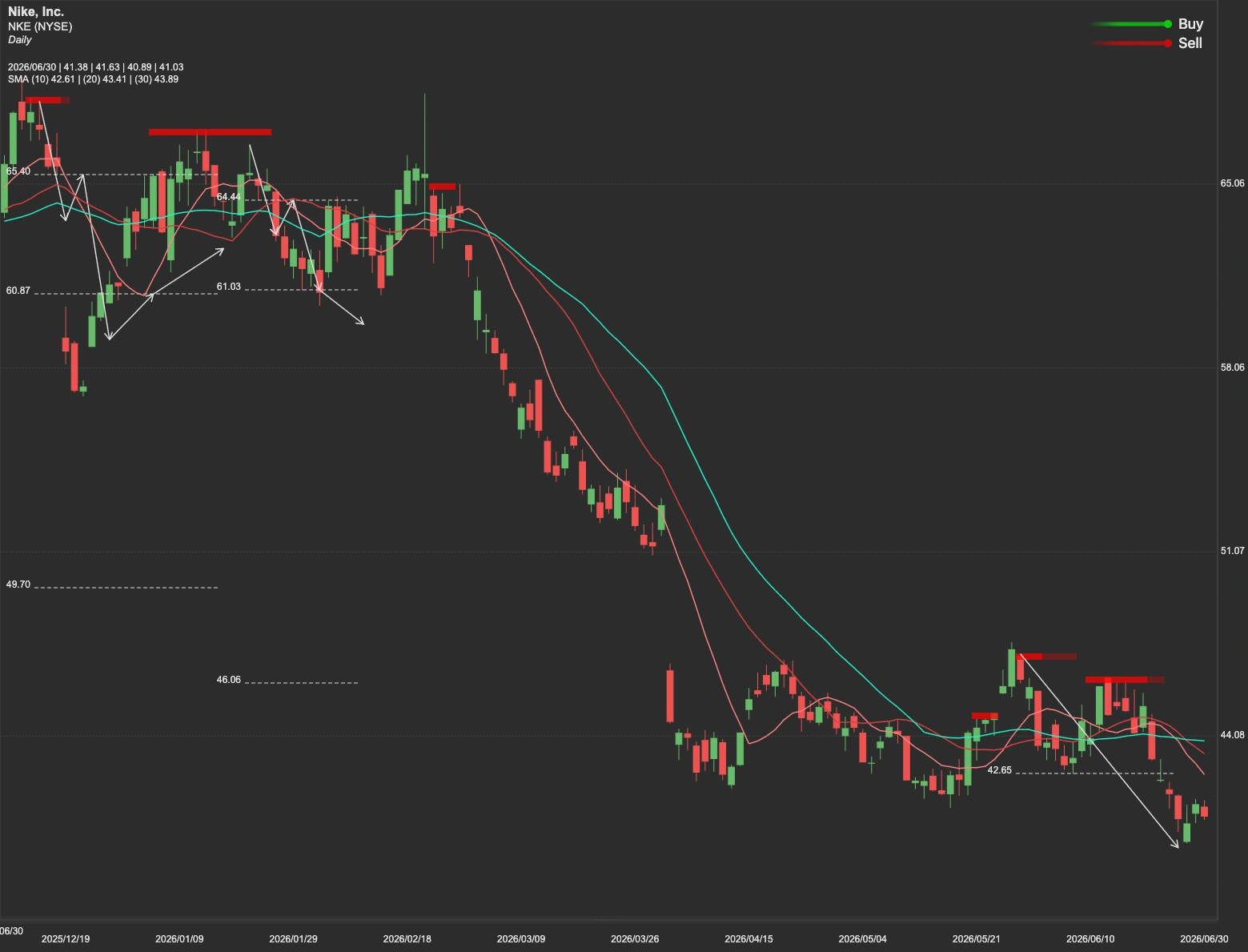
NKE Stock Technical Analysis
While Nike's operational turnaround is beginning to show signs of progress, the stock's technical structure suggests there is still a considerable journey before a sustained long-term uptrend can develop.
The first key hurdle for NKE stock is $55, which represents the most important near-term resistance level. A decisive break and sustained move above this level would improve short-term momentum and could open the door toward the next major resistance around $66.
Beyond that, the medium-term technical resistance sits near $76. From a long-term perspective, the major resistance remains around $96.