
NVIDIA (NASDAQ: NVDA) Stock Analysis: Record Results Power AI Leadership
NVIDIA’s fiscal fourth quarter and full-year 2026 results underscored extraordinary financial momentum. The scale, ecosystem depth, and platform transitions underway reinforce NVIDIA’s position at the epicenter of the global AI infrastructure buildout. Accelerated computing and AI inference are now foundational enterprise expenditures, and NVIDIA remains the dominant supplier of both silicon and full-stack AI infrastructure.
Record-Breaking Financial Momentum
For the fourth quarter of fiscal 2026, NVIDIA posted record revenue of $68.1 billion, up 20% sequentially and 73% year over year. Full-year revenue reached $215.9 billion, representing a staggering 65% annual increase. The scale of expansion underscores how deeply embedded NVIDIA has become in the accelerated computing and generative AI ecosystem.
Profitability metrics were equally impressive. Quarterly GAAP gross margin expanded 2.0 pts year over year to 75.0%, while operating margin reached 65%, compared with 61% in Q4 FY25. Although full-year margins declined compared with fiscal 2025, with GAAP gross margin of 71.1%, down 3.9 pts year over year, and operating margin of 60%, compared with 62% in FY25. GAAP operating income for the full year still grew 60% year over year to $130.4 billion, demonstrating that NVIDIA remains in a powerful earnings upcycle.
GAAP diluted earnings per share were $1.76 for the quarter, up 98% year over year, and $4.90 for the full year, up 67% year over year, reflecting rapid earnings compounding.
Data Center: Scaling the AI Industrial Base
Data Center revenue remained the primary growth engine, climbing to a record $62.3 billion in the quarter, up 75% from a year earlier. For the full fiscal year, Data Center revenue surged 68% to a record $193.7 billion. This expansion is driven by the major platform shifts—accelerated computing and AI.
CEO Jensen Huang emphasized the arrival of the “agentic AI inflection point,” positing that Grace Blackwell with NVLink currently leads inference efficiency and that Vera Rubin will extend that leadership further.
The newly unveiled Rubin platform, comprising six new chips, is designed to deliver up to a 10x reduction in inference token cost compared with the Blackwell platform. Major cloud providers—including Amazon Web Services, Google Cloud, Microsoft Azure, and Oracle Cloud Infrastructure—are expected to be among the first to deploy Vera Rubin-based instances.
At the infrastructure layer, BlueField-4 now powers NVIDIA’s Inference Context Memory Storage Platform, establishing a new class of AI-native storage architecture.
Segment Diversification: Gaming, ProViz and Automotive
Gaming revenue rose to $3.7 billion in Q4, up 47% year over year, driven by strong Blackwell demand. Full-year revenue rose 41% to a record $16.0 billion. Professional Visualization delivered exceptional momentum, with revenue up 159% year over year to $1.3 billion, reflecting strong demand for Blackwell. Full-year revenue rose 70% to a record $3.2 billion.
Automotive and Robotics revenue rose 6% year over year to $604 million in Q4, with full-year revenue reaching a record $2.3 billion, up 39%, driven by continued adoption of NVIDIA’s self-driving platforms.
Cash Flow Strength and Capital Returns
Free cash flow reached $34.9 billion in the fourth quarter and $96.6 billion for the full year. NVIDIA returned $41.1 billion to shareholders during fiscal 2026 through buybacks and dividends and still retains $58.5 billion in repurchase authorization.
The dividend remains symbolic at $0.01 per share, but capital allocation flexibility is substantial. With over $100 billion in annual operating cash flow, NVIDIA retains significant optionality for continued buybacks, strategic investments, and AI ecosystem expansion.
Fiscal 2027 Outlook: Growth Continues
For the first quarter of fiscal 2027, NVIDIA expects revenue of approximately $78 billion, plus or minus 2%, with GAAP gross margin of 74.9% and non-GAAP gross margins of 75%, plus or minus 50 basis points, inclusive of a 0.1% impact from stock-based compensation expense. GAAP and non-GAAP operating expenses are expected to be approximately $7.7 billion and $7.5 billion, respectively, inclusive of $1.9 billion of stock-based compensation expense. Notably, the outlook does not assume any Data Center compute revenue from China.
Technical Outlook
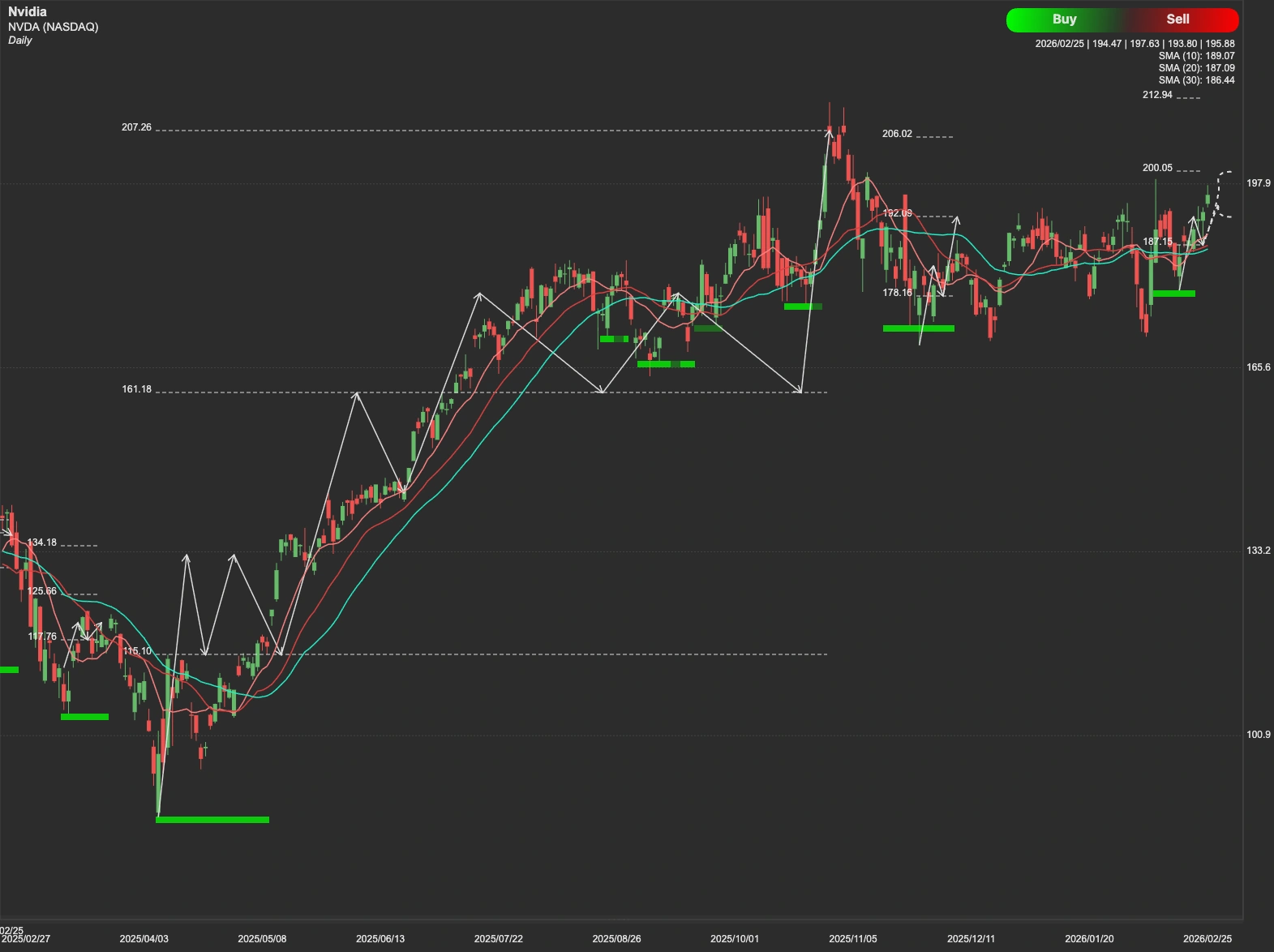
From a technical perspective, NVDA is firmly established in a clear uptrend. The stock is currently facing a primary resistance level at $212. A decisive daily close above this mark would likely confirm a breakout, maintaining the integrity of the current uptrend and clearing the path for the next bullish target of $223.
If the $212 resistance holds firm and price action cools, the stock may seek its first major support level at $184. Should broader market volatility increase or a deeper correction occur, the secondary and more significant support level sits at $161.