
Oracle Stock Analysis: AI Infrastructure Boom Fuels Revenue Growth
Oracle Corporation (NYSE: ORCL) has delivered a historic performance for the fourth quarter and full fiscal year 2026, driven by a monumental surge in demand for its Cloud Infrastructure and Cloud Applications solutions. However, this aggressive expansion comes with high capital requirements, leaving investors to weigh explosive top-line growth against substantial capital expenditure.
AI Demand Is Driving Oracle's Growth Story
For the fourth quarter of fiscal 2026, revenue climbed 21% year over year to a record $19.2 billion, while total cloud revenue surged 47% to $9.9 billion. The strongest growth came from Oracle’s Cloud Infrastructure (IaaS) division, where revenue soared 93% to $5.8 billion. Meanwhile, cloud applications (SaaS) revenue increased 10% to $4.1 billion.
Software revenue declined 2% to $6.8 billion as enterprise customers continued migrating from on-premise software to the Cloud. Services revenue was $1.5 billion, up 13%, and Hardware revenue was $0.9 billion, up 9%.
Profitability also remained solid. Fourth-quarter GAAP operating income increased 20% to $6.1 billion, while non-GAAP operating income rose 22% to a record $8.6 billion. Operating margins remained resilient, with GAAP operating margin steady at 32% and non-GAAP operating margin improving to 45%. Q4 GAAP earnings per share increased to $1.45, up 21%, and non-GAAP earnings per share climbed to $2.11, up 24%.
For the full fiscal year 2026, Oracle generated record revenue of $67.4 billion, up 17% from the prior year. Cloud revenue reached $34.0 billion, representing a 39% increase. Fiscal 2026 GAAP earnings per share rose 34% to $5.83, while non-GAAP earnings per share climbed 27% to $7.63.
Record Backlog
Perhaps the most significant metric from the report was Oracle's Remaining Performance Obligations (RPO), which ended the quarter at $638 billion, representing a staggering 363% year-over-year increase. The company added $85 billion of new backlog during Q4 alone.
Management revealed that much of the recent RPO growth comes from large-scale AI contracts. Importantly, many customers have either prepaid for GPUs or supplied GPUs directly to Oracle. The prepaid and customer supplied hardware portions of large AI contracts now total $75 billion. This arrangement reduces Oracle's capital requirements to build out AI datacenters.
Massive Capital Spending
The company spent $55.7 billion on capital investments during fiscal 2026, an increase of 162% from the previous year. Even after accounting for financing arrangements and customer prepayments, net cash outlay for capital expenditures reached nearly $48 billion. These investments pushed free cash flow to negative $23.7 billion during fiscal 2026, despite operating cash flow reaching a record $32.0 billion (up 54% year over year).
In fiscal year 2026, Oracle raised $43 billion in debt financing and $5 billion in equity financing. The company ended fiscal 2026 with $31.3 billion in cash and cash equivalents and total debt of approximately $129.5 billion.
Management expects fiscal 2027 capital spending to rise further, with net cash outlay for capital expenditures projected at approximately $70 billion. To fund this, Oracle plans to raise approximately $40 billion in FY2027 through a combination of debt and equity (including a previously announced $20 billion at-the-market equity issuance). Oracle does not expect to issue additional debt in calendar year 2026.
Strong Guidance for Fiscal Year 2027
Looking ahead, Oracle’s guidance suggests momentum could continue accelerating. For the first quarter of fiscal 2027, management expects revenue growth between 27% and 29%, while cloud revenue is projected to expand between 58% and 64%. Oracle also reaffirmed its ambitious full-year fiscal 2027 revenue target of $90 billion and raised non-GAAP EPS guidance to $8.05.
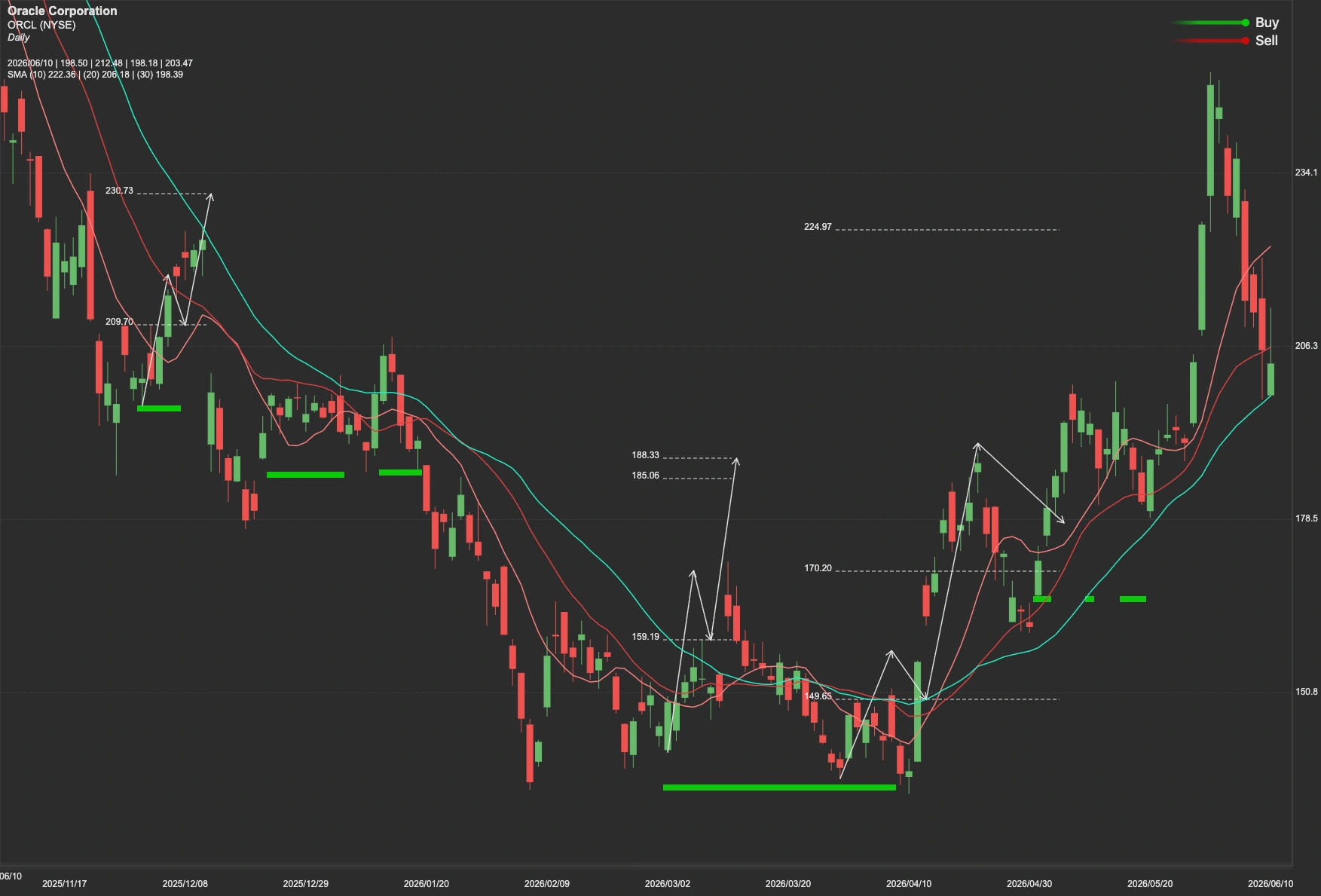
ORCL Stock Technical Analysis
Oracle's fundamentals are robust, but its heavy capital requirements and equity dilution risks are keeping market participants cautious.
From a technical perspective, the key resistance level currently sits near $236. If ORCL can establish a sustained breakout and maintain momentum above this level, the next upside target could emerge around $270.
However, failure to decisively clear resistance may trigger a pullback toward the first major support zone near $171. Should broader market weakness or profit-taking intensify, ORCL could potentially seek further support around $135-$120.