
Oracle Stock Analysis: Cloud Strength Vs. AI bubble and Debt Concerns
Oracle Corporation (NYSE: ORCL) announced its fiscal Q2 2026 results to a sharply mixed market reaction. While the company delivered an impressive adjusted earnings per share (EPS) of $2.26, significantly beating analyst expectations, its reported revenue of $16.1 billion fell just shy of the $16.19 billion consensus estimate. This slight revenue miss, coupled with broader market worries over high corporate AI spending and Oracle's surging debt, caused the stock to plunge over 10% in extended trading.
Financial and Operational Highlights
Oracle reported Q2 total revenue of $16.1 billion, up 14% year over year in USD. Cloud revenue (IaaS plus SaaS) reached $8.0 billion, growing 34% year over year, driven primarily by explosive demand for Oracle Cloud Infrastructure (IaaS), which surged 68% to $4.1 billion. Cloud applications (SaaS) revenue contributed another $3.9 billion, up 11% year over year. Software revenues were down 3% in USD to $5.9 billion.
The company’s standout metric was its $523 billion in Remaining Performance Obligations, up 438% year over year, fueled by large-scale cloud and AI contracts with Meta, NVIDIA, and others.
Profitability: GAAP earnings per share (EPS) jumped 91% to $2.10, significantly bolstered by a $2.7 billion pre-tax gain from the strategic sale of Oracle's interest in Ampere. Non-GAAP EPS also saw a robust 54% increase to $2.26.
Balance Sheet and Growing Debt
Oracle’s balance sheet continues to shift toward AI-led data center expansion. Cash and equivalents rose to $19.2 billion, while property, plant, and equipment climbed to $67.9 billion from $43.5 billion in May, underscoring heavy investment in AI infrastructure.
Debt remains elevated at over $108 billion in total borrowings, renewing concerns about sector-wide leverage associated with AI-driven capital spending. Still, operating cash flow over the last twelve months grew 10% to $22.3 billion, providing growing capacity to service obligations.
Strategic Shift to Chip Neutrality
Chairman and CTO Larry Ellison confirmed a major strategic pivot, announcing the sale of the Ampere chip company to establish a policy of "chip neutrality." This decision positions Oracle to deploy any CPU or GPUs required by its customers, ensuring agility in the fast-evolving AI sector.
Meanwhile, its multicloud footprint has become a differentiator. The company now operates 211 live and planned regions and is building 72 Oracle Multicloud datacenters to be embedded throughout the Amazon, Google and Microsoft clouds. Oracle reported its multicloud database business grew 817% in Q2. This confirms that Oracle's aggressive build-out of global data centers and its "Cloud Neutrality" strategy, which allows customers to run Oracle databases in any cloud they choose, is paying massive dividends.
AI Integration Across All Software Layers
Management emphasized that embedding AI across cloud datacenter software, autonomous database and analytic software, and applications software represents the next major growth engine. Oracle believes this vertically integrated AI stack will unlock automation opportunities in banking, healthcare, and analytics—potentially expanding its total addressable market.
Technical Outlook
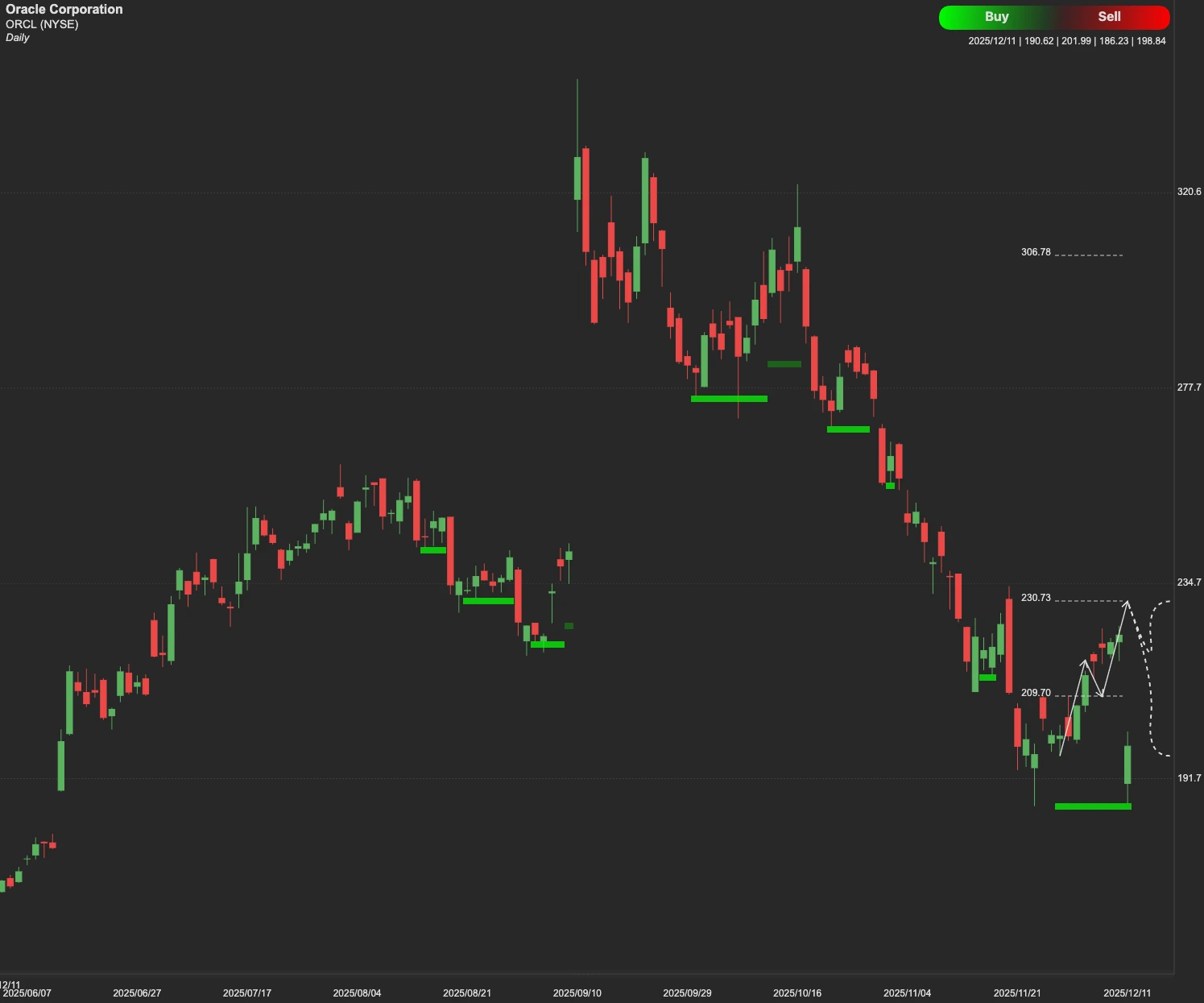
Despite the strong underlying RPO and IaaS numbers, the market’s immediate negative reaction means ORCL stock is now facing a crucial technical test. A sustained breakout above $229 could trigger a momentum-driven move toward the next major resistance at $261. Only by clearing these levels decisively can the stock confirm an upward trend supported by its strong fundamentals.
Should the stock fail to overcome the $229 ceiling, or if broader market pressures related to AI spending and debt take hold, ORCL may seek support. The initial support level is at $183. A breakdown below this point would signal a larger correction, potentially leading the stock to test the further support range between $169 and $153.