
PayPal Q1 2026 Results Show Stability, but Challenges Remain Ahead
PayPal Holdings, Inc. (NASDAQ: PYPL) reported its first-quarter 2026 financial results on May 5, 2026, delivering what management described as a "solid start" to the year. However, beneath the surface of the headline numbers lies a complex corporate turnaround. Under the guidance of newly appointed President and CEO Enrique Lores, PayPal is executing a multi-year restructuring program aimed at sharpening focus, driving automation, and recapturing the company's historical growth trajectory.
1Q'26 Financial Performance: Stable but Pinched
PayPal’s first-quarter performance presented a mixed bag of stable top-line growth offset by compression in profitability.
Net revenues grew by 7% year-over-year (5% on a currency-neutral basis) to reach $8.4 billion. This expansion was driven by a 7% increase in transaction revenues to $7.5 billion, supported by steady performance across Payment Service Provider (PSP), Venmo, and branded checkout. Other value-added services revenues grew even faster, climbing 10% to $852 million, thanks to robust momentum in consumer and merchant credit.
Transaction margin dollars (TM$) rose 3% to $3.8 billion. Stripping out the interest earned on customer balances, transaction margin dollars still grew by 3% to $3.5 billion, driven by credit, Venmo, and PSP with improved loss performance. Growth was partially offset by strategic investments to drive habituation and selection rate across branded checkout and buy now pay later.
GAAP operating income decreased by 3% to $1.5 billion, with GAAP operating margins contracting by 182 basis points to 17.8%.
Non-GAAP operating income fell by 5% to $1.5 billion, dragging non-GAAP operating margins down by 229 basis points to 18.4%.
GAAP net income dropped 14% to $1.1 billion, resulting in a 6% decline in GAAP earnings per share (EPS) to $1.21. Non-GAAP EPS managed a minor 1% gain, rising to $1.34 from $1.33 in 1Q'25.
Cash Flow and Capital Allocation
Operating cash flow was $1.1 billion, and free cash flow was $0.9 billion. Adjusted free cash flow was $1.7 billion, which excludes the net timing impact between originating buy now, pay later (BNPL) receivables as held for sale and the subsequent sale of those receivables.
The company ended the quarter with cash, cash equivalents, and investments of $13.5 billion and total debt of $11.6 billion.
Capital allocation remains highly shareholder-friendly. PayPal returned $1.5 billion to stockholders by repurchasing 34 million shares during the quarter. On a trailing 12-month basis, the company returned $6.0 billion to stockholders, reducing weighted average shares by 8%. Additionally, the Board declared a cash dividend of $0.14 per share, payable on June 25, 2026.
Operational Metrics: Engagement vs. Account Loss
Total Payment Volume (TPV) grew by a healthy 11% (8% currency-neutral) to $464.0 billion. Total payment transactions rose 7% to 6.5 billion; excluding payment service provider transactions (PSP), payment transactions increased 7%, reflecting customer engagement with transaction growth in branded experiences (debit and branded checkout) and Venmo.
However, payment transactions per active account (TPA) on a trailing 12-month basis ticked down by 1% to 58.7. Stripping out PSP, TPA actually increased by 6%.
The most notable headwind remains active account growth. While total active accounts grew 1% year-over-year to 439 million, they declined on a sequential basis. PayPal lost approximately 0.2 million active accounts (a sequential drop of 0.04%) compared to the previous quarter.
The Turnaround Plan: Cost Savings and AI Adoption
In his commentary, CEO Enrique Lores emphasized that PayPal is operating with high urgency to simplify its organization and improve its cost structure: "We are taking deliberate steps to sharpen our strategy, simplify our organization, and improve both our growth trajectory and cost structure by focusing our investments where we believe they will have the greatest impact."
PayPal is targeting a minimum of $1.5 billion in gross run-rate savings over the next two to three years. These savings are expected to be unlocked through structural simplification, clearer corporate accountability, and an accelerated rollout of artificial intelligence (AI) and automation across its operations. Management plans to aggressively reinvest these savings into accelerating growth and counteracting business headwinds.
A Challenging Guidance Outlook
Despite a solid start to the year, PayPal's management reiterated its conservative full-year 2026 guidance, citing a complex and dynamic operating environment.
For the full year 2026, the company continues to anticipate:
-
A slight decline in Transaction Margin Dollars (TM$).
-
Low-single digit decline to slightly positive growth for non-GAAP EPS.
-
Mid-single digit decline for GAAP EPS.
-
$6B+ of adjusted free cash flow.
-
$6B for share repurchases.
Second-quarter guidance was even softer, with management forecasting approximately a 9% decline in non-GAAP EPS and a 3% decline in Transaction Margin Dollars.
PYPL Stock Technical Analysis
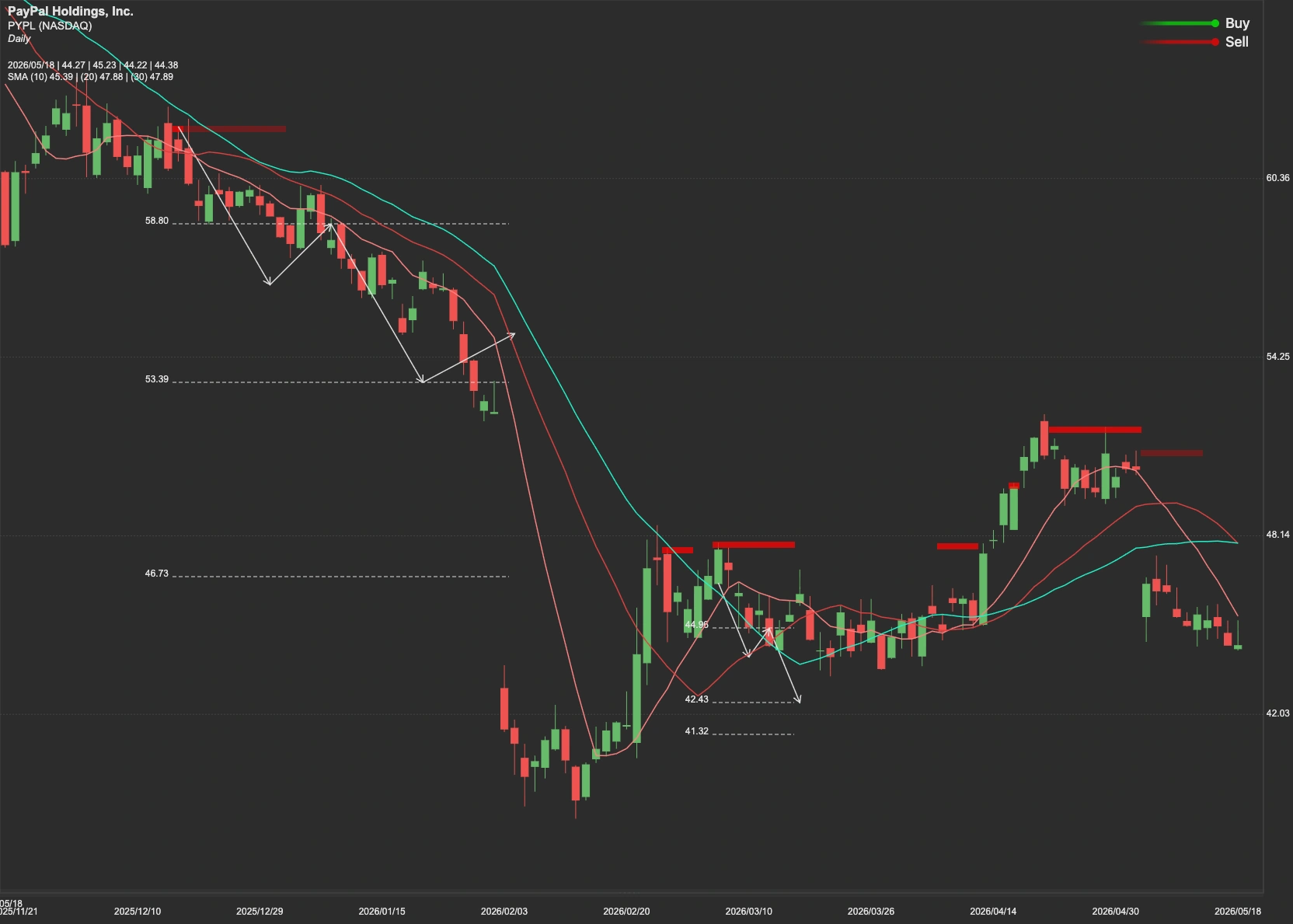
From a technical perspective, PYPL stock still has significant hurdles before establishing a sustainable uptrend. In the short term, the key resistance level sits around $55. A successful breakout and sustained move above that level could open the door toward the next major resistance near $67. For longer-term investors, the more significant resistance level stands near $109.