
PepsiCo Q2 2026 Earnings Show Resilience Despite North America Headwinds
PepsiCo, Inc. (NASDAQ: PEP) delivered a solid second-quarter performance that highlighted the strength of its international operations and the resilience of its diversified food and beverage portfolio, even as North American demand remained softer than expected.
Second-Quarter Performance
The company reported second-quarter net revenue of $24.18 billion, up 6.4% year over year, due to 2.4% organic revenue growth, a 2.2% benefit from foreign exchange translation, and a 1.8% net benefit from acquisitions and divestitures. Organic revenue growth reflects the benefits associated with effective net pricing and a contribution from organic volume growth.
Gross profit was $13.1 billion, compared to $12.4 billion last year. Gross margin fell by 50 basis points to 54.2%, while core gross margin contracted by 80 basis points to 54.3%.
Reported operating profit surged 125% to $4.02 billion, while earnings per share climbed 137% to $2.18. Much of the dramatic year-over-year increase was due to the absence of last year's impairment charges related to the Rockstar and Be & Cheery brands. On an adjusted basis, core operating profit increased 4% to $4.1 billion, with core operating margin contracting 40 basis points. Core EPS grew at a more modest 4% to $2.20, and core constant currency EPS edged up 1% for the quarter.
The company ended the quarter with cash, cash equivalents, and short-term investments of $10.7 billion and total debt of $53.2 billion.
International Strength vs. North American Slowdown
The international businesses continue to perform incredibly well, posting organic revenue growth of 7% in Q2. Every international segment delivered positive organic revenue growth, supported by organic volume gains across Asia Pacific Foods, International Beverages Franchise, and Europe, Middle East and Africa, alongside a sequential improvement in organic volume trends in Latin America Foods.
North America presented a more mixed picture. Organic revenue declined 0.5% as food and beverage demand moderated in the U.S. during the quarter.
PepsiCo Beverages North America reported net revenue growth of 7%, largely driven by acquisitions completed in 2025, while underlying organic revenue growth was only 1%. Organic beverage volume declined 4%, reflecting continued pressure in several categories and transitional impacts within the company's water business.
Meanwhile, PepsiCo Foods North America saw net revenue decline 2%, primarily due to lower effective net pricing despite market share gains supported by innovation and affordability initiatives.
Management acknowledged that consumer demand in North America softened more than expected during the second quarter and now expects a more gradual recovery through the remainder of the year.
Forward Outlook
Management maintained its full-year fiscal 2026 guidance, expecting organic revenue growth of 2% to 4% and core constant currency EPS growth of 4% to 6%. Including favorable currency movements and acquisition contributions, PepsiCo expects net revenue growth of 4% to 6% and core EPS growth of approximately 5% to 7%. The company also reaffirmed plans to return approximately $8.9 billion to shareholders during fiscal 2026 through dividends and share repurchases.
However, Chief Financial Officer Steve Schmitt cautioned that input cost inflation is expected to tick higher in the second half of 2026. Record productivity savings and refund claims for tariffs paid last year should help mitigate a good portion of the higher costs and investments in the business that aim to accelerate growth. As a result, PepsiCo expects core and core constant currency EPS growth to be heavily weighted toward the fourth quarter.
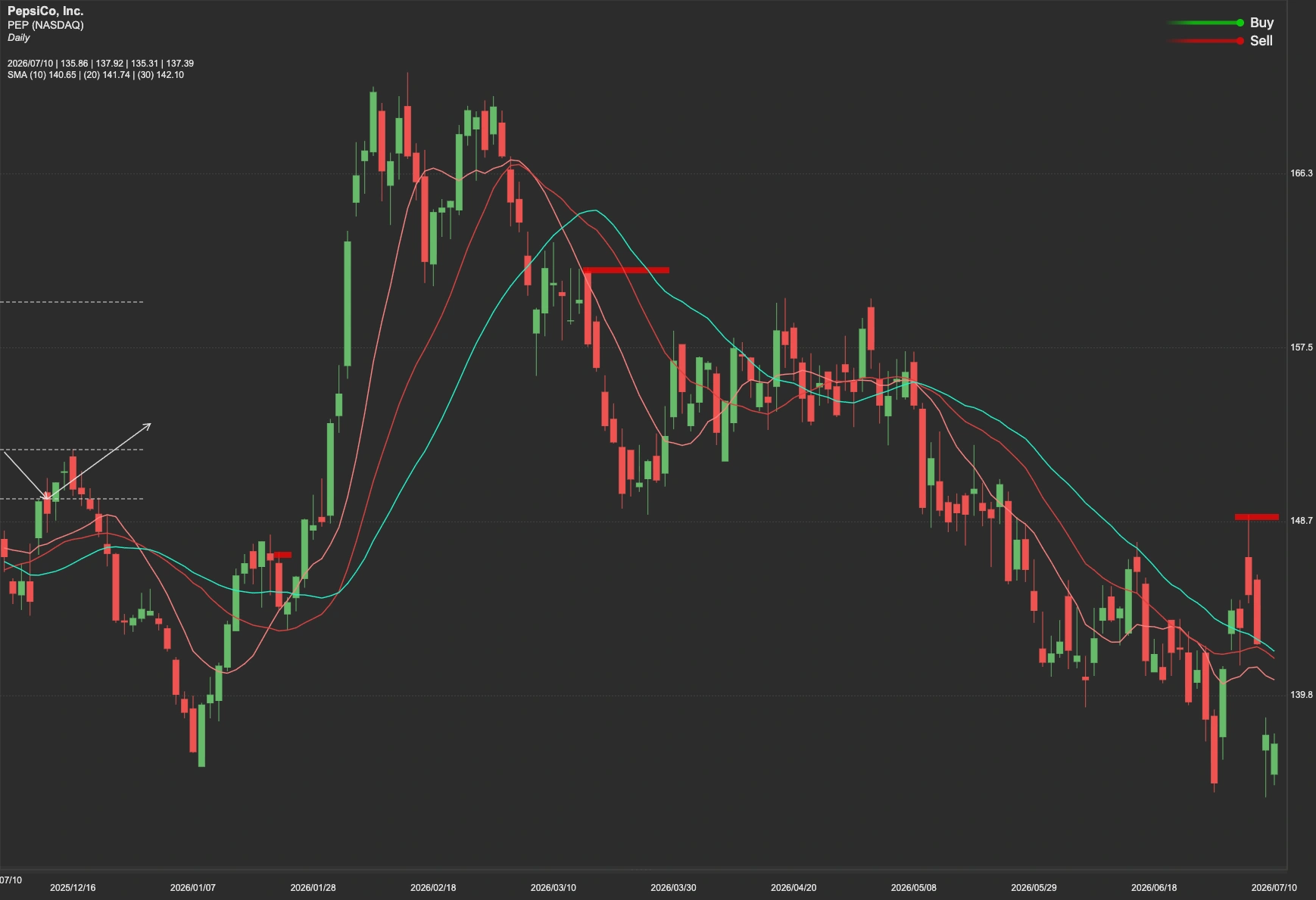
PEP Stock Technical Analysis
From a technical perspective, the $152 level represents a major resistance zone that could determine the stock's next directional move. A decisive breakout and sustained close above $152 would improve bullish momentum and open the path toward the next resistance target around $166.
However, if buyers fail to overcome the $152 resistance, the stock could remain under pressure and revisit the primary support near $122. If broader market conditions deteriorate, the next major support level sits near $110.