
Shopify Stock Analysis: Strong Growth Meets Market Skepticism
Shopify Inc. (NASDAQ: SHOP) entered 2026 with strong operational momentum, yet the market reaction to its fourth quarter and full-year 2025 results tells a more cautious story. Despite delivering 30% full-year revenue growth and generating $2 billion in free cash flow, the stock declined 11% following the earnings release.
Full Year 2025: Scaling to New Heights
For the full year 2025, Shopify generated $11.56 billion in revenue, up 30% year over year. This was driven by a 35% surge in Merchant solutions revenue ($8.8 billion) and a 17% rise in Subscription solutions ($2.75 billion). Gross merchandise volume (GMV) reached $378.4 billion, reflecting 29% annual growth. This growth helped Shopify secure a >14% share of the US ecommerce market. The company reported an operating income of $1.47 billion for the year. Most notably, the company achieved a 17% free cash flow margin for the year. This performance underscores Shopify’s evolution into a scaled, cash-generative commerce infrastructure platform rather than merely a high-growth software story.
Growth drivers remain diversified and durable. International revenue expanded 36%, B2B GMV surged 96%, Gross Payments Volume expanded 37%, and Shop Pay GMV climbed 62%. Payment penetration continues to deepen, reinforcing merchant ecosystem stickiness.
Q4 2025: A Strong Finish
The fourth quarter of 2025 showed that Shopify’s momentum accelerated during the holiday season. The company achieved Q4 revenue growth of 31% year-over-year, reaching $3.67 billion.
Revenue Streams: Merchant solutions remained the primary engine, generating $2.9 billion (up 35% YoY), while Subscription solutions contributed $777 million (up 17% YoY).
Profits & Cash: Gross profit for the quarter rose to $1.69 billion. Shopify achieved a 19% free cash flow margin for the fourth quarter, translating to $715 million in free cash flow, making ten consecutive quarters of double-digit free cash flow margins.
Operational Discipline: Despite AI-focused investments such as Catalog, Sidekick, and Universal Commerce Protocol, operating income for the quarter hit $631 million, a significant jump from the $465 million reported in the same period of 2024.
Net income: For the fourth quarter of 2025, Shopify reported net income of $743 million, compared with $1.29 billion in Q4 2024. The year-over-year decline was primarily driven by fluctuations in non-operating items, particularly gains and losses on equity investments and other mark-to-market adjustments. Excluding the impact of equity investments, fourth-quarter 2025 net income was $594 million, up from $458 million in the prior-year quarter.
Balance Sheet and Capital Allocation
The balance sheet remains solid despite the maturity of convertible senior notes during the year. Cash, cash equivalents, and restricted cash ended 2025 at $1.55 billion. Strong operating cash flow of $2.03 billion for the year supported both reinvestment and shareholder returns, including the newly authorized $2 billion share repurchase program. Management emphasized that capital allocation remains unchanged: "prioritizing growth while remaining disciplined, flexible, and focused on long-term value for Shopify and shareholders."
Looking Ahead to 2026
Looking ahead, Shopify expects first-quarter 2026 revenue growth in the low-thirties percentage range year over year. Gross profit dollars are projected to grow in the high twenties, while operating expenses are expected to represent 37% to 38% of revenue. Free cash flow margin is anticipated to land in the low-to-mid teens for Q1, slightly below the prior-year quarter, reflecting continued investment in AI infrastructure and platform expansion.
Technical Outlook: The Road Ahead
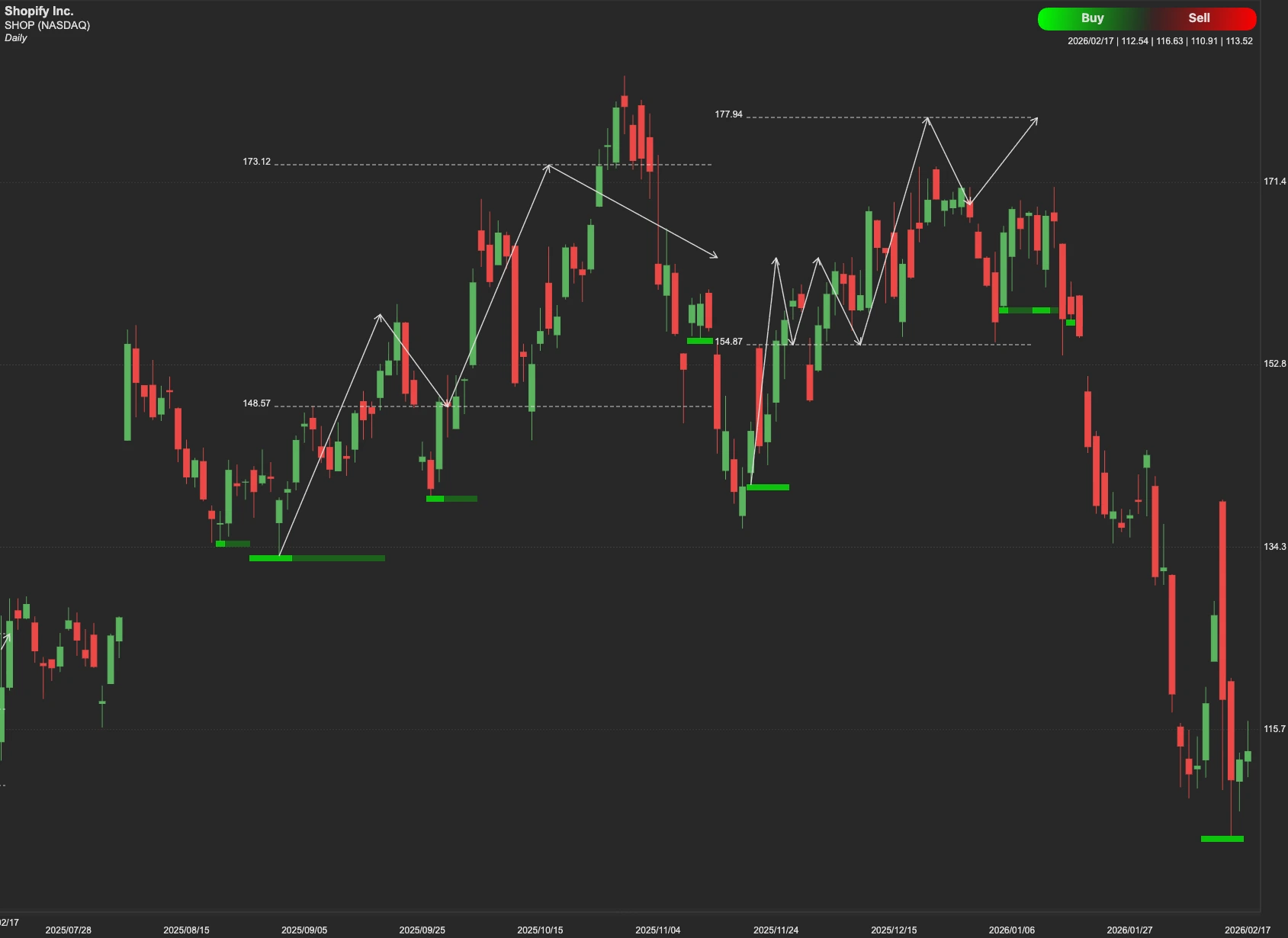
From a technical perspective, the stock now faces clearly defined levels that will determine its next directional move. The first key resistance level stands at $138. A sustained move above this threshold would indicate stabilization following the post-earnings decline. If momentum carries the stock beyond $153, the next major resistance level, a renewed upward trend would be more firmly established.
However, if the stock fails to overcome resistances, downside risk increases. The first major support level rests at $91. Should broader market conditions weaken or selling pressure intensify, secondary support at $78 becomes the next structural level to monitor.