
Snowflake Stock Analysis: AI Momentum Meets Critical Technical Hurdles
Snowflake (NYSE: SNOW) recently reported financial results for the fourth quarter and full year of fiscal 2026, showcasing significant growth in its AI Data Cloud ecosystem. With AI momentum, sustained innovation, a record number of net new customers, and expanded partnerships, the fundamental narrative remains strong. However, for investors, the immediate future of the stock price depends on a "battle of levels" between revenue growth and technical resistance.
Revenue Jumps and Operating Loss Narrows
The company generated $1.28 billion in revenue during the quarter, representing 30% year-over-year growth, while product revenue climbed to $1.23 billion, also up 30%. Gross margin expanded slightly to 66.8%, from 66.2% a year ago.
Although Snowflake remains unprofitable on a GAAP basis, the quality of its earnings continues to improve. The operating loss narrowed to $318 million from $387 million a year earlier, and non-GAAP operating income rose to $139 million, resulting in an 11% operating margin compared to 9% last year. GAAP net loss was $310 million, with a net loss per share of $0.90, compared with a net loss of $327 million and a net loss per share of $0.99 in Q4 FY2025. Non-GAAP diluted earnings per share increased to $0.32 from $0.30.
For the full fiscal year, revenue climbed 29% to $4.68 billion, while product revenue reached $4.47 billion, accounting for 95% of total revenue. GAAP gross profit increased to $3.15 billion, and gross margin improved to 67.2%, up 70 basis points year-over-year. GAAP operating loss was $1.44 billion, compared to $1.46 billion of operating loss in FY25. GAAP net loss was $1.33 billion, compared with net loss of $1.29 billion in FY25. On a non-GAAP basis, full year operating income reached $490 million, translating to a 10% operating margin, up from 6% a year ago. Non-GAAP diluted EPS increased to $1.25 from $0.83.
AI and Enterprise Expansion Driving Momentum
Snowflake continues to position itself at the center of enterprise AI infrastructure. Over 9,100 accounts are now using Snowflake AI features, while nearly 2,500 accounts adopted Snowflake Intelligence within three months.
Customer metrics remain strong:
-
733 customers generate over $1 million in trailing 12-month product revenue, up 27% year-over-year.
-
740 net new customers were added in Q4, representing 40% growth.
-
Net revenue retention rate stands at 125%, reflecting sustained expansion within the installed base.
-
Importantly, remaining performance obligations (RPO) grew 42% year-over-year to $9.77 billion, providing strong forward visibility.
Strategic partnerships with Anthropic, Google Cloud, and OpenAI further strengthen Snowflake’s AI ecosystem positioning.
Cash Flow and Balance Sheet Strength
Snowflake generated $781 million in operating cash flow in Q4 and delivered $765 million in non-GAAP free cash flow, representing a robust 60% FCF margin for the quarter.
For the full year, non-GAAP adjusted free cash flow reached $1.19 billion, underscoring improving capital efficiency despite GAAP net losses.
Cash and equivalents ended the year at $2.86 billion, providing flexibility for continued innovation, M&A, and share repurchases.
Fiscal 2027 Guidance Signals Balanced Growth
Looking ahead, management expects product revenue to grow 27% year over year in fiscal 2027, with full-year product revenue guidance of $5.66 billion. While this represents a modest deceleration from the 29% growth rate achieved in fiscal 2026, margin expansion is expected to continue, with full-year non-GAAP operating margin projected at 12.5%.
Technical Analysis
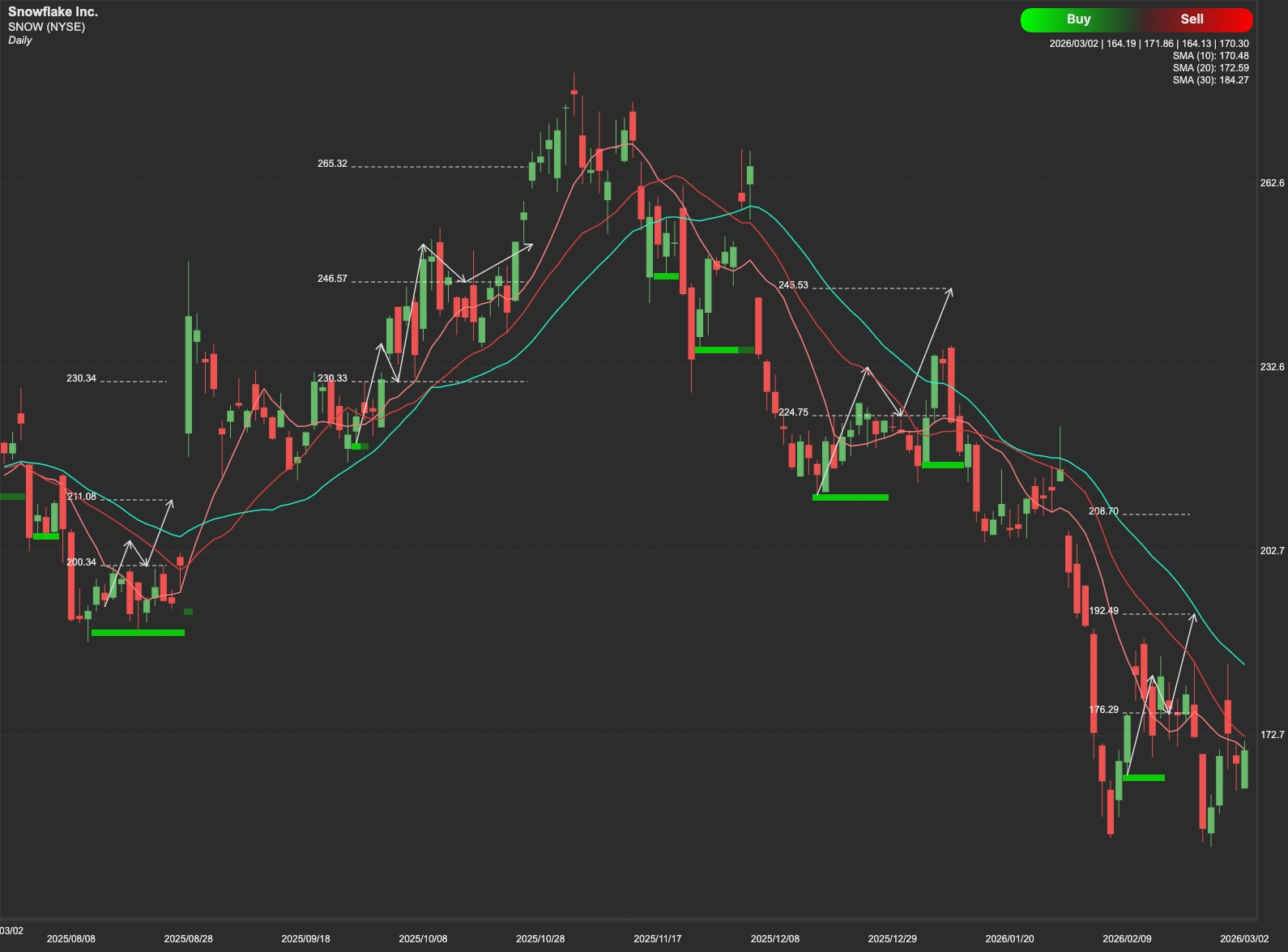
From a technical perspective, the $200 level represents a major resistance zone that must be decisively cleared to confirm a sustained bullish trend. If SNOW stock breaks above $200 and holds that level with strong volume support, the next key resistance level stands near $225. Overcoming these zones is essential to confirm a sustained upward trend.
However, if the stock fails to overcome the $200 resistance, downside risks remain. In that case, shares could retrace toward the $145 support level, and if selling pressure intensifies, the next major support sits near $120.