
Target Stock Analysis: Margin Reset and Strategic Investment Drive 2026 Growth Outlook
Target Corporation (NYSE: TGT) delivered a mixed set of fourth-quarter and full-year 2025 results, reflecting a business in transition. After navigating a challenging 2025 marked by declining comparable sales and margin pressure, the retailer is attempting to reset its growth trajectory through aggressive strategic investments and a renewed focus on merchandising authority, store experience, and technology.
Earnings Snapshot: Stabilization but Not Yet Recovery
Fourth-quarter net sales of $30.5 billion declined 1.5% year over year, while comparable sales fell 2.5%. The comp decline was driven by a 3.9% drop in store sales, partially offset by a 1.9% increase in digital sales. Importantly, trends accelerated in the final two months of the quarter, and management cited a healthy February sales increase.
One constructive development in Q4 was gross margin expansion. The gross margin rate improved to 26.6%, compared with 26.2% in 2024, driven by lower inventory shrink, reduced supply chain and digital fulfillment costs, and growth in advertising and other revenues, partially offset by the net impact of merchandising activities, including higher product and import costs.
Operating income was $1.4 billion in Q4, a decrease of 5.9% from $1.5 billion in 2024, and operating margin was 4.5% compared with 4.7% in 2024. Excluding the impact of non-recurring items, adjusted operating income was $1.5 billion, slightly above last year, and adjusted operating margin rate was 4.8%.
GAAP EPS for Q4 came in at $2.30, down from $2.41 last year. Adjusted EPS of $2.44—excluding $0.15 of business transformation costs—was modestly above prior-year levels and in line with company expectations.
For full-year 2025, performance softened:
-
Net sales declined 1.7% year over year to $104.8 billion.
-
GAAP diluted EPS fell to $8.13 from $8.86 in 2024.
-
Adjusted EPS dropped to $7.57.
Full-year gross margin rate was 27.9%, compared with 28.2% in 2024, reflecting pressures from merchandising activities. Full-year operating income declined 8.1% year over year to $5.1 billion, and adjusted operating margin compressed to 4.6%, down from 5.2% a year earlier. After-tax return on invested capital (ROIC) also stepped down to 13.8% from 15.4%, signaling reduced capital efficiency amid softer profitability.
Interest expense increased both quarterly and annually due to higher average debt levels, adding another incremental headwind to net earnings.
2026 Guidance: Measured Growth with Margin Expansion
Management expects approximately 2% net sales growth in 2026, driven by modest comparable gains, new stores, and expanding non-merchandise revenue streams.
The company is targeting:
-
Full-year 2026 operating margin approximately 20 basis points higher than the 4.6% adjusted operating margin in 2025.
-
GAAP and adjusted EPS in a range of $7.50 to $8.50.
Strategic Plan: $2 Billion Incremental Investment
Target plans an incremental $2 billion in investment for a New Chapter of Growth in 2026, including:
-
Over $1 billion in additional capital expenditures (total ~$5 billion)
-
$1 billion in operating investments
-
More than 30 new store openings in 2026
-
Investing in over 130 planned full-store remodels
-
Major in-store floor plan transformations
-
Expanded payroll and training
-
Increased AI and digital investments
The retailer is sharpening focus across differentiated categories—Home, Beauty, Baby, Food & Beverage, Wellness, Women’s apparel, and fandom-driven assortments—while scaling its loyalty ecosystem and same-day services powered by Target Circle 360.
Technical Outlook
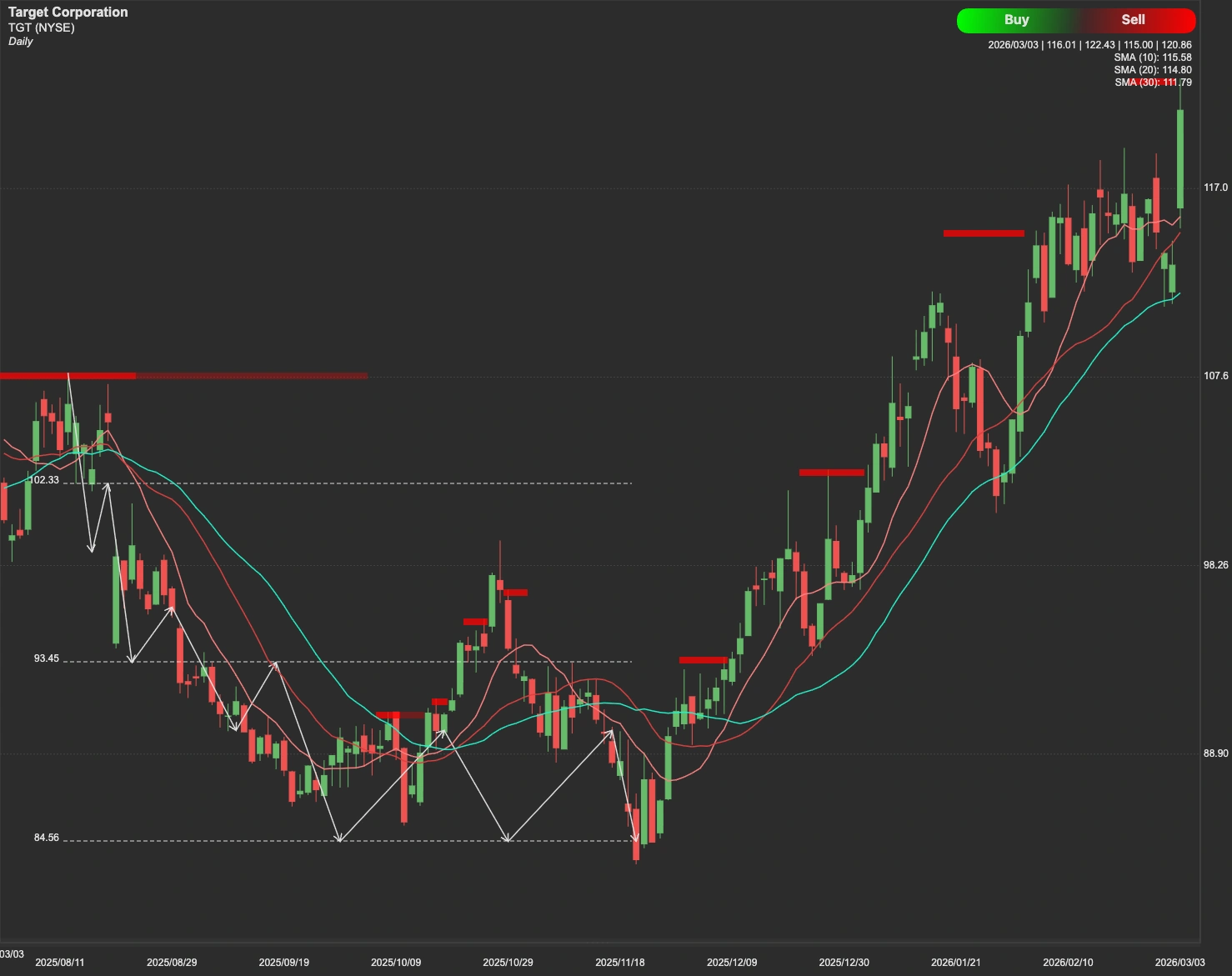
From a technical perspective, the $132 level represents a major technical barrier. A confirmed and sustained break above this level could signal improving investor confidence in the turnaround strategy. If momentum builds above $132, the next upside target is $143.
However, if TGT fails to hold above $132 and selling pressure intensifies, the stock may retrace toward key support levels. Initial support rests at the $100 psychological level. A breach there could lead to a deeper correction toward the long-term support floor at $85.