
Toll Brothers Stock Analysis: Resilient Luxury Homebuilding with Margin Pressures
Toll Brothers, Inc. (NYSE: TOL), the nation’s leading luxury homebuilder, recently reported its financial results for the fourth quarter and full fiscal year ended October 31, 2025. The results painted a picture of a resilient company executing well in a "choppy environment," as CEO Douglas C. Yearley, Jr. stated. However, while record revenues underscore the strength of the luxury segment, declining backlog and guidance for lower deliveries in FY2026 set up a fundamental tension.
Financial Review: Record Revenue Meets Margin Compression
Toll Brothers closed FY 2025 with strong top-line numbers, achieving a record $10.84 billion in home sales revenue, a modest increase from $10.56 billion in FY 2024. For the fourth quarter, home sales revenues rose to $3.41 billion, compared to $3.26 billion last year, driven by a slight increase in delivered homes (3,443 units).
However, profitability showed signs of strain:
Net Income and EPS: Q4 net income dipped to $446.7 million (diluted EPS of $4.58) from $475.4 million (diluted EPS of $4.63) in the comparable period last year. Net income for the full fiscal year was $1.35 billion and earnings per diluted share were $13.49, compared to net income of $1.57 billion and earnings of $15.01 per diluted share in FY 2024. FY 2024 results benefited from a one-time land-sale gain. Excluding this gain, net income and earnings per diluted share were $1.45 billion and $13.82 in FY 2024.
Gross Margin: The Q4 adjusted home sales margin fell to 27.1% from 27.9%. The adjusted home sales gross margin for the full fiscal year contracted to 27.3%, down from 28.4% in FY 2024. This signals the increasing challenge of maintaining pricing power amidst higher costs.
Demand Headwinds: The most significant concern for future performance lies in the contract and backlog figures. Net signed contract value declined both in Q4 ($2.53B vs. $2.66B) and for the full year ($9.85B vs. $10.07B). Crucially, the backlog value dropped significantly to $5.5 billion, down from $6.5 billion at FY 2024’s fourth quarter end, indicating potential volume struggles in the first half of FY 2026.
Balance Sheet and Capital Return
Toll Brothers ended FY 2025 fourth quarter with $1.26 billion in cash and a net debt-to-capital ratio of 15.3%, underscoring financial flexibility in a soft housing environment. The company returned approximately $750 million to shareholders through repurchases and dividends, including $651.6 million in share buybacks during the year.
Strategic Focus and FY2026 Outlook
The company is moving to maximize returns by exiting its Apartment Living segment, recently announcing the sale of its interests and operating platform to Kennedy Wilson. This strategic streamlining allows management to focus on the core luxury homebuilding business. Crucially, management continues to emphasize price-and-pace discipline, conservative land acquisition, and capital efficiency—strategies that tend to outperform during cyclical slowdowns.
The financial guidance for FY 2026:
FY 2026 Deliveries: Projected at 10,300 to 10,700 units, slightly lower than FY 2025's 11,292.
Average Delivered Price: Expected to remain high at $970,000 to $990,000.
Adjusted Home Sales Gross Margin: Guided for a further dip to 26.00%, confirming that margin compression is expected to continue.
Community Count: Management projects an 8% to 10% increase in community count, targeting 480–490 by year-end.
Technical Outlook
The market has a mixed fundamental outlook—strong cash flow, low net debt-to-capital (15.3%), and aggressive share repurchases ($651.6 million in FY25) versus a contracting backlog and falling margins.
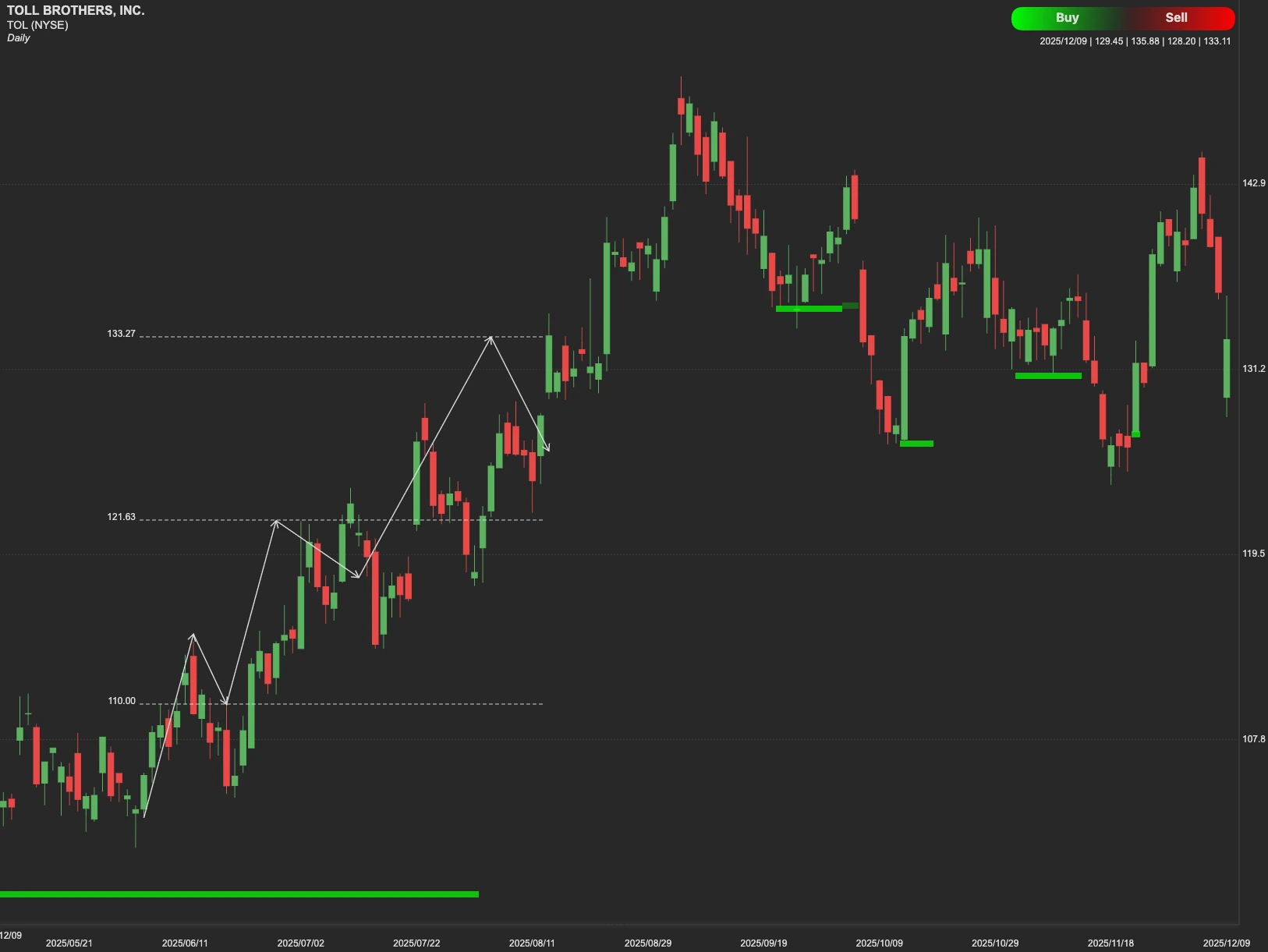
From a technical perspective, $149 is the key resistance level investors should monitor closely. If the stock can successfully break and hold above the $149 resistance, the next upside target is projected to be $165.
Conversely, a rejection at the $149 level, potentially triggered by persistent margin concerns or broader housing market weakness, would likely send the stock searching for support. The primary support level to watch is $111. A breakdown below $111 would signal a deeper correction, with the next critical support zone identified between $95 and $83.