
TSLA Stock Analysis: Tesla’s AI Investment Cycle Takes Center Stage as Margins Face Pressure
Tesla (NASDAQ: TSLA) delivered a mixed second quarter for 2026, combining record vehicle deliveries and strong revenue growth with shrinking operating margins and negative free cash flow as the company accelerated investments in artificial intelligence, robotics, autonomous driving, and manufacturing capacity.
Record Deliveries Push Revenue Growth
Tesla produced 451,758 vehicles and delivered a record 480,126 vehicles during the second quarter. Model 3 and Model Y remained the company's primary growth engines, accounting for more than 97% of total deliveries.
The strong delivery performance helped Tesla surpass $100 billion in trailing twelve-month revenue for the first time. Total second-quarter revenue increased 26% year over year to $28.24 billion.
The Automotive business generated $20.52 billion in revenue, up 23% from the previous year, while the Energy Generation and Storage segment grew 13% to $3.14 billion. Services and Other revenue surged 50% to a record $4.58 billion.
Revenue growth was supported by higher vehicle deliveries, expanding energy deployments, favorable foreign exchange movements, and rising FSD subscription revenue. However, lower vehicle average selling prices and reduced regulatory credit revenue partially offset these gains.
Margins Squeeze
Despite stronger revenue, Tesla's earnings remained under pressure as the company continued one of the largest investment cycles in its history.
Total gross profit increased 23% year over year to $4.75 billion, while gross margin declined slightly to 16.8%.
Operating expenses ballooned 47% to $4.4 billion, fueled by spending on AI and other R&D projects, stock-based compensation tied to the 2025 CEO Performance Award, and SG&A growth. Operating income dropped 57% to just $398 million, reducing operating margin from 4.1% a year ago to 1.4%.
GAAP net income declined 5% year over year to $1.11 billion, while non-GAAP net income fell 17% to $1.15 billion. Diluted GAAP earnings per share came in at $0.32.
Adjusted EBITDA decreased 4% year over year to $3.27 billion, with EBITDA margin falling to 11.6%.
Cash Flow Turns Negative as Capital Spending Accelerates
Tesla generated strong operating cash flow of $4.70 billion during the quarter, an 85% increase from the previous year.
However, capital expenditures surged 142% year over year to $5.79 billion as the company expanded production facilities, AI computing infrastructure, battery manufacturing, semiconductor projects, and autonomous vehicle programs.
As a result, Tesla reported negative free cash flow of $1.09 billion, compared with positive free cash flow in both the prior-year quarter and the first quarter of 2026.
Cash, cash equivalents, and short-term investments ended the quarter at $43.5 billion, providing the company with substantial financial flexibility despite the increased investment pace. Management noted that "We will manage the business such that we ensure a strong balance sheet, maintaining sufficient liquidity to fund our product roadmap, long-term capacity expansion plans – including further vertical integration – and other expenses.”
AI, Robotaxi, and Robotics Become Tesla's Primary Growth Focus
Tesla continues to shift its long-term strategy toward artificial intelligence and autonomous mobility.
During the quarter, Cybercab entered production at Gigafactory Texas, while engineering test drives on public roads began ahead of commercial deployment. Robotaxi operations expanded across multiple U.S. metropolitan areas, including Austin, Miami, Orlando, and Tampa.
The company also continued expanding FSD (Supervised), achieving record net new subscription adoption. More than 55% of new North American deliveries included FSD subscriptions, while additional European markets approved the technology.
Tesla also made meaningful progress on Optimus humanoid robots. Production lines are now being installed at the Fremont Factory after Model S and Model X manufacturing lines were decommissioned. Initial Optimus production is expected later this year.
Meanwhile, Tesla continued investing in Cortex AI computing infrastructure, battery production, lithium refining, 4680 battery cells, semiconductor manufacturing, and Supercharger network expansion.
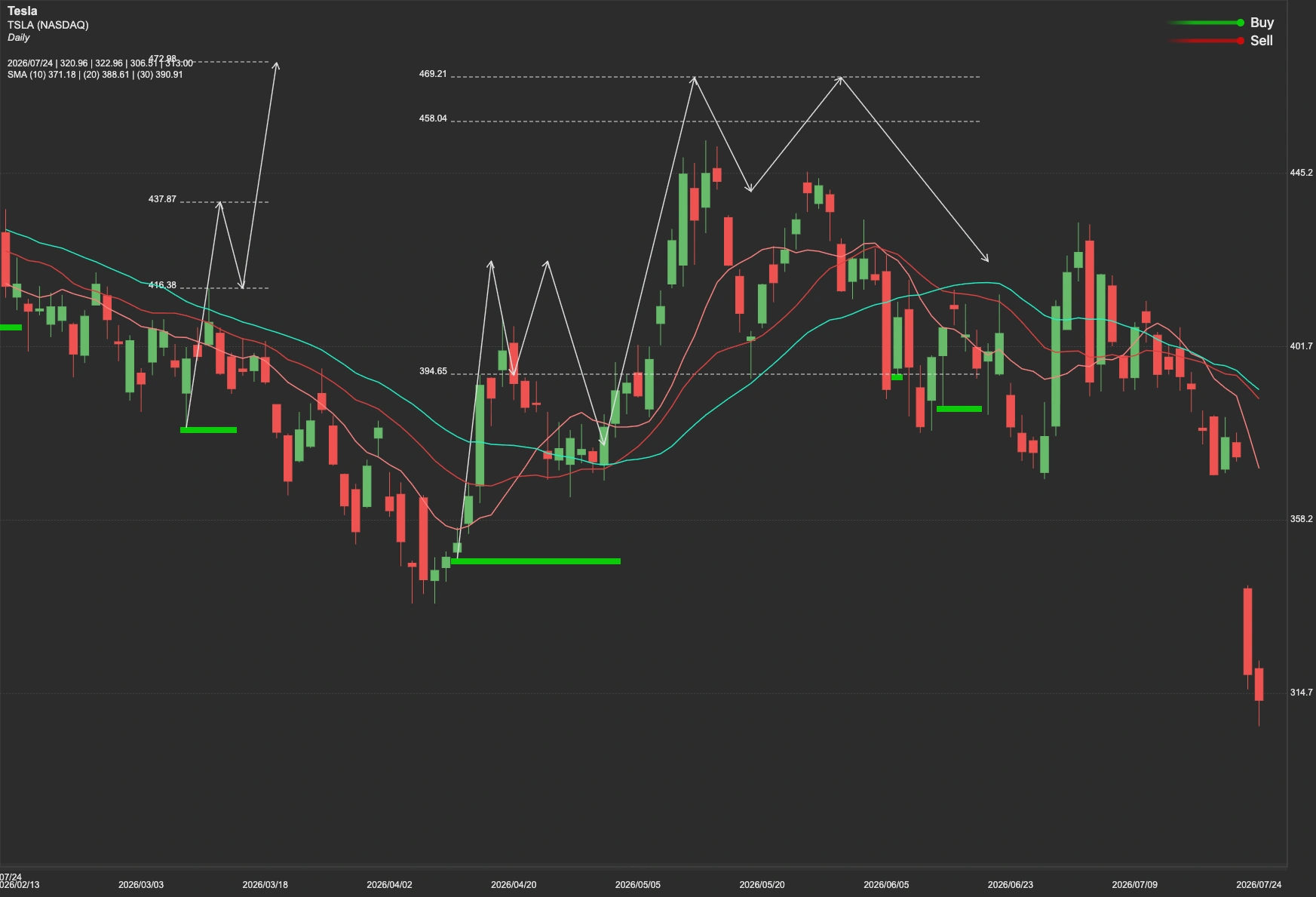
TSLA Stock Technical Analysis
From a technical standpoint, Tesla stock faces an immediate hurdle around the $352. If buyers can push and hold the price above $352, the path opens toward the next major resistance at $403, which would represent a meaningful breakout and likely coincide with renewed institutional interest.
However, if $352 holds as resistance and sellers take control, the stock may retreat to test support at $281. A breakdown below that level would open the door to a deeper correction zone between $257 and $226.