
Uber Q1 2026 Analysis: Mobility and Delivery Continue to Surge
Uber Technologies, Inc. (NYSE: UBER) delivered a powerful start to 2026, reinforcing the company’s transition from a high-growth platform into a highly profitable cash flow machine. First-quarter results showcased strong execution across Mobility and Delivery, expanding margins, and accelerating shareholder returns, while management continued investing aggressively in AI, autonomous vehicles, and enterprise services.
Strong Q1 Results
Uber reported first-quarter Gross Bookings of $53.7 billion, rising 25% year-over-year and 21% on a constant currency basis. Trips climbed 20% to 3.6 billion, supported by continued expansion in Monthly Active Platform Consumers and higher engagement per user. Mobility Gross Bookings increased 25% to $26.4 billion, while Delivery Gross Bookings surged 28% to nearly $26 billion, highlighting continued strength across both core segments.
Revenue rose 14% year-over-year to $13.2 billion despite a significant accounting-related headwind tied to business model changes in the UK. Management noted that the accounting adjustment reduced reported revenue growth by roughly 9 percentage points but had no impact on underlying economics or profitability.
Profitability continued to improve at an impressive pace. On a GAAP basis, the company generated operating income of $1.9 billion, up 57% year over year, driven by strong operating performance. Non-GAAP operating income jumped 42% year-over-year to $1.9 billion, while adjusted EBITDA increased 33% to $2.5 billion.
Net income for the quarter was $263 million down 85% year over year, which included a $1.5 billion net pre-tax headwind from revaluations of the equity investments. GAAP diluted EPS was $0.13 down 85% compared to $0.83 in Q1 2025. Non-GAAP net income grew 39% year over year to $1.5 billion, and non-GAAP EPS grew 44% to $0.72, at the high end of the company's guidance.
The company also demonstrated substantial cash generation strength. Uber produced $2.3 billion in free cash flow during the quarter and nearly $9.8 billion on a trailing twelve-month basis. Strong cash generation enabled the company to repurchase a record $3 billion worth of shares during Q1, reducing diluted share count by approximately 2% year-over-year.
The Fundamental Growth Engine
Perhaps most impressive is the maturation of the "Uber One" ecosystem, which has now reached 50 million members. These members are proving to be the backbone of the platform’s strategy, accounting for half of all Gross Bookings across the Mobility and Delivery segments.
Another standout growth engine remains Uber for Business (U4B), which now generates more than $5 billion of (high margin) annualized Gross Bookings and continues growing at 45% year-over-year. U4B now serves well over 300,000 organizations globally.
Efficiency Through AI and Disciplined Capital
One of the more important long-term developments was management’s growing emphasis on artificial intelligence. Uber disclosed that 95% of its engineers now use AI coding tools monthly, with over 10% of code already written autonomously by AI agents. The company believes AI-driven productivity gains can help moderate hiring growth while accelerating development velocity and operational efficiency.
Uber also continues building its autonomous vehicle strategy through a focused and disciplined way across self-driving technology partners, OEMs, and enabling infrastructure. Management reiterated the vehicle commitments are designed to be flexible and transferable to fleet or financial partners over time, allowing the company to benefit from AV growth without structurally increasing capital intensity.
Business Outlook
Looking forward, Uber guided for second-quarter Gross Bookings between $56.25 billion and $57.75 billion, representing constant currency growth of 18% to 22%. Management noted that the acquisition of SpotHero (which closed in April) is expected to have an immaterial impact on financial results. The company also expects Q2 Non-GAAP EPS between $0.78 and $0.82 alongside Adjusted EBITDA of $2.70-2.80 billion, signaling continued momentum despite macro and geopolitical uncertainties.
For the full year, Uber expects 2026 stock-based compensation between $1.95 billion and $2.15 billion and non-GAAP depreciation and amortization expense of $450-550 million.
Technical Analysis
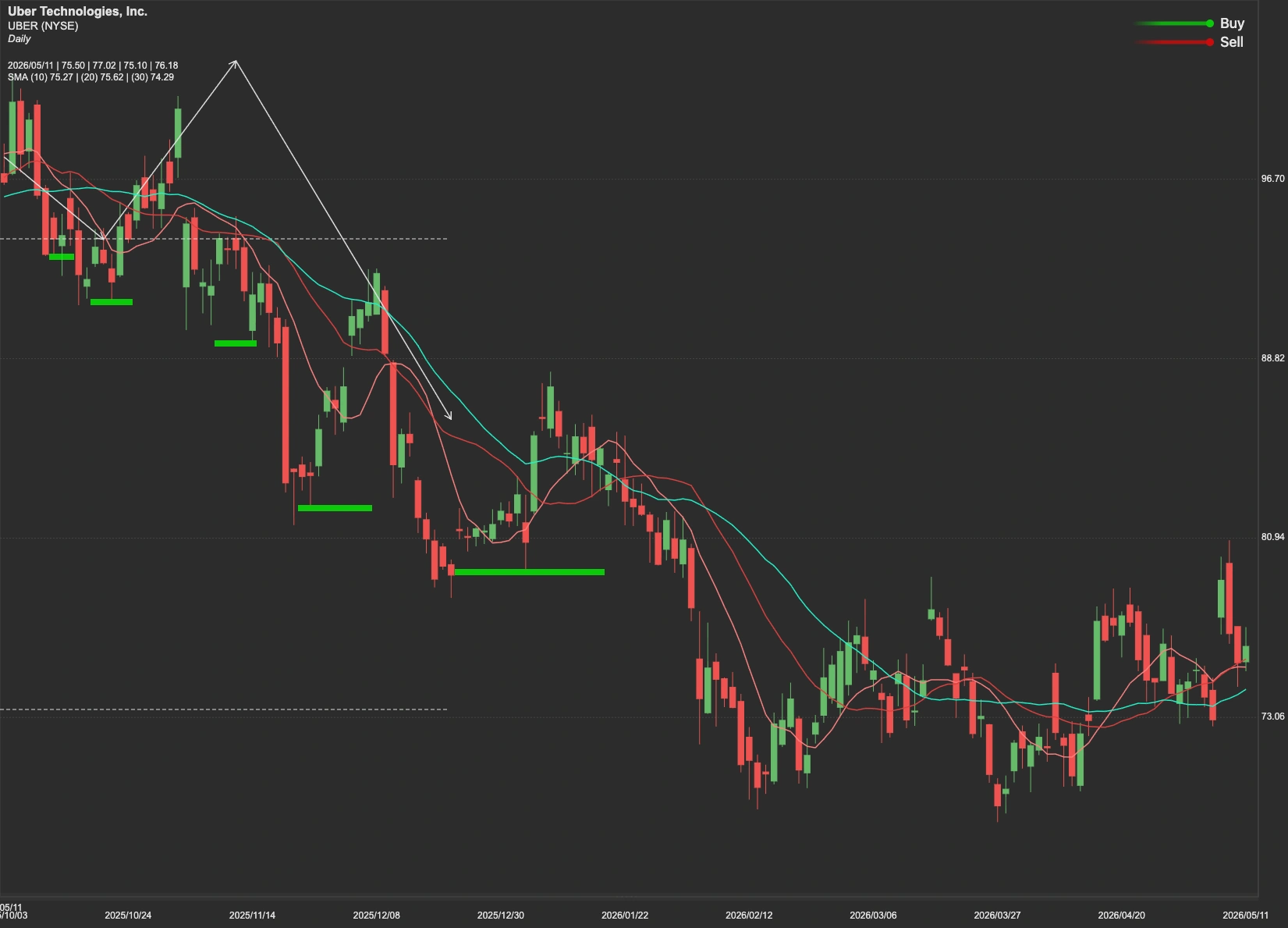
Resistance at $85: The $85 level remains the key resistance zone traders are watching closely. A sustained breakout and hold above $85 could open the door toward the next upside target near $95 as bullish momentum strengthens.
Support Levels: Should the stock fail to hold its ground at the current resistance, investors should look toward the $67 level for initial support. A deeper correction could see the stock seeking a floor at the significant $60 support zone, which represents a long-term base.