
Uber Stock Analysis: Record Profits Meet a Post-Earnings Sell-Off
Uber Technologies, Inc. (NYSE: UBER) delivered another record-breaking quarter to close out 2025, yet the market’s reaction has been unexpectedly frosty. Despite strong growth across key financial and operational metrics, the stock fell 8.8% following the earnings release, reflecting investor caution around sustainability, valuation, and forward expectations.
Fundamental Strength: The Numbers Behind the Record
In the fourth quarter, Uber reported 3.8 billion trips, up 22% year over year, driven by 18% growth in Monthly Active Platform Consumers and 3% growth in monthly Trips per MAPC. Gross Bookings climbed 22% year over year to $54.1 billion, while revenue rose 20% year over year to $14.4 billion.
Profitability improved significantly. GAAP income from operations surged 130% year over year to a record $1.8 billion. Adjusted EBITDA reached $2.5 billion, up 35% year over year, with Adjusted EBITDA margin (as a percentage of gross bookings) expanding to 4.6%, up from 4.2% in Q4 2024. Operating cash flow was a record $2.9 billion and free cash flow totaled $2.8 billion in the quarter.
However, GAAP net income declined 96% year over year to $296 million, GAAP diluted EPS declined to $0.14 from $3.21 in the prior year, largely due to a $1.6 billion headwind from equity investment revaluations. While non-GAAP net income grew 25% year over year to $1.5 billion, and non-GAAP EPS grew 27% year over year to $0.71, compared with $0.56 a year earlier.
Full-Year 2025: Scaling Profitability
For the full year, Uber generated $193.5 billion in Gross Bookings, up 19% year over year, and $52.0 billion in revenue, up 18% year over year. GAAP income from operations nearly doubled to $5.6 billion. Adjusted EBITDA reached $8.7 billion, up 35% year over year, and free cash flow totaled $9.8 billion, up 42% year over year.
GAAP net income grew 2% to $10.1 billion, compared with $9.9 billion in 2024, GAAP diluted EPS increased to $4.73, compared with $4.56 in 2024. Net income for the year ended December 31, 2024 includes a $6.4 billion benefit from a tax valuation release and a $1.8 billion net benefit (pre-tax) from revaluations of Uber’s equity investments. Net income for the year ended December 31, 2025 includes a $5.0 billion benefit from a tax valuation release and a $97 million net headwind (pre-tax) from revaluations of Uber’s equity investments. Non-GAAP net income grew 32% year over year to $5.2 billion, and non-GAAP EPS grew 35% year over year to $2.45.
Segment Performance: Mobility and Delivery Lead
Mobility and Delivery remain the growth engines.
Mobility Gross Bookings rose 20% year over year to $27.4 billion for the fourth quarter, while revenue increased 19% to $8.2 billion. Segment Adjusted EBITDA grew 25% to $2.2 billion.
Delivery showed even stronger acceleration, with Gross Bookings up 26% year over year to $25.4 billion for the fourth quarter and revenue up 30% to $4.9 billion. Segment Adjusted EBITDA surged 40% to $1.0 billion.
Freight remained relatively flat, contributing modestly compared to the core businesses.
Strategic Positioning Into 2026
CEO Dara Khosrowshahi emphasized that the company is not just a ride-hailing app but is becoming the "largest facilitator of AV (Autonomous Vehicle) trips in the world."
The Q1 2026 outlook projects Gross Bookings of $52.0–$53.5 billion, representing growth of 17% to 21% year over year on a constant currency basis—a slight deceleration from the 22% seen in Q4. Q1 2026 guidance calls for Non-GAAP EPS of $0.65–$0.72 and adjusted EBITDA of $2.37 billion to $2.47 billion.
Technical Outlook: Support and Resistance
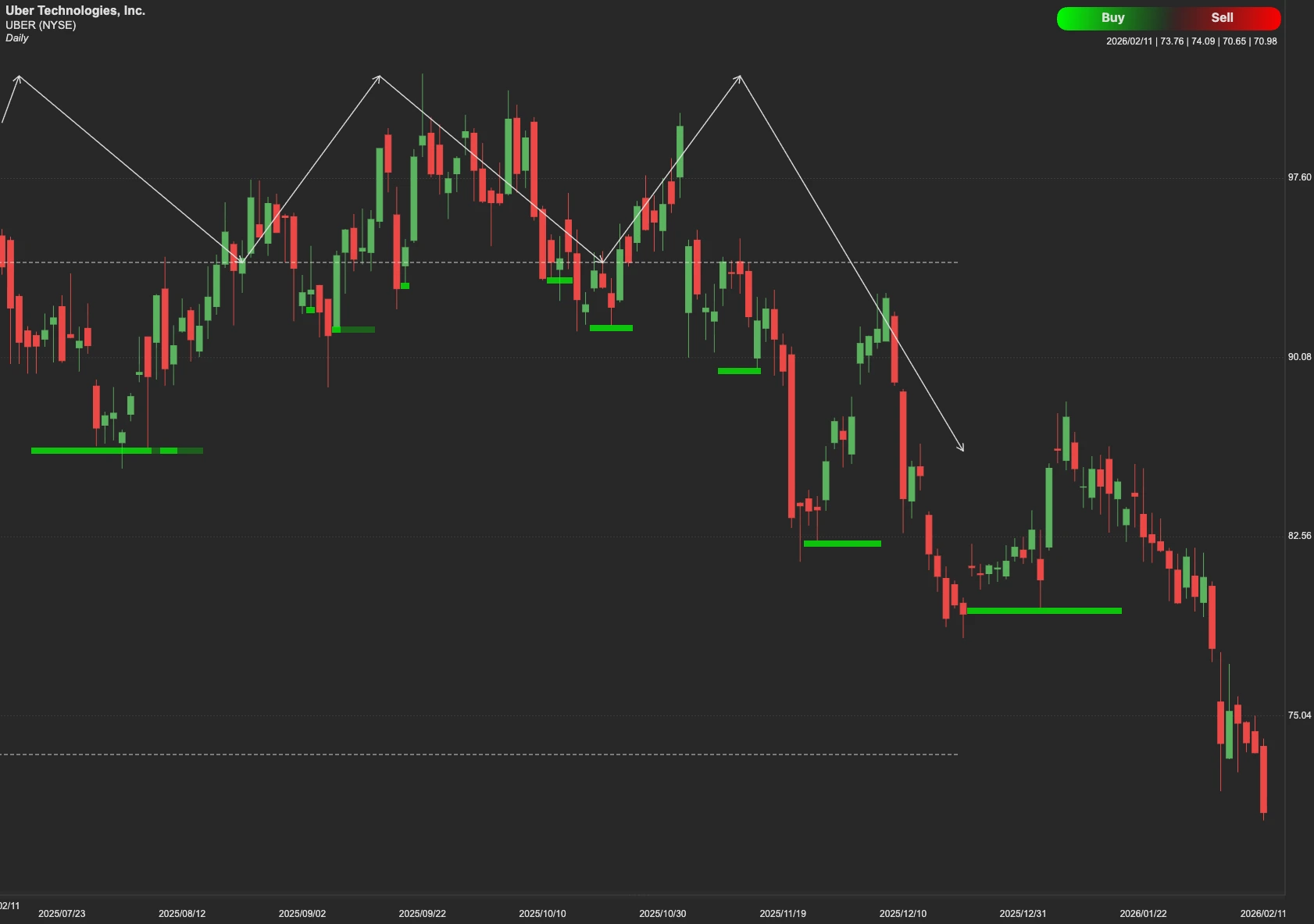
The 8.8% drop following the earnings release has forced Uber into a critical technical junction. As the stock processes this "sell-the-news" reaction, investors must watch key levels to determine if this is a healthy correction or the start of a deeper slide.
Currently, the immediate hurdle for Uber is the $81 level. If the bulls can push the price back above $81 and hold it, it opens the door to the next key resistance at $89. A breakout above $89 would be necessary to confirm that the long-term upward trend is sustainable.
Conversely, if the stock fails to reclaim $81, it may descend to seek liquidity at lower support zones. The first major support sits at $60. Should that level fail to hold, a further slide toward the $54 mark is possible.