
Uber Stock Analysis: Strong Q2 Fundamentals and AV Expansion Face Key Technical Resistance
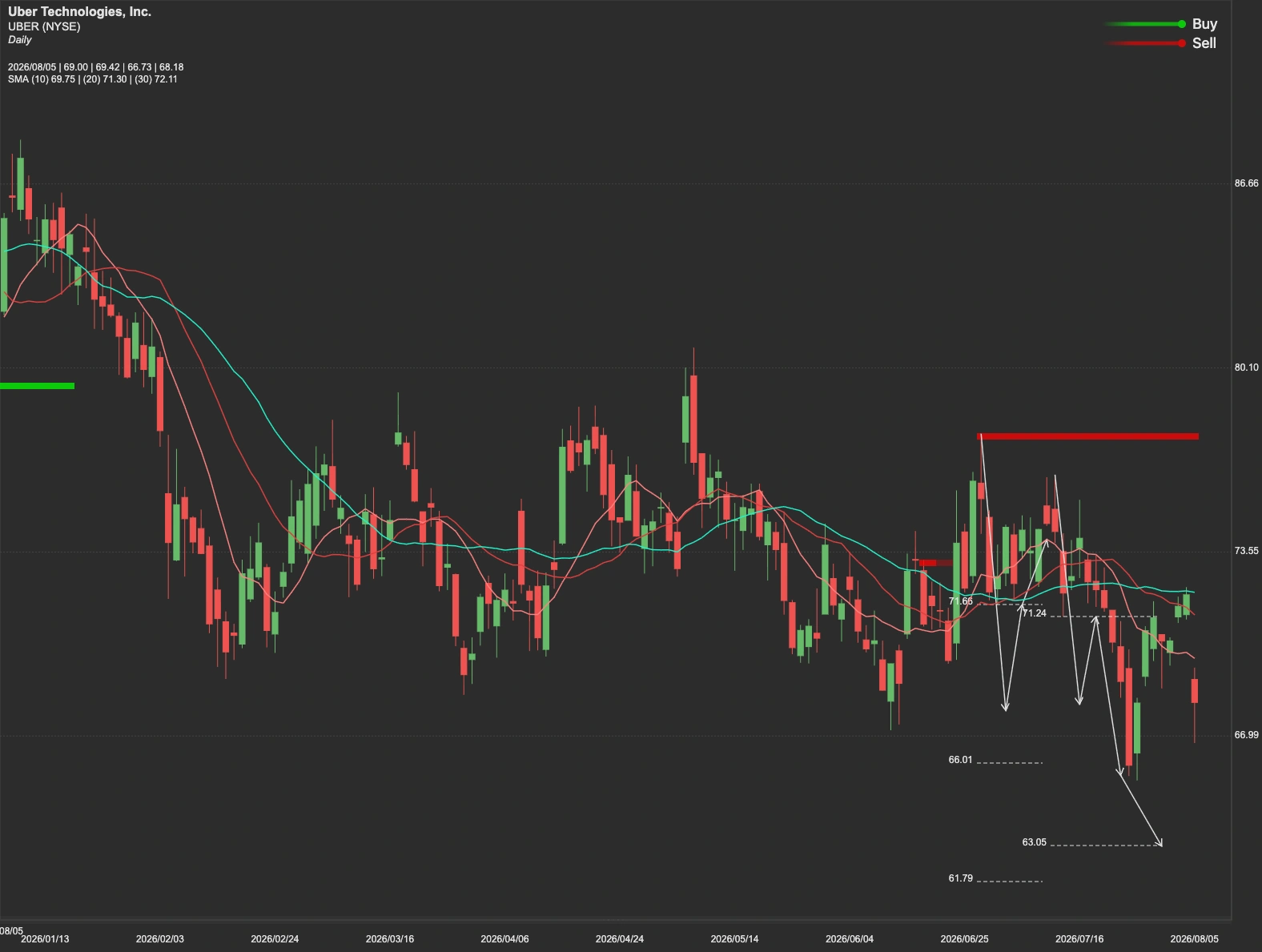
Uber Technologies, Inc. (NYSE: UBER) recently delivered an outstanding Q2 2026 financial report, underpinned by record engagement, surging gross bookings, and expanding margins. Alongside its second-quarter earnings, the company announced a transformational acquisition offer for Delivery Hero and expanded its autonomous vehicle strategy through a new partnership milestone with Wayve in London. Despite these milestones, UBER shares fell 5.29% to $68.18 on the session following the release.
Q2 2026 Financial Performance
For the quarter ended June 30, 2026, Uber reported Gross Bookings of $58.0 billion, up 24% year over year (22% on a constant-currency basis). Revenue grew 12% to $14.2 billion, or 11% in constant currency. Business model changes negatively impacted total revenue YoY growth by 8 percentage points on a reported and constant currency basis.
Key financial highlights include:
- Monthly Active Platform Consumers increased 16% to 208 million.
- Trips grew 18% to 3.87 billion.
- GAAP operating income rose 30% to $1.89 billion.
- Adjusted EBITDA increased 33% to $2.82 billion.
- Non-GAAP operating income climbed 40% to $2.14 billion.
- Non-GAAP EPS increased 35% to $0.81.
- Free cash flow reached $2.79 billion, while trailing twelve-month free cash flow exceeded $10 billion for the first time in company history.
GAAP net income surged to $2.39 billion, diluted EPS up 85% year over year to $1.17, supported by a $1.6 billion pre-tax gain from revaluations of Uber's equity investments, versus a $17 million headwind in the prior-year quarter.
At quarter end unrestricted cash, cash equivalents and short-term investments stood at $5.4 billion, long-term debt was $10.7 billion, while $2.0 billion of short-term debt appeared on the balance sheet and equity method investments ballooned from $287 million to $3.77 billion. Diluted share count fell from 2.126 billion to 2.050 billion on continued buybacks.
Delivery Is Now the Growth Engine
Delivery was the standout. Gross Bookings rose 26% year over year to $27.5 billion, revenue climbed 28% to $5.25 billion, and segment operating income surged 38% to $1.06 billion.
Mobility also remained resilient. Gross Bookings grew a healthy 22% year over year to $29.0 billion, but segment revenue rose just 1% to $7.36 billion (0% in constant currency). Segment operating income still advanced 28% to $2.22 billion.
Freight returned to relevance with bookings up 25% year over year to $1.57 billion and operating losses narrowed to $24 million.
Autonomous Vehicle Strategy Continues to Progress
Uber also announced another milestone in autonomous transportation.
Transport for London granted private hire vehicle licences to Wayve's autonomous vehicles, allowing Uber and Wayve to begin limited autonomous ride operations in London later this summer. More than 100,000 Londoners have already registered their interest in participating.
Uber now works with more than 30 autonomous vehicle partners globally and continues building a hybrid transportation network combining autonomous vehicles with human drivers. Management believes autonomous mobility represents a significant long-term growth opportunity that can improve efficiency, expand margins, and strengthen Uber's competitive advantage.
Q3 2026 Guidance
Management guided third-quarter Gross Bookings to $58.25–$60.25 billion, representing 18%–22% constant-currency growth — with an assumed roughly 1 percentage point currency headwind. Non-GAAP EPS is guided to $0.84–$0.88 (28%–35% YoY growth), implying Adjusted EBITDA of $2.86–$2.96 billion.
UBER Stock Technical Analysis
From a technical perspective, the immediate resistance sits at $73 for UBER stock. The stock must reclaim and hold above $73 before any recovery attempt can be treated as more than a bounce. A decisive close above that level would open the path toward the next key resistance at $80, and only a sustained move through these levels would confirm a durable upward trend.
However, failure to overcome $73 shifts the burden to the downside. The first line of defense is support at $63. A break beneath that level exposes deeper support at $57.